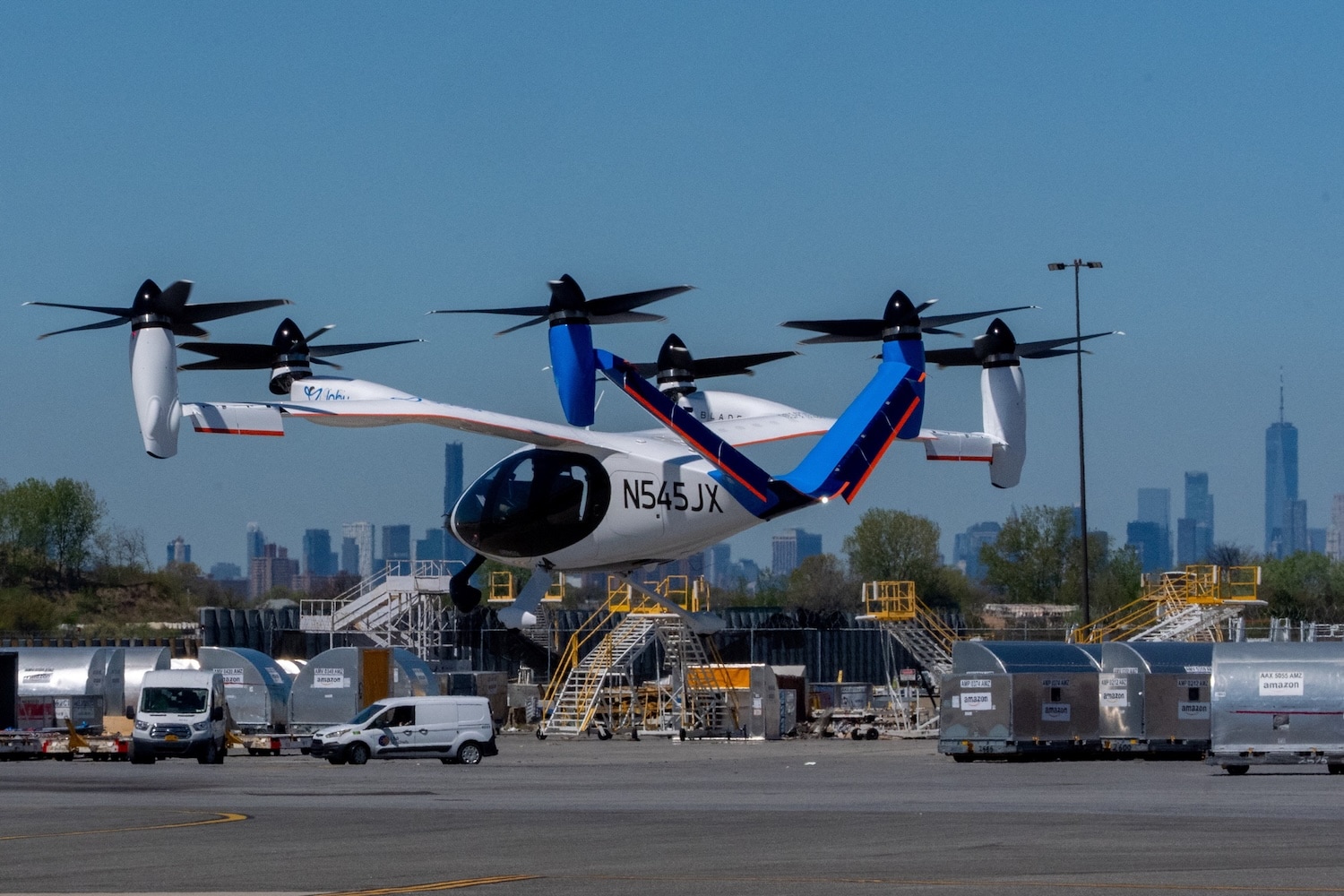
The viability of electric Vertical Take-Off and Landing (eVTOL) technology hinges on a single metric: the compression of the transit-to-cost ratio within ultra-congested Tier-1 ecosystems. Joby Aviation’s recent flight demonstrations in New York City represent more than a technical milestone; they serve as a stress test for the operational feasibility of replacing a sixty-minute ground-based logistical bottleneck with a seven-minute aerial bypass. Success requires the simultaneous optimization of battery energy density, acoustic signatures, and multi-modal infrastructure integration.
The Triad of Operational Viability
To evaluate Joby’s entry into the New York market, one must analyze the intersection of three distinct variables: Energy Throughput, Acoustic Compliance, and Vertiport Throughput.
1. Energy Throughput and the Reserve Requirement
The flight from JFK to the Downtown Manhattan Heliport covers approximately 13 to 15 miles depending on flight path restrictions. While the distance is negligible for fixed-wing aircraft, the energy cost of the vertical takeoff and landing phases—the "hover" periods—consumes a disproportionate percentage of the total battery capacity.
The aircraft operates on a lithium-ion chemistry optimized for power density rather than just energy density. This is necessitated by the high-load demands of the transition phase, where the tilting actuators move from vertical lift to wing-borne flight. The FAA mandates specific energy reserves for IFR (Instrument Flight Rules) conditions, meaning the aircraft cannot land with an empty "tank." Joby must maintain enough charge for a 20-minute reserve or to reach an alternate landing site. This requirement effectively reduces the usable battery window, forcing the aircraft to rely on high-speed megawatt-level charging during the passenger turn-around phase to maintain a consistent sorties-per-hour cadence.
2. Acoustic Compliance as a Regulatory Barrier
Traditional helicopters are effectively banned or severely restricted in Manhattan due to decibel levels that exceed 80 dBA at street level during flyovers. Joby’s aircraft utilizes six distributed electric propulsion units. By spinning these rotors at lower tip speeds compared to a single large helicopter rotor, the frequency profile shifts from a low-frequency "thump" to a higher-frequency "whir" that dissipates rapidly into the background noise of the city.
The goal is to remain below 65 dBA during takeoff—roughly the volume of a normal conversation—at a distance of 100 meters. This isn't just a comfort feature; it is the fundamental prerequisite for securing the "Social License to Operate." Without this acoustic profile, the expansion of vertiports beyond the existing waterfront heliports into the interior of the boroughs remains politically impossible.
3. Vertiport Throughput and the Last Mile Friction
The seven-minute flight time is a deceptive metric if the ground-side processing exceeds twenty minutes. For Joby to achieve market dominance over ride-hailing services like Uber Black or Blade’s existing helicopter fleet, the "curb-to-cabin" time must be minimized. This introduces the requirement for digitized manifests and biometric security clearing, allowing passengers to move from the street to the aircraft without the traditional friction of an airport terminal.
The Cost Function of Urban Aerial Logistics
The transition from a speculative technology to a mass-market utility requires a drastic reduction in the seat-mile cost. Joby’s strategy relies on shifting the cost structure from high-maintenance internal combustion engines to the lower lifecycle costs of electric powertrains.
Component Depreciation and Maintenance
Traditional turbines require overhaul every few thousand hours, costing hundreds of thousands of dollars. Electric motors, by contrast, have fewer moving parts and operate at lower thermal stress. However, the battery pack represents a "consumable" capital expenditure. Frequent high-speed charging and deep discharge cycles accelerate capacity fade. Joby must achieve a battery cycle life that exceeds 1,500 flights to keep the cost per seat-mile competitive with premium ground transportation.
Pilot-to-Passenger Ratio
Currently, the FAA requires a piloted operation for all eVTOL flights. With a four-passenger capacity, the pilot represents 20% of the total weight and a significant portion of the operating expense. The long-term economic model for Joby and its competitors (such as Archer or Volocopter) likely anticipates a transition toward semi-autonomous or remotely piloted operations. Until then, the high cost of specialized eVTOL pilots—who require ratings for both powered-lift and traditional fixed-wing flight—creates a floor for ticket pricing.
Strategic Bottlenecks in the NYC Airspace
New York City possesses the most complex Class B airspace in the world. Integrating low-altitude eVTOL paths between the flight corridors of Newark (EWR), LaGuardia (LGA), and JFK requires a sophisticated Unmanned Aircraft System Traffic Management (UTM) layer.
- Dynamic Rerouting: Weather patterns over the Hudson and East Rivers create micro-climates. The aircraft’s weight-to-power ratio must account for sudden wind shears that do not affect larger commercial jets.
- Charging Infrastructure: The Downtown Manhattan Heliport and the JFK terminals require significant electrical grid upgrades. A fleet of ten eVTOLs charging simultaneously would pull several megawatts, requiring either massive battery storage on-site or dedicated high-voltage lines.
- Winter Operations: Lithium-ion performance degrades in sub-zero temperatures. New York winters will test the aircraft’s thermal management systems, as energy must be diverted from propulsion to keep the battery cells within an optimal operating temperature range.
Revenue Modeling: Time Value of Money
The target demographic for the initial JFK-Manhattan route is the high-net-worth individual and the corporate traveler whose Time Value of Money (TVM) exceeds $200 per hour.
If a ground transfer takes 90 minutes during peak congestion and costs $120, a 10-minute air taxi flight priced at $200 offers a net saving of 80 minutes for an $80 premium. For a consultant or executive, the efficiency gain is undeniable. However, the "Uber-ification" of this service—bringing prices down to $50 or $70—requires a massive scale that the current heliport infrastructure cannot support.
The constraint is not the sky; it is the concrete. The number of pads available for takeoff and landing determines the ceiling of the entire business model.
The Path to Commercialization
Joby is currently in the fourth of five stages of FAA type certification. This phase involves rigorous testing of every component under "worst-case" scenarios, including bird strikes, battery fires, and motor failures. The NYC flight was a proof of concept for the integrated system, but the real challenge is the "Production Certificate"—the ability to manufacture these highly complex machines at scale with aerospace-grade quality control.
Delta Air Lines' investment in Joby provides the necessary "feeder" ecosystem. By integrating the air taxi booking directly into the Delta app, Joby solves the customer acquisition problem. A passenger traveling from London to Manhattan can book a "seamless" journey where the air taxi is the final leg of a single itinerary. This integration reduces the cognitive load on the traveler and ensures high load factors for the aircraft.
The immediate strategic priority for Joby is the finalization of the "Conops" (Concept of Operations) with the Port Authority of New York and New Jersey. This involves defining the exact ingress and egress routes to avoid conflict with existing helicopter sightseeing tours and news aircraft. Once the routes are codified and the charging infrastructure is grounded, the transition from demonstration to revenue-generating service can begin.
The final hurdle is the pilot training pipeline. Because the eVTOL is a new category of aircraft, there is no legacy pool of pilots. Joby must essentially run its own academy to ensure a steady supply of operators who are proficient in the fly-by-wire logic unique to their tilt-rotor configuration.
The NYC market serves as the global bellwether. If the Manhattan-to-JFK corridor can be solved—technically, legally, and economically—the blueprint can be exported to Los Angeles, London, and Tokyo. The failure to launch in New York, conversely, would signal a broader contraction in the eVTOL sector, relegating it to a niche luxury service rather than a fundamental shift in urban mobility.
The strategic play is to secure the primary vertiport concessions now. Space in Manhattan is finite; the company that controls the charging pads controls the market, regardless of whose aircraft is technically superior. Physical infrastructure, not software, remains the ultimate moat in the aerial ride-sharing economy.