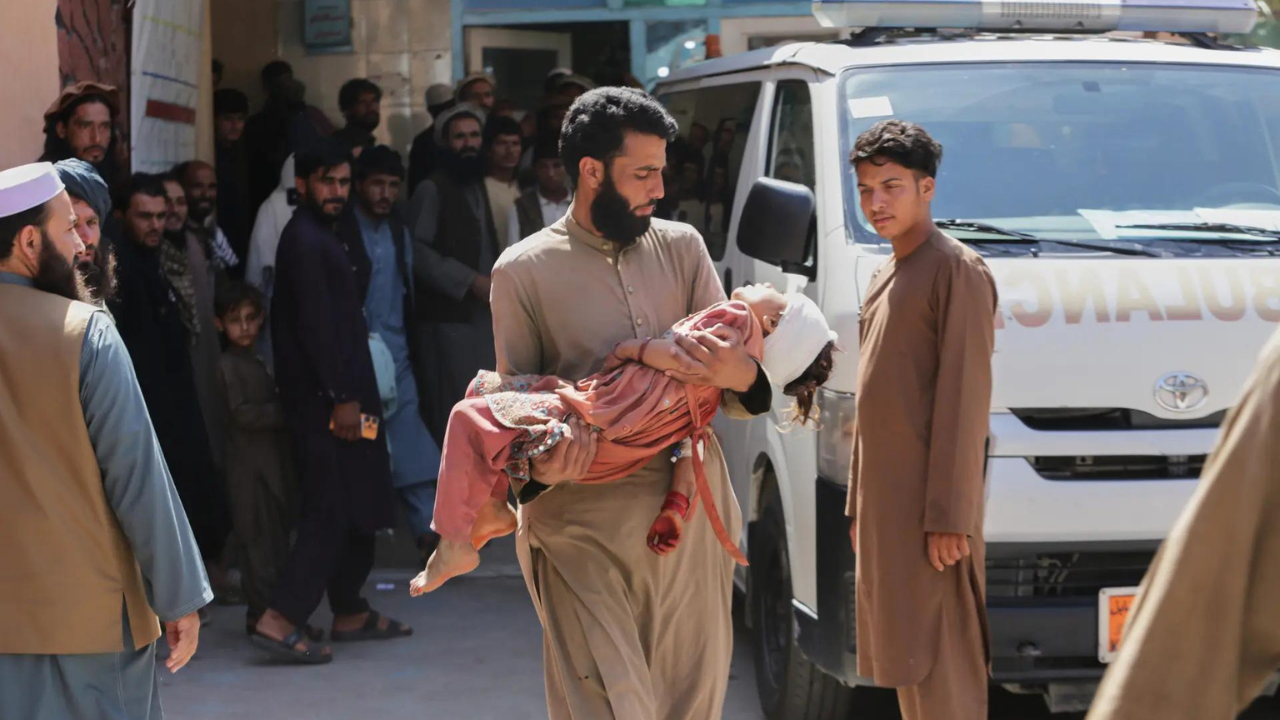
The metal of a cargo truck bed is unforgiving. It is cold in the pre-dawn mountain air, absorbing the chill of the Balochistan highlands until it burns the skin of anyone pressed against it. When fifty people are packed into a space built for crates and sacks, the metal disappears beneath a mass of human warmth, tangled limbs, and the quiet rhythm of shallow breathing.
They were traveling in the dark.
For the families crouched in the back of that vehicle, the darkness was both a shield and a prison. They were returning. Or, more accurately, they were being returned. Decades of life, of small businesses started in the alleyways of Peshawar, of children born with Pakistani accents who had never seen the orchards of Kandahar, were compressed into whatever bundles they could carry on their laps.
Then came the pass near Qila Saifullah.
A sharp turn. A sudden loss of control. The heavy vehicle, top-heavy and moving too fast through the treacherous terrain of southwestern Pakistan, tilted.
Silence did not follow. The sound of shifting metal and shattering wood tore through the ravine. When the dust finally settled in the early hours of the morning, twenty-two lives had ended in the dirt. More than two dozen others lay broken among the debris.
This is not a story about a traffic accident. It is a story about what happens when human beings become logistical problems.
The Geography of Displacement
To understand why twenty-two Afghan refugees died on a remote Pakistani highway, you have to understand the sheer weight of a border.
For over forty years, the frontier between Pakistan and Afghanistan has functioned as a pressure valve. When Kabul fell, when the Soviet tanks rolled in, when civil war tore the valleys apart, millions of people walked eastward. They crossed the Durand Line. They settled in places like Quetta, Karachi, and Islamabad. They built lives in the margins, operating under a complex web of temporary registrations, undocumented status, and shifting political goodwill.
But goodwill is a finite resource.
In late 2023, the government of Pakistan announced a massive, sweeping directive. All undocumented foreigners—a term that overwhelmingly applied to an estimated 1.7 million Afghans—were ordered to leave the country voluntarily or face deportation. The deadline was short. The pressure was immense.
Consider the mechanics of a mass exodus. When hundreds of thousands of people are told they must leave a country immediately, the standard systems of transit collapse. Families cannot simply book a commercial bus ticket or hire a moving company. They are priced out, targeted by authorities, or forced to move in secret to avoid harassment.
They turn to the open market of desperation.
That is how you end up with fifty human beings in the back of a commercial cargo truck. It is cheaper. It passes through checkpoints under the guise of freight. It is a gamble taken by people who have run out of choices.
The Anatomy of a High-Speed Descent
The road winding through the district of Qila Saifullah is a ribbon of asphalt carved into rugged, unforgiving rock. It demands respect from even the most experienced drivers.
When a truck is loaded far beyond its intended capacity, its center of gravity shifts upward. Every curve becomes a mathematical equation balancing friction against momentum. If the driver hits a patch of loose gravel, or if the brakes overheat from the constant friction of descending a steep grade, the vehicle ceases to be a means of transport. It becomes a projectile.
The local rescue workers who arrived at the scene described a site of absolute devastation.
In the immediate aftermath of a mass casualty event in a remote region, there is no fleet of advanced ambulances. There are no trauma helicopters. There are local volunteers, police officers with basic first aid kits, and a small regional hospital that is suddenly forced to deal with dozens of critical injuries simultaneously.
- The Immediate Toll: Twenty-two dead, including women and children.
- The Injured: Over twenty survivors, many with severe fractures and internal trauma.
- The Logistics: A remote district hospital overwhelmed by the sudden influx of patients requiring specialized surgical care.
The numbers are stark, but they fail to capture the reality of the scene. They do not describe the scattered shoes, the torn identity papers fluttering in the mountain breeze, or the sound of a child crying for a mother who will not wake up.
The Hidden Cost of Policy
It is easy to look at this tragedy and blame the driver. We can talk about poor road maintenance, the lack of vehicle inspections, or the reckless speed of commercial transport in Pakistan. Those are real factors. They matter.
But the real problem lies elsewhere.
The true cause of the crash near Qila Saifullah did not begin on that highway. It began in the bureaucratic offices where deportation policies are drafted without a thought for the human conveyor belt they create. When a state creates conditions so hostile that hundreds of thousands of people feel compelled to flee overnight, it creates a market for unsafe transit.
The truck was overloaded because the family could not afford two vehicles. The driver was rushing because every hour spent on the road increased the risk of extortion or arrest. The passengers were hidden beneath tarpaulins because visibility meant vulnerability.
This is the hidden cost of geopolitical maneuvering. When nations tighten their borders or purge their populations, the impact is felt most acutely by those who possess nothing but the clothes on their backs.
The journey back to Afghanistan is rarely a homecoming. For many of these refugees, Afghanistan is a land of economic collapse, severe drought, and strict social restrictions. They are leaving poverty in Pakistan to face uncertainty and hunger across the border. The road between those two realities is a gauntlet.
The Memory in the Dirt
The dust has since settled on the highway near Qila Saifullah. The wreckage has been towed away, leaving only oil stains on the asphalt and broken glass in the ditch. The survivors will eventually be moved—either back to the border or into the care of relatives who remain in Pakistan.
The twenty-two who died will be buried in names that most of the world will never read. They will become a single line in an annual report on refugee migration, a statistical data point used by NGOs to argue for increased funding or by governments to justify policy adjustments.
But for a few days, the reality of the refugee crisis could not be ignored. It was laid bare on the side of a mountain road, stripped of political rhetoric and legal jargon. It was revealed for what it truly is: a matter of life and death, played out in the dark, on the back of a speeding truck that never made it home.