The wind in Ruai does not care about international diplomacy. It blows fierce and dry off the plains, carrying a fine, orange dust that coats the teeth, stings the eyes, and settles into the deep cracks of sunburned hands.
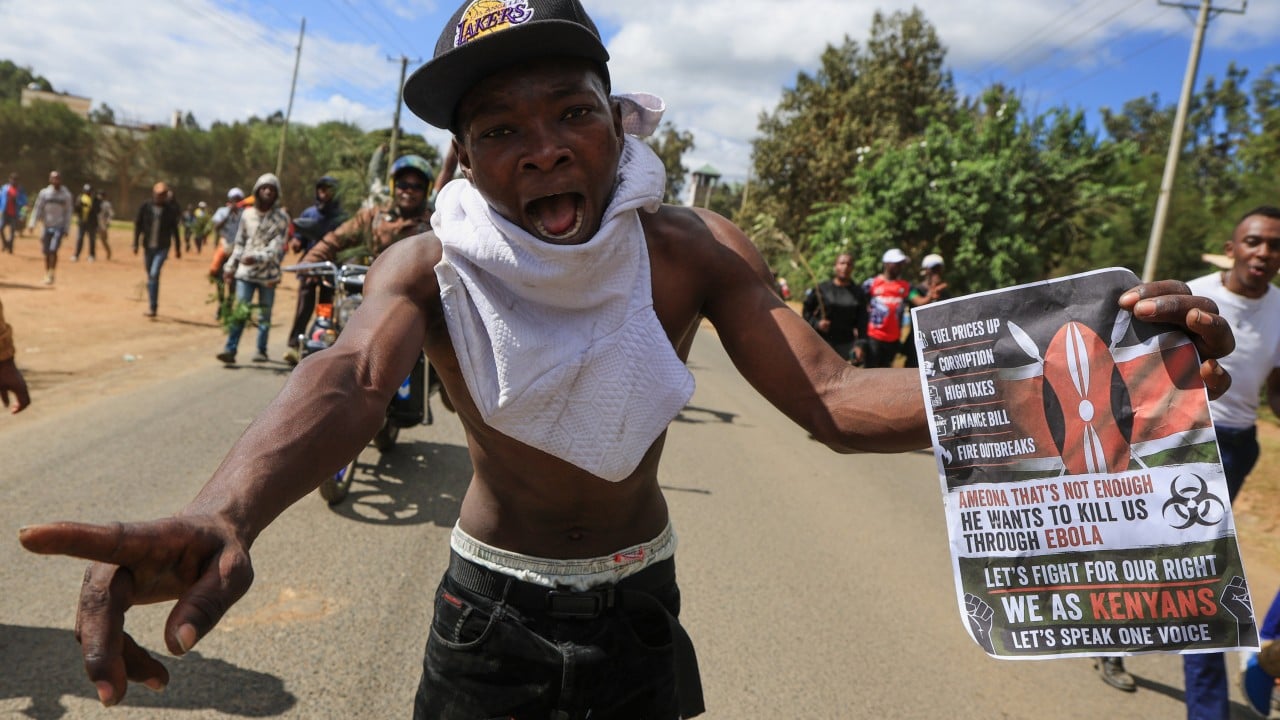
On a Tuesday morning, that dust swirled around the boots of fifty young men and women standing outside a high concrete wall. They were not carrying weapons. They were carrying placards made from flattened cardboard boxes, written in thick, black marker.
To the bureaucrats sitting in offices three thousand miles away, the building behind that wall was a triumph of global health infrastructure. It was safe. It was isolated. It was a state-of-the-art quarantine facility, built with foreign capital to contain the world’s most terrifying pathogens—specifically, a sudden outbreak of Ebola.
But to the people who live in Ruai, a settlement on the eastern fringes of Nairobi, the building looked like something else entirely. It looked like a Trojan horse. More specifically, it looked like a place where wealthy foreign citizens, flown out of hot zones across the continent, could bring a deadly virus into a neighborhood that lacks reliable running water.
The tension had been building for weeks, but it snapped when rumors confirmed that American citizens suspected of exposure were scheduled to arrive.
Fear is a physical weight. It alters how a person walks, how they breathe, how they look at their neighbors. In a community where a single medical emergency can wipe out a family’s generational savings, the introduction of a hemorrhagic fever isn't a theoretical risk. It is an existential threat.
The Geography of Risk
Consider the mechanics of a quarantine.
The word itself comes from the Italian quarentena, meaning forty days, born during the Black Death when ships were forced to sit at anchor before docking in Venice. The logic remains unchanged centuries later: isolate the threat until the danger passes.
But isolation is a luxury of geography.
When a wealthy nation builds a containment center within its own borders, it typically chooses remote areas, backed by immense institutional resources, specialized negative-pressure plumbing, and dedicated security cordons. When that same facility is placed in a developing nation, the boundary lines blur.
The Ruai facility sits remarkably close to metal-sheet homes, bustling open-air markets, and schools where children play in the dirt. The contrast is stark enough to cause vertigo. On one side of the wall lies millions of dollars in medical technology, designed to protect the lives of foreign nationals. On the other side lies a community reliant on communal water points and overstretched local clinics.
An invisible wall of privilege separates these two realities.
If a virus breaks containment in a high-resource setting, the response is swift and total. If it breaks containment in a neighborhood where five people share a single room, the result is a catastrophe. This is the calculation the protestors made. They did not need a degree in epidemiology to understand the mathematics of density and poverty.
The Sound of One Voice
Among the crowd stood a young man named Joseph. His hands were calloused from working informal construction jobs, the kind of labor that disappears the moment a neighborhood goes into lockdown.
"They tell us it is safe," Joseph said, his voice competing with the roar of passing transit trucks. "They tell us the air cannot carry it. But if it is so safe, why did they not build it in Washington? Why bring the sickness here to us?"
It is a question that standard news reports often gloss over, labeling the demonstrations as mere "unrest" or "anti-foreign sentiment." That is a lazy diagnosis.
The anger in Ruai is rooted in a profound, historically justified skepticism. For decades, the global South has served as a testing ground and a backstop for crises managed by the global North. To understand the fury of the youth, one must look at the history of medical exploitation on the continent, from unauthorized drug trials to the hoarding of life-saving vaccines during global pandemics.
When the local youth blocked the entrance to the facility with burning tires, they were not just protesting a building. They were voting on a contract they never signed.
The Calculus of Containment
Medical authorities argue that regional quarantine centers are essential. Ebola is a brutal adversary. It demands immediate, aggressive isolation. By establishing centers near major African aviation hubs like Nairobi, international health organizations can intercept cases before they reach global metropolitan centers.
Logistically, it makes sense. Ethically, it creates a moral hazard.
The strategy effectively uses the local population as a shock absorber. The underlying assumption is that a crisis contained in an African suburb is preferable to a crisis contained in a European or American city. This hierarchy of human value is what the young people of Ruai smelled in the dust.
Let us look at the numbers that define this friction.
A standard Ebola isolation unit requires a minimum of several hundred liters of water per patient, per day, just for decontamination and cleaning. Ruai experiences chronic water shortages. Residents frequently buy water from private bowsers at exorbitant rates. The sight of tanker trucks rolling past thirsty households to supply a facility meant for foreign citizens is a visual friction that no public relations campaign can smooth over.
The Breakdown of Trust
Public health does not function without trust.
You can build the most advanced laboratory in the world, but if the community surrounding it believes that the facility is actively trying to harm them, the project is a failure before the first patient arrives. The mistake made in Ruai was a classic error of technocratic arrogance: the assumption that scientific authority supersedes local sovereignty.
No one held town halls. No one asked the elders or the youth leaders how they felt about hosting a high-level bio-containment unit. The project arrived like an alien spacecraft, dropped into their midst by decree.
When transparency is absent, conspiracy fills the void.
Rumors rippled through the neighborhood that the facility wasn't just for quarantine, but for active experimentation. While western analysts might dismiss these fears as ignorance, they are actually the rational defense mechanisms of a population that has been lied to before. Trust is built in spoonfuls and poured out in buckets. In Ruai, the bucket was tipped over before construction even finished.
The Cold Logic of the Street
By afternoon, the police arrived.
The tear gas canisters fired into the crowd created white plumes that mixed with the red dust of the road. The protestors scattered, coughing and wiping their faces with wet rags, only to reform their lines blocks away.
This is not a conflict that can be solved with kinetic force.
The youth of Kenya are connected, literate, and acutely aware of their position in the global economy. They use their smartphones to track the movement of flights, to read international news, and to organize. They saw the reports of American citizens being evacuated from West African outbreak zones, and they drew a straight line to the concrete wall in their backyard.
The protest is a demand for a simple recognition: our lives are not a buffer zone.
The standoff remains unresolved. The concrete wall still stands, its grey face impassive against the Kenyan sun. Inside, the beds are empty, waiting for patients who may or may not arrive. Outside, the youth keep watch, their presence a stubborn reminder that global health policy cannot be separated from human dignity.
As the sun dipped below the horizon, painting the dust a deep, bruised purple, the fires of the burning tires died down to embers. The smell of burnt rubber lingered in the air, thick and acrid, settling over the roofs of Ruai like a shadow that refused to lift.