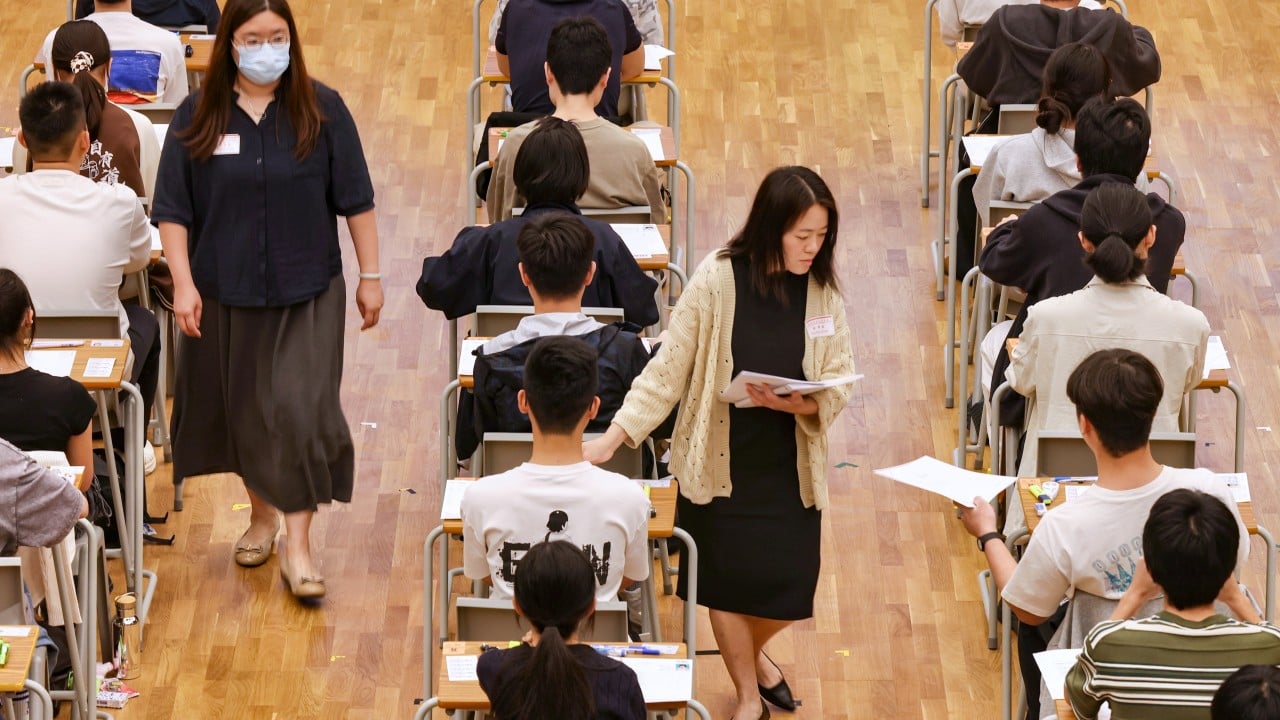
The Hong Kong Examinations and Assessment Authority (HKEAA) thinks it is being clever. By injecting bubble tea, YouTube trends, and "relatable" social media tropes into the Diploma of Secondary Education (DSE) exams, they believe they are modernizing a stale system.
They are actually insulting the intelligence of every student in the city. If you enjoyed this article, you should read: this related article.
The prevailing narrative—the one you'll read in every soft-feature news outlet—is that these "lifestyle" topics make the exam less intimidating. They claim that asking students to write about the social impact of boba or the fleeting fame of influencers creates a bridge between ivory-tower academia and the real world. This is a lie. It isn't a bridge; it’s a trapdoor.
The Mirage of Relatability
When an exam board swaps classical philosophy for sugary drinks, it isn't "meeting students where they are." It is admitting that it no longer knows how to justify the value of deep literacy. The DSE English and Chinese papers have increasingly leaned on these low-stakes, high-recognition topics to mask a terrifying reality: the gap between "exam-smart" and "actually educated" is widening into a canyon. For another look on this development, see the latest coverage from The Washington Post.
The "lazy consensus" argues that students perform better when they like the topic. Logic suggests otherwise. When you give a seventeen-year-old a topic like YouTube, you aren't testing their ability to analyze complex systems. You are testing their ability to regurgitate the most generic, sanitized version of their own hobbies.
True intellectual rigor requires friction. It requires a student to wrestle with a text that is alien to them, to find meaning in something that didn't happen on a five-inch screen yesterday. By removing that friction, we aren't making the exam easier; we are making the results meaningless.
The Poetry "Twist" is a Desperate Pivot
Recent exams have attempted to balance this pop-culture obsession by throwing in a "twist" of poetry or classical literature. This is the academic equivalent of serving a salad after a dozen donuts. It doesn't fix the nutritional deficit; it just confuses the palate.
Exam takers shouldn't be "pleased" by a topic. If a student walks out of a high-stakes hall feeling "happy" because they got to write about milk tea, the examiners have failed. An exam is a pressure cooker designed to measure cognitive endurance and analytical depth. If the pressure is dialed down to "casual brunch conversation," the data produced by the scores is useless for universities and employers alike.
We’ve seen this pattern before in the UK’s GCSE reforms and the American SAT shifts. Every time an institution tries to "democratize" content by making it more topical, the intellectual ceiling drops. You don’t raise the floor by lowering the roof.
The Bubble Tea Tax on Critical Thinking
Let’s look at the mechanics. A question about bubble tea culture usually asks for a discussion on "trends" or "health." These are closed-loop topics. There is no hidden depth. There is no subtext. You either know it’s popular and sugary, or you don't.
Contrast this with a requirement to analyze the socio-economic implications of the 1967 riots or the structural nuances of Tang Dynasty poetry. Those topics demand a grasp of history, power dynamics, and linguistic precision. You cannot "vibes-based" your way through a critique of Du Fu. You can absolutely "vibes-based" your way through a 500-word essay on why teenagers like watching MrBeast.
The HKEAA is essentially taxing the critical thinking skills of the elite to accommodate the median. It’s a race to the middle that leaves everyone unprepared for the brutal reality of global competition. While students in Singapore and Shanghai are being drilled in high-level synthesis and abstract reasoning, Hong Kong is asking its brightest stars to reflect on their favorite toppings.
Stop Asking if Students Like the Topic
The "People Also Ask" sections of the internet are filled with anxious parents wondering "How can my child prepare for unpredictable DSE topics?"
The answer they get is usually: "Read more news. Stay updated on social media."
This is the worst advice imaginable. If you want a student to dominate the DSE, tell them to stop scrolling and start reading the hardest books they can find. The student who can parse a 19th-century legal judgment or a complex scientific paper will find a question about YouTube trivial. But the student who spends their life in the "relatable" zone will hit a brick wall the moment the exam board decides to stop playing nice and introduces a genuinely difficult unseen text.
The Myth of the "Level Playing Field"
Proponents of these modern topics argue they level the playing field. They say that a student from a low-income family might not know about classical music or European history, but everyone knows about bubble tea.
This is patronizing. It assumes that students from marginalized backgrounds are incapable of engaging with high culture unless it’s spoon-fed to them through the lens of their daily consumption habits. It’s a soft bigotry of low expectations.
Furthermore, it’s factually incorrect. The wealthy student doesn't just know about bubble tea; they know the marketing strategies, the global supply chain, and the venture capital backing the brands because those are the conversations happening at their dinner tables. The "relatable" topic actually gives a massive advantage to the student who understands the business of the trend, not just the trend itself.
The "fairness" argument is a smokescreen for a lack of pedagogical courage.
The Professional Price of Content Fluff
I’ve spent years watching HR departments in multinational firms filter out candidates. Do you know what they look for? They look for the ability to handle "cognitive load." They want to see if you can take a massive, boring, complex set of data and find the narrative.
When the DSE trains students to find narratives in things that are already entertaining, it fails to prepare them for the boredom of professional excellence. Life isn't a YouTube algorithm. Most of the work that moves the needle in the 21st century is dense, difficult, and decidedly un-trendy.
By validating "relatability" as a standard for excellence, we are producing a generation of workers who expect their tasks to be engaging. We are building a workforce that lacks the mental stamina for the grind.
The "Twist" Needs to be the Standard
The poetry and the "difficult" texts shouldn't be the outlier. They should be the baseline. We need to stop treating the DSE like a consumer satisfaction survey.
If the HKEAA wants to "modernize," they should look at how technology is actually changing the brain—specifically, how it’s destroying attention spans. The antidote isn't to put more technology-based topics in the exam. The antidote is to use the exam to force a return to deep, sustained focus on difficult subjects.
Imagine a scenario where the DSE removed all "current events" from the curriculum for three years. What would happen? Scores would likely tank initially. But the value of a high score would skyrocket. A "5**" would actually mean something again, rather than just signifying that a student is particularly good at describing their weekend.
The Death of Expertise
We are currently witnessing the death of expertise in real-time. When we treat the opinions of a teenager on the "cultural significance of boba" with the same weight as their ability to analyze the mechanics of language, we are telling them that their feelings are as valid as facts.
This is the same logic that leads to a world where a TikToker’s medical advice is taken as seriously as a doctor’s. It starts in the exam hall. It starts when we tell students that their subjective experience of "lifestyle" is a legitimate substitute for objective academic rigor.
The DSE isn't a conversation. It’s an evaluation. If you want to be "pleased" by a topic, go to the cinema. If you want to be certified as a capable, thinking adult in a competitive global economy, you should expect to be challenged by things you find boring, difficult, and entirely unrelated to your Instagram feed.
The HKEAA needs to stop chasing likes and start enforcing standards. Until they do, the DSE will remain a hollowed-out version of what an education system should be: a rigorous rite of passage, not a lifestyle magazine.
Stop looking for the "twist" in the exam. The real twist is that the system has stopped believing that students are capable of handling anything deeper than a straw.