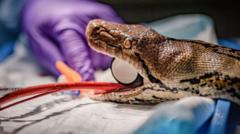
The operating room hummed with a quiet, sterile urgency that human patients know too well. But this table was different. Two separate surgical tables had been pushed together, married side-by-side to accommodate a patient who measured fifteen feet from nose to tail tip.
Her name was Jodie. She was a twenty-three-year-old reticulated python, a resident of Chester Zoo, carrying forty kilograms of scaled muscle and a terrifying secret hidden along her jawbone.
A malignant fibrosarcoma had taken root.
For most wild creatures, a diagnosis like this is a quiet sentence. Nature is efficiently brutal, offering no room for complex oncology or specialized surgical interventions. When keepers noticed Jodie was eating less, dropping into long spells of unnatural inactivity, the shadow of mortality fell across her enclosure. An initial surgery in 2024 carved the tumor away, offering a brief reprieve. But cancer is stubborn. By the following year, the growth returned with a vengeance, beginning to compromise the very bone she needed to feed.
Enter Ian Ashpole and a team of veterinary specialists who refused to surrender to convention.
Consider what happens next: veterinary medicine often borrows from human innovation, but turning human therapies toward a massive, cold-blooded reptile requires an entirely separate dimension of imagination. The team reached across disciplines, collaborating with human cancer specialists and researchers from the University of Liverpool to answer a single question. Could a therapy designed for people save a snake?
The chosen weapon was electrochemotherapy.
To visualize this, imagine opening a microscopic doorway. A potent chemotherapy drug called bleomycin is introduced, but on its own, it struggles to breach the protective walls of stubborn cancer cells. By pairing the drug with a series of precisely calibrated electrical pulses delivered straight to the tumor site, those cellular doors are forced open. The medicine rushes inside precisely where it is needed most. This laser-focused approach means doctors can utilize drastically lower doses of the drug, sparing healthy tissue from systemic chaos.
Yet, applying this to a giant python required solving logistical puzzles that no textbook could untangle.
Reptiles cannot regulate their own body temperature under general anesthesia. Vets had to wrap the massive animal in heated blankets, pumping warm air continuously through the surgical suite to keep her stable while two operating tables strained beneath her weight.
For ninety minutes, the team worked with microscopic precision alongside a creature capable of crushing bone. They removed the tumor and a compromised section of her jawbone, then administered the electrical pulses to scour away any invisible, lingering rogue cells.
Then came the waiting.
Recovery in the animal kingdom is rarely quiet. Within a remarkably short window, Jodie shook off the anesthesia. Weeks later, during a final clinical check, veterinarians found zero evidence of the cancer returning. Footage released by the zoo showed her doing what pythons do best, unhinging her jaw to swallow a whole chicken with effortless grace.
The boundaries separating human medicine from animal care are dissolving. A technique built to save human lives bridged the gap to a fifteen-foot reptile, proving that compassion, when matched with radical ingenuity, recognizes no species.
Jodie patrols her habitat now, completely unaware of the historical line she crossed, sliding forward into a future that, only months prior, looked entirely impossible.