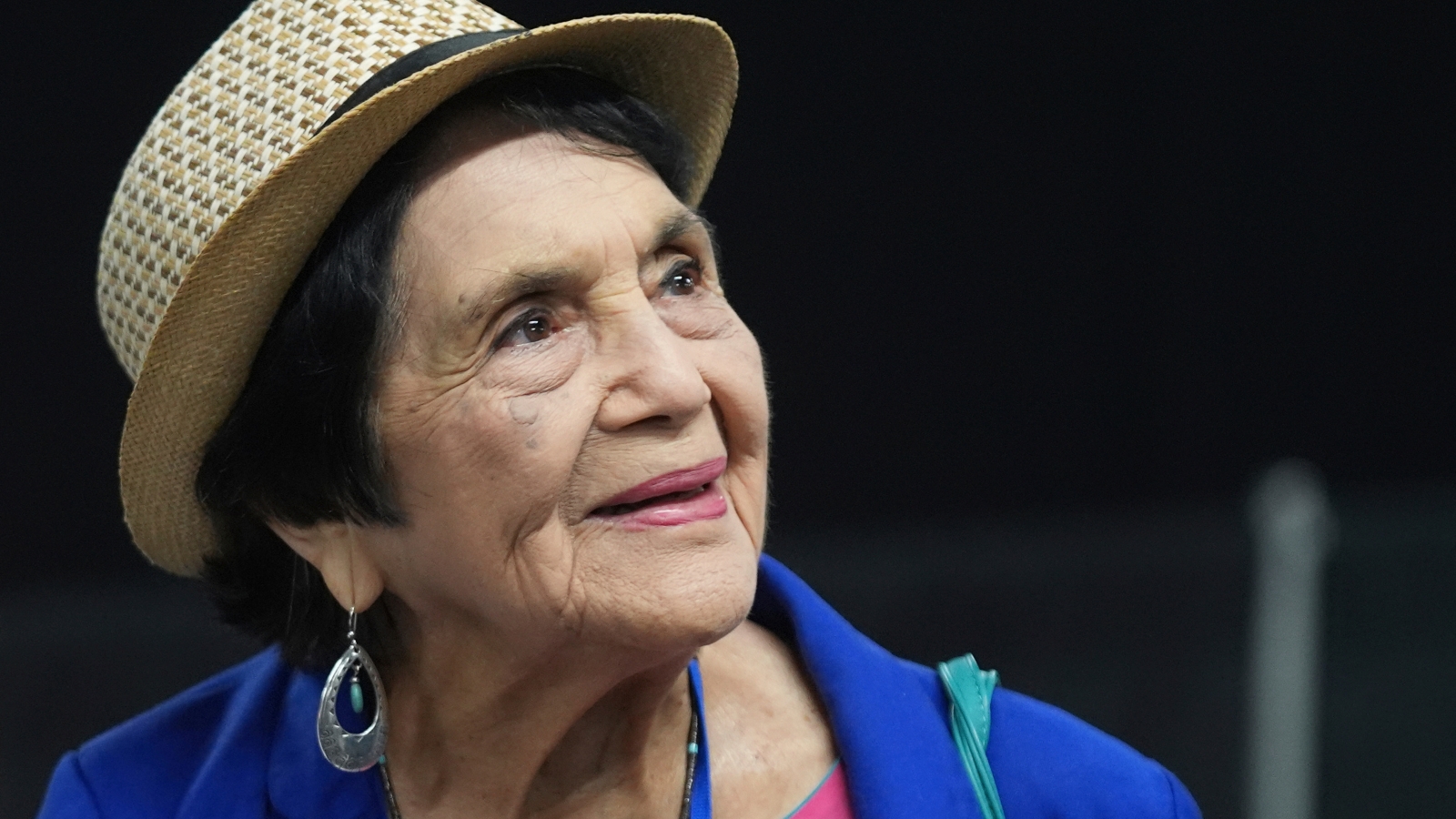
Dolores Huerta, the co-founder of the United Farm Workers and the architect behind some of the most effective consumer boycotts in American history, leaves behind a complicated, fiercely contested legacy that sanitized obituaries routinely flatten into a simple slogan. While mainstream news cycles rush to canonize the ninety-six-year-old organizer as a gentle grandmotherly figure who coined "Sí, se puede," the reality of her career is far sharper, more ruthless, and infinitely more instructive for modern labor movements. Huerta did not win contracts by asking nicely or relying on moral suasion alone; she won them by weaponizing supply chains, exploiting the public relations vulnerabilities of major grocery retailers, and forcing agricultural monopolies to the bargaining table through calculated economic pain.
To understand how a former schoolteacher from Stockton, California, brought multi-billion-dollar agribusinesses to their knees in the 1960s and 1970s, you have to look past the charismatic speeches and examine the grueling, unglamorous mechanics of her organizing model. Standard historical accounts frequently center Cesar Chavez as the spiritual and public face of the farmworker movement, inadvertently relegating Huerta to the role of a supporting lieutenant. That framing is factually wrong. Inside the union, Chavez handled the fasting, the internal morale, and the broader philosophical direction, while Huerta operated as the chief negotiator, the legislative lobbyist in Sacramento and Washington, and the logistical mastermind who turned local strikes into international economic crises. For an alternative perspective, see: this related article.
The Architecture of the Boycott
Strikes in the agricultural sector are notoriously difficult to sustain. Unlike factory workers who can physically block a plant entrance and halt assembly lines, farmworkers operate across vast, porous rural expanses where growers can easily bus in replacement labor from across state lines or the Mexican border within hours. During the famous Delano grape strike that began in 1965, Huerta quickly recognized that a traditional picket line at the edge of a vineyard was a losing proposition. Grower associations possessed deep cash reserves and the unwavering backing of local law enforcement, judges, and state politicians.
Huerta shifted the battlefield from the rural fields of the San Joaquin Valley to the urban supermarkets of New York, Boston, Chicago, and Toronto. She understood a fundamental truth about modern capitalism long before contemporary corporate strategists caught on: brand reputation and retail shelf space are infinitely more fragile than production facilities. Further insight on the subject has been provided by Reuters.
By dispatching strike organizers to major metropolitan centers, Huerta built an unprecedented coalition of urban consumers, religious congregations, student activists, and traditional industrial unions. Her strategy relied on secondary boycotts—pressuring grocery chains like A&P and Safeway to stop stocking California table grapes entirely, rather than merely asking individual shoppers to walk past the produce aisle. If a supermarket chain refused to pull the grapes, Huerta’s teams picketed the storefronts, turning the grocer into the target of neighborhood outrage.
It worked. By 1970, grape consumption had plummeted across North America, cold-storage facilities were rotting with unsold fruit, and major table grape growers finally signed historic collective bargaining agreements with the United Farm Workers. Those contracts did not just raise wages; they established the first union-run hiring halls, banned the use of toxic pesticides like DDT in the fields before the federal government acted, and created employer-funded health plans and pensions for migrant workers.
The Myth of "Sí, Se Puede" and the Reality of Internal Friction
Every retrospective on Huerta inevitably highlights the 1972 origins of "Sí, se puede" (Yes, it can be done). During a grueling twenty-four-day fast by Chavez in Phoenix, Arizona, to protest a state law banning farmworker strikes and boycotts, local organizers told Huerta that changing the political climate in a deeply conservative state was impossible. She pushed back with the phrase that would eventually be adopted by presidential campaigns and social justice movements worldwide.
Yet the romanticism surrounding that slogan obscures the brutal internal politics that eventually fractured the union she built. By the late 1970s and early 1980s, the United Farm Workers began hemorrhaging members, contracts, and political influence. While external forces—most notably the election of conservative California Governor George Deukmejian, who gutted the Agricultural Labor Relations Board—played a massive role in the union's decline, internal structural failures were equally damaging.
Critics, historians, and former UFW organizers have spent decades dissecting what went wrong inside the organization’s headquarters at La Paz. Several key factors contributed to the collapse of the union's field organizing capacity:
- Centralization of Power: As the union grew, decision-making became tightly concentrated among a small inner circle around Chavez and Huerta, alienating veteran field organizers who felt disconnected from the leadership.
- Purges of Dissenters: During the late 1970s, the leadership conducted aggressive internal purges, forcing out experienced organizers, lawyers, and boycott directors who questioned the union's strategic direction or demanded greater democratic accountability.
- Shift Away from Field Organizing: Resources were increasingly diverted away from organizing workers in the fields and toward direct-mail fundraising, real estate development, and rigid adherence to internal ideological exercises like "The Game," a controversial encounter-group practice adopted by Chavez.
Huerta remained fiercely loyal to Chavez throughout these turbulent years, a decision that preserved the public unity of the organization while costing it some of its brightest operational talent. Acknowledging this history does not diminish her monumental achievements; rather, it reveals the immense difficulty of transitioning a scrappy, insurgent protest movement into a durable, democratic institution capable of surviving generational shifts.
Navigating Sexism in the Fields and the Boardroom
Long before intersectionality became standard academic vocabulary, Huerta was living its sharpest contradictions. Operating in the male-dominated world of mid-twentieth-century labor organizing and Mexican American civil rights, she routinely faced hostility from both sides of the bargaining table. Growers mocked her, refused to negotiate with a woman, and attempted to dismiss her as an emotional agitator rather than a serious contract strategist.
Inside the movement, the resistance was quieter but just as persistent. Traditional machismo dictated that women belonged in the strike kitchens or behind typewriters, not hammering out complex legal language on wage scales and medical benefits. Huerta ignored the unwritten rules. She sat at the head of the negotiating table, chain-smoking and dissecting contract clauses with corporate attorneys until dawn.
Her personal life paid a steep price for that relentless schedule. A mother of eleven children across two marriages and a long-term partnership with Richard Chavez, Cesar’s brother, Huerta endured relentless public judgment for leaving her children in the care of relatives and movement volunteers while she traveled the country organizing boycotts. Male labor leaders were praised for sacrificing family time for the cause; Huerta was scrutinized and criticized for failing to conform to traditional maternal expectations.
| Era | Primary Focus | Key Legislative or Structural Outcome |
|---|---|---|
| 1955–1962 | Community Service Organization (CSO) | Secured right for non-citizens to receive public assistance and pensions in California; introduced Spanish-language voting ballots. |
| 1962–1975 | National Farm Workers Association / UFW | Co-founded union; led Delano grape boycott; helped pass the 1975 California Agricultural Labor Relations Act. |
| 1975–1990s | International Boycotts & Political Lobbying | Led second major table grape boycott focused on pesticide poisoning; campaigned against the 1986 immigration amnesty loopholes. |
| 2002–2026 | Dolores Huerta Foundation | Trained grassroots community organizers across California’s Central Valley to run for local school boards and city councils. |
This friction pushed Huerta into an explicit, uncompromising brand of feminism that occasionally put her at odds with her own allies. In the 1970s, she worked closely with Gloria Steinem and the Feminist Majority Foundation, insisting that reproductive freedom, childcare access, and equal pay were fundamental labor issues, not bourgeois distractions from class struggle. When the UFW’s close ties to the Catholic Church created tension over contraception and abortion rights, Huerta refused to back down from her support for women's bodily autonomy.
The Police Batons in San Francisco
If there is a single moment that encapsulates the physical reality of Huerta’s career, it occurred on September 14, 1988, outside the St. Francis Hotel in San Francisco. Huerta, then fifty-eight years old and standing just over five feet tall, was peacefully distributing press releases at a demonstration protesting presidential candidate George H.W. Bush’s opposition to the table grape boycott.
Without warning, San Francisco police officers charged the crowd. Officer Francis Achim struck Huerta repeatedly in the torso with a wooden baton. The beating was severe enough to shatter three of her ribs and rupture her spleen, requiring emergency surgery and multiple blood transfusions to save her life. The incident, captured on television news cameras, sparked national outrage and forced major reforms to the San Francisco Police Department’s crowd-control policies.
Huerta used the subsequent legal settlement not to retire into comfortable obscurity, but to bankroll further organizing work for women in the labor movement. The physical trauma never slowed her pace. Well into her eighties and nineties, she maintained a travel schedule that would exhaust a twenty-year-old campaign staffer, showing up on picket lines for hotel workers in Las Vegas, fast-food employees in Los Angeles, and teachers in Chicago.
What Modern Organizers Get Wrong About Her Legacy
Contemporary activists frequently invoke Huerta’s name while ignoring the core discipline that made her dangerous to entrenched corporate power. Today’s protest culture heavily favors viral social media moments, symbolic demonstrations, and ideological purity tests over the slow, tedious work of base-building.
Huerta’s operational blueprint was the exact opposite. Through the Dolores Huerta Foundation, which she established in 2002 after stepping back from day-to-day leadership at the UFW, she focused on hyper-local civic power. Instead of chasing national headlines, her foundation knocked on thousands of doors in neglected rural towns across Kern, Fresno, and Tulare counties, teaching working-class residents how to read municipal budgets, pack school board meetings, and unseat entrenched local politicians who ignored toxic water supplies and underfunded schools.
She understood that passing a sweeping federal law means very little if the local sheriff, county supervisor, and school superintendent remain hostile to working families. Power is not granted through moral victories or trending hashtags; it is built block by block, through disciplined voter registration, strategic coalitions with unlikely allies, and an unwavering willingness to disrupt the economic comfort of those in charge.
The passing of Dolores Huerta closes the final chapter on the founding generation of the modern farmworker movement, leaving behind a stark question for the labor organizers, progressives, and community leaders currently rushing to praise her name: are they willing to do the actual, unglamorous work of organizing the unorganized, or do they just want to print her face on another t-shirt?