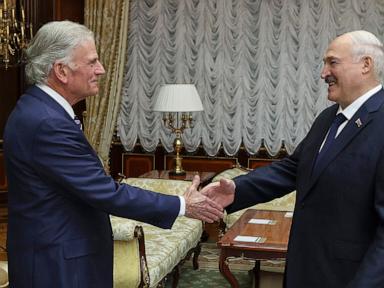
Western media loves a simple narrative. It usually looks like this: A desperate dictator reaches for the fringe of American religion to buy a shred of legitimacy, and a gullible preacher falls for the trap. It’s a clean story. It’s easy to digest. It’s also completely wrong.
The meeting between Alexander Lukashenko and Franklin Graham isn't a case of one side exploiting the other. It is a calculated, cold-blooded merger of two distinct brands of survivalism. To view this through the lens of "religious freedom" or "human rights" is to miss the underlying mechanics of power. If you’re looking for a morality play, go to a theater. If you want to understand how the world actually works, look at the incentives.
The Legitimacy Myth
The standard critique suggests that by welcoming Graham, Lukashenko is trying to "soften" his image for the West. This is a fundamental misunderstanding of his current geopolitical standing. After years of sanctions and a pivot toward total reliance on Moscow, the Belarusian leader isn't trying to win over the U.S. State Department. He knows that ship has sailed, hit an iceberg, and vanished.
He is doing something far more sophisticated: He is engaging in asymmetric diplomacy.
By hosting the son of Billy Graham—the man who served as the de facto chaplain to every U.S. president for half a century—Lukashenko signals to his domestic base and his neighbors that he is not isolated. He is showing that he can still command the presence of "Big America." Not the America of the Biden administration, but the America of the cultural heartland. It’s a move designed to prove that the "West" is not a monolith.
Graham’s Realpolitik
On the other side of the table, Franklin Graham isn't some wide-eyed missionary wandering into a lion’s den. He is the CEO of a multi-million dollar global enterprise. For Graham, Belarus isn't just a mission field; it’s a strategic hedge.
As secularism tightens its grip on Western Europe and North America, evangelical leaders are increasingly looking toward Eastern Europe as the last bastion of "traditional values." They see a region where the state actively enforces the social structures they feel are being dismantled at home.
When Graham shakes hands with a leader often labeled "Europe’s last dictator," he isn't endorsing every policy of the Belarusian state. He is securing a foothold in a territory that shares his disdain for Western liberal shifts. It’s a trade: Graham provides the spectacle of international prestige, and in exchange, he gets unfettered access to a population that hasn't been "corrupted" by the cultural trends he fights daily in the United States.
The Logic of the Massive Gathering
The media often scoffs at these "massive gatherings" as empty theater. They aren't. In a country where public assembly is tightly controlled, a religious event of this scale is a pressure valve.
For Lukashenko, allowing thousands of people to gather under a religious banner is a controlled risk. It provides a sense of community and hope that doesn't target the government. It’s a classic authoritarian maneuver: occupy the public’s emotional energy with something transcendent so they don't use it for something political.
Critics argue this "undermines" religious freedom by making the church a tool of the state. I’ve seen this play out in dozens of emerging markets and volatile regions. The reality is that the church in these environments doesn't have the luxury of pure independence. It either exists in the shadow of the state or it doesn't exist at all. Graham knows this. He isn't there to change the system; he’s there to operate within it.
The Failure of "Values-Based" Foreign Policy
The "lazy consensus" among pundits is that Graham shouldn't go because it "sends the wrong message." This is the same tired argument used to discourage trade, sports, and cultural exchange with any nation that doesn't follow the liberal script.
Here is the truth: Isolation is a failed tool. If the goal of the West is to influence the Belarusian people, cutting off every non-political channel is self-defeating. When you remove American cultural and religious figures from the equation, you leave a vacuum. Who fills it? Usually, the most radical and anti-Western elements available.
Graham’s presence, regardless of his personal politics, keeps a line of communication open to a massive demographic in the U.S. that the State Department cannot reach. It creates a weird, back-channel form of diplomacy that operates on a frequency bureaucrats don't understand.
The Business of Belief
Let’s talk numbers. The Billy Graham Evangelistic Association (BGEA) and Samaritan’s Purse are massive logistical machines. They move more "soft power" than many small countries. When they enter a country like Belarus, they bring more than just Bibles. They bring a logistical footprint, international attention, and a specific brand of American organizational efficiency.
Lukashenko wants that efficiency. He wants his people to see that his administration can facilitate world-class events despite international pressure. It is a performance of competency.
The Risk Nobody Talks About
The real danger here isn't that Lukashenko gets a PR boost. The danger is for the Belarusian evangelical community itself.
By tying their fortunes to a high-profile visit from an American firebrand, they become a target the moment Graham flies home. If the political winds shift, or if Graham says something particularly offensive to the Kremlin, the local believers are the ones who pay the price.
This isn't a concern for the talking heads in Washington or the executives in North Carolina. They are insulated by distance and wealth. But for the pastor in Minsk, this visit is a high-stakes gamble. He is trading long-term stability for a weekend of visibility.
The Nuance of the Handshake
Stop looking for a hero in this story. There isn't one.
There is a leader fighting for the survival of his regime and a preacher fighting for the relevance of his movement. They are using each other. It is transactional, it is cynical, and it is remarkably effective.
To call it a "welcome" is a simplification. It is an alliance of convenience between two men who understand that in the modern era, visibility is the only currency that matters. While the critics bark about optics, the event will happen, the crowds will show up, and both men will get exactly what they wanted.
The West views this as a scandal. To the participants, it’s just Tuesday.
The world isn't run by ideals; it’s run by those who know how to weaponize them. If you can't see the utility in this meeting, you aren't paying attention to the board. You’re just complaining about the way the pieces look.
Stop asking if this is "right." Ask who benefits.
The answer is both of them, and neither of you.