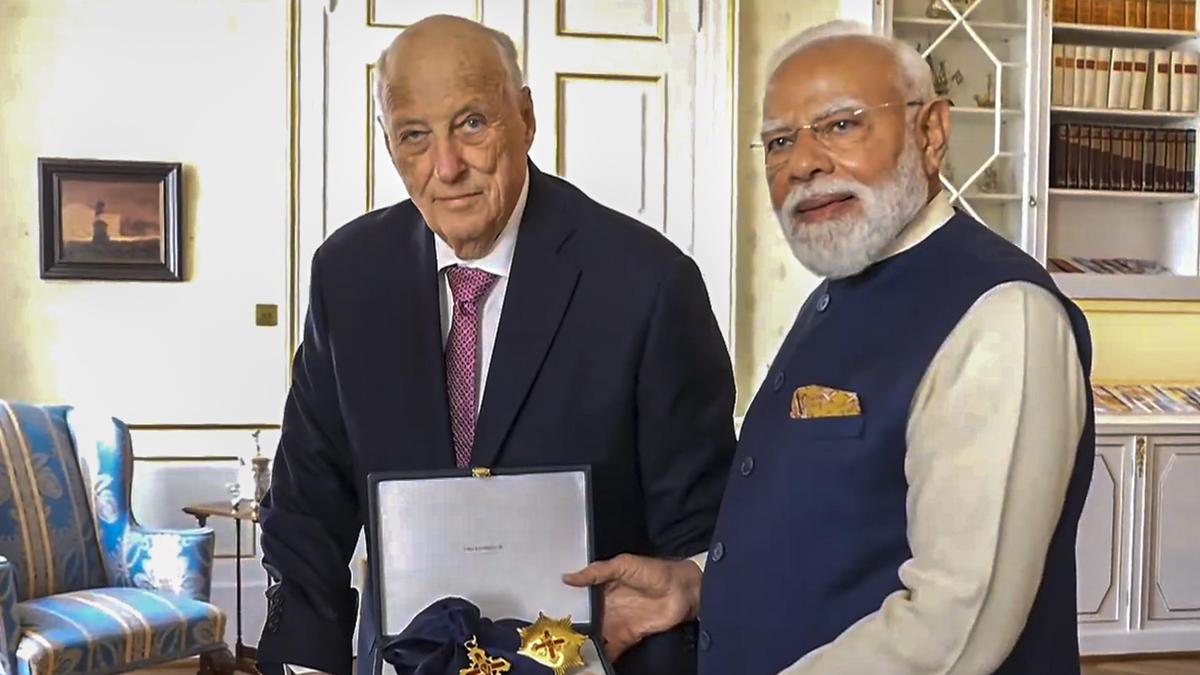
Mainstream media outlets love a good medal ceremony. When news broke regarding Prime Minister Narendra Modi receiving a top civilian honor from Norway, the headlines practically wrote themselves. The standard narrative immediately kicked into gear: a celebration of surging bilateral ties, validation of geopolitical supremacy, and a definitive stamp of global approval.
It is a comforting story. It is also entirely wrong.
The lazy consensus among political commentators is that foreign civilian honors are objective metrics of a nation's rising status. We are told these awards represent hard-won diplomatic victories. In reality, they are the geopolitical equivalent of a corporate participation trophy.
To understand what is actually happening behind the scenes of these state visits, you have to look past the velvet boxes and the photo opportunities. You have to look at the transactional calculus that dictates modern diplomacy.
The Currency of Convenience
International relations operate on interest, not affection. When a nation bestows its highest civilian honor upon a foreign leader, it is rarely a retrospective lifetime achievement award. It is a down payment on future concessions.
I have spent years analyzing trade flows and bilateral treaties following these high-profile award ceremonies. A predictable pattern emerges. The medals flow right before major defense contracts are signed, sovereign wealth funds seek market access, or critical voting blocs in international forums need aligning.
Take the broader trend of India's recent diplomatic honors across Europe and the Middle East. If you track the timeline of these announcements, they frequently coincide with major economic pivots.
- Energy security negotiations.
- Free trade agreement bottlenecks.
- Strategic maritime access agreements.
Awarding a medal is the cheapest tool in a diplomat's arsenal. It costs a government virtually nothing to host a banquet and pin a ribbon on a visiting head of state. Yet, the return on investment can be astronomical if it softens the ground for commercial negotiations. The competitor articles focus on the prestige; the real story is the price tag of the underlying commodities.
The Flawed Premise of Global Validation
The standard punditry frames these awards as proof that the recipient nation has "arrived" on the world stage. This premise is fundamentally flawed. It assumes that Western or European validation is the ultimate benchmark of domestic policy success.
Let us look at the mechanics of sovereign power. A country with a massive consumer market, a dominant digital public infrastructure, and a pivotal role in global supply chains does not need validation from Oslo, Paris, or Washington. The power dynamic is often reversed.
Smaller, wealthy nations frequently use these honors to maintain relevance with emerging economic giants. Norway's sovereign wealth fund, one of the largest in the world, requires stable, high-growth markets to deploy its capital. Securing long-term access to India's rapidly expanding digital and green energy sectors is a strategic necessity for them. The medal is not a reward for past behavior; it is an invitation to keep the door open for foreign capital.
To argue that these honors elevate a leader's status misses the point entirely. The leader's existing status is the sole reason the honor was extended in the first place.
The Domestic Disconnect
There is a glaring downside to this obsession with international accolades that most analysts refuse to admit. The optics of global adoration do not translate into domestic economic realities.
A state-of-the-art semiconductor plant, an overhauled agricultural supply chain, or a functional urban waste management system cannot be built out of gold medals. While the international press corps marvels at the diplomatic choreography, domestic policymakers still face the brutal, unglamorous grind of structural reform.
Imagine a scenario where a country accumulates every civilian honor on the planet while its manufacturing sector struggles with regulatory red tape and infrastructure bottlenecks. The plaques on the wall would do nothing to fix the fiscal deficit. True state capacity is built on institutional strength, predictable tax regimes, and labor productivity—not the approval of foreign committees.
Dismantling the PAA Narrative
If you look at the common queries surrounding these events, people invariably ask: How do foreign honors impact a country's global standing? The brutally honest answer is: they don't.
Ask any seasoned trade negotiator what happens the morning after a gala dinner. The warmth of the ceremony evaporates the moment the draft text of a trade treaty hits the table. The foreign ministry that just handed out a medal will still aggressively protect its domestic dairy farmers, demand intellectual property concessions, and enforce strict visa quotas.
The idea that a symbolic gesture creates a smoother path for hard-nosed economic negotiations is a myth sold to the public. Business interests are cold, calculated, and immune to sentimentality.
How to Read Geopolitics Like an Insider
Stop evaluating foreign policy through the lens of optics. If you want to know the true state of bilateral relations between two nations, ignore the award citations and track three specific metrics:
- Foreign Direct Investment (FDI) Quality: Look at whether capital is flowing into high-value manufacturing and technology transfer, or merely speculative real estate and portfolio investments.
- Customs and Tariff Structures: Watch for the actual reduction of non-tariff barriers. If a country gives you a medal but keeps your pharmaceutical exports stuck in customs for six months, the medal is meaningless.
- Joint R&D Expenditures: Track the hard cash committed to collaborative scientific research and defense co-production.
The next time a headline screams about a historic civilian honor being conferred, change the channel. Look at the financial pages instead. Find out which trade delegations were traveling on the same plane, which market access clauses were quietly revised, and who is funding the next major infrastructure corridor. That is where the real history is being written. The rest is just theater.