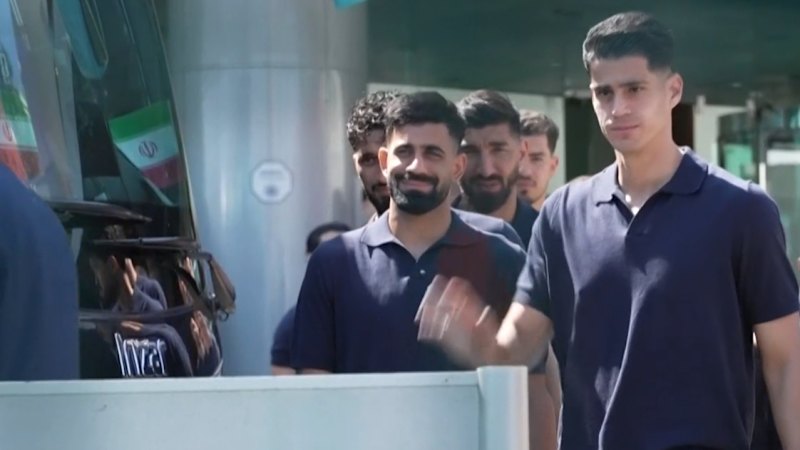
The legacy sports media loves a good fairy tale. As news breaks that the Iranian national football team has arrived on American soil, the typing pool is already churning out the same tired, predictable narrative. They will call it "ping-pong diplomacy for a new generation." They will ramble about the unifying power of sport, the thawing of geopolitical ice, and the beautiful game's magical ability to bridge ideological divides.
It is a comforting script. It is also completely wrong. You might also find this connected story interesting: The WNBA Does Not Have a Violence Problem—It Has a Marketing Crisis.
Let’s dismantle the lazy consensus right now. This match is not a bridge; it is a pressure cooker. I have spent two decades analyzing the intersection of international sports governance and state-backed soft power, watching federations play checkers while regimes play grandmaster-level chess. To view Team Melli’s arrival in the United States through a purely athletic or utopian lens is to willfully blind yourself to the mechanics of modern sports diplomacy.
The mainstream press is asking the wrong question: "Can a football match improve US-Iran relations?" The real question we should be asking is far more cynical: "How are both regimes weaponizing 90 minutes of football to validate their domestic survival?" As highlighted in recent coverage by Sky Sports, the implications are widespread.
The Myth of the Neutral Pitch
Sport has never been separate from politics, least of all for Iran. The Islamic Republic has historically treated the soccer pitch as a highly visible stage for ideological enforcement and global recognition. When the team steps onto American turf, they are carrying the heavy baggage of a domestic federation controlled under the tight surveillance of state apparatuses.
To believe that ninety minutes of chasing a leather ball can dissolve decades of economic sanctions, nuclear brinkmanship, and systemic human rights disputes is a special kind of naive. Football matches do not change foreign policy; they merely mirror it with higher stakes and louder crowds.
Think back to the famous 1998 World Cup clash in Lyon, France. Iran defeated the United States 2-1. The media painted it as a beautiful display of mutual respect because players exchanged white roses. But what actually happened next? Did the Clinton administration lift sanctions? Did Tehran halt its regional ambitions? No. The domestic hardliners wrapped the victory in anti-Western propaganda, using the athletic triumph to validate their ideological stance. The roses were for the cameras; the victory was for the regime's domestic marketing machine.
The Invisible Players on the Field
When you watch this upcoming match, you are not just looking at twenty-two athletes. You are looking at two highly conflicted structures trying to extract maximum PR value with minimal political damage.
For the Iranian federation, this tour is about projecting normalcy. It is a calculated attempt to signal to the world—and to their own citizens—that despite international isolation, they can still command center stage in the heart of the West. It is about buying legitimacy on the cheap.
For the US hosts, it is a performative display of Western liberalism. "Look at how open we are," the organizers implicitly scream, "we welcome our fiercest geopolitical rivals to our stadiums." It is a self-congratulatory exercise that masks the brutal reality of ongoing diplomatic gridlock.
But this contrarian view carries a heavy downside that nobody wants to admit. By pointing out that the match is an ideological chessboard, we run the risk of completely dehumanizing the players themselves. The athletes are caught in a vicious vice. If they perform well, the regime back home hijacks their success. If they use the American platform to protest domestic policies—as members of Team Melli did during the 2022 World Cup by refusing to sing the national anthem—they face severe personal and professional retribution when they return. They are trapped in a game where the rules are written by politicians who have never laced up a pair of boots.
Dismantling the People Also Ask Nonsense
If you look at public forums regarding this fixture, the questions being asked expose a profound misunderstanding of how international sports governance works.
- Does FIFA ban countries for political actions?
The governing bodies claim they strictly prohibit state interference in football federations. It is a rule honored mostly in the breach. FIFA selectively enforces this whenever it aligns with their commercial interests or global public pressure. The premise that international sports bodies are neutral arbiters of global ethics is a corporate fiction designed to protect broadcast revenues. - Can cultural exchanges like sports matches lead to policy breakthroughs?
Historically, almost never. Ping-pong diplomacy worked between the US and China in 1971 only because both Richard Nixon and Mao Zedong had already spent months laying the secret groundwork for a strategic realignment against the Soviet Union. The table tennis match was the theatrical reveal, not the catalyst. Without that pre-existing political will, a sports match is just an expensive exhibition. Currently, that political will between Washington and Tehran is non-existent.
The Actionable Reality for the Spectator
Stop consuming sports media like a passive consumer buying into a manufactured feel-good narrative. If you are going to watch this match, change your framework entirely.
First, ignore the corporate commentary. The broadcast teams will desperately try to stay in their lane, offering shallow platitudes about teamwork while actively ignoring the tension vibrating through the stadium.
Second, watch the stands, not just the ball. The real conflict will not be between the lines of grass; it will be in the seating bowls. These matches inevitably become proxy battlegrounds for diaspora groups, pro-regime factions, and human rights activists all fighting for the brief attention of the television cameras. The stadium is not a sanctuary from the real world; it is a magnifying glass.
The arrival of the Iranian team in the US is not a victory for global unity. It is a high-wire act where football is used as a shield for state agendas. Enjoy the tactical setups, appreciate the athletic brilliance, but leave the romanticized diplomacy fairytales at the turnstile.