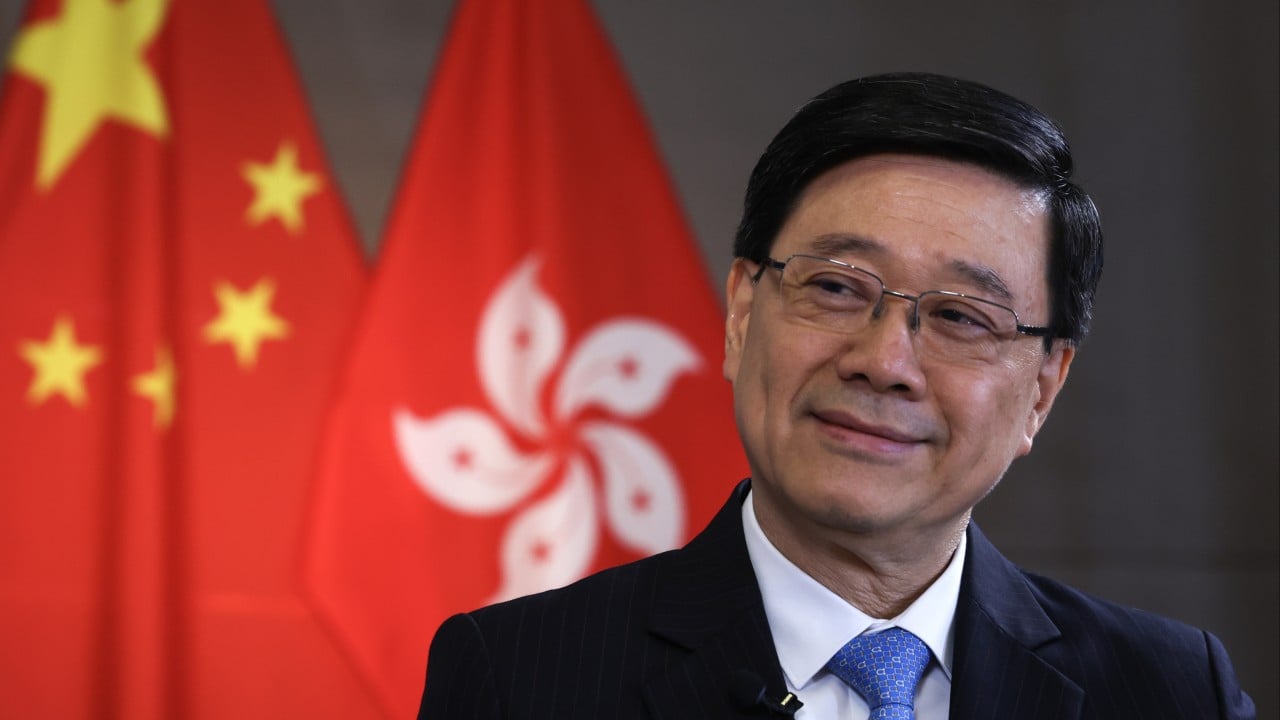
The cabin of an A350 at 35,000 feet smells of stale upholstery, pressurized air, and the distinct, slightly bitter scent of black coffee gone cold. It is 3:00 AM over the Indian Ocean. Most of the passengers are asleep, their heads propped against windows, thin blankets pulled to their chins. But in seat 2K, the reading light stays on.
John Lee is staring at a briefing binder that is four inches thick.
To the casual observer, a Chief Executive traveling to a foreign capital is an exercise in pageantry. There are flags, red carpets, and stiff handshakes frozen for photographers. But the reality of modern economic diplomacy is a grueling endurance sport. It is fought in the margins of jet lag, in the quiet anxiety of hotel suites before the sun rises, and in the sudden realization that the old alliances that sustained a city for a century are no longer enough.
Hong Kong is facing an existential recalculation. For decades, the city operated on a simple, brilliant formula: act as the golden bridge between mainland China and the Western financial system. Money flowed in from New York and London; opportunities flowed out from Beijing. You did not need to hunt for business. The world came to you.
Then the world changed. Political friction, pandemic isolation, and shifting global alliances fractured the bridge. The Western capital that once flowed automatically has become cautious, constrained by geopolitical anxiety.
When a pipeline dries up, you do not sit by the empty well and pray for rain. You grab a shovel and look for new ground. That is why the leader of a city of seven million people is spending his nights flying toward capitals that many traditional financiers used to view as secondary markets. The new mandate is simple, aggressive, and fiercely pragmatic: do not give up on a single market.
The Arithmetic of Ambition
To understand why this shift matters, consider a hypothetical entrepreneur named Sarah. For fifteen years, Sarah ran a logistics and supply-chain consultancy out of an office in Central, Hong Kong. Her Rolodex was filled with numbers from Frankfurt, Chicago, and Tokyo. When European retail chains wanted to manufacture in Guangdong, Sarah was the connective tissue.
By late 2023, Sarah noticed a quiet chilling of her inbox. The inquiries from her traditional European clients were slowing down. They were not angry; they were just hesitant. They were "diversifying risk."
If Sarah’s story ended there, it would be a tragedy of economic contraction. But it does not.
A few months ago, Sarah received an unexpected inquiry from a green-technology firm based in Riyadh, followed quickly by a family office in Jakarta looking to invest in automated port infrastructure. They did not care about the geopolitical talking points dominating the headlines in Washington or Brussels. They cared about efficiency. They cared about capital liquidity. They cared about the fact that Hong Kong still possesses a legal system trusted for commercial contracts and an absence of capital controls.
This is the micro-level reality of what John Lee’s administration is trying to catalyze. It is an acknowledgment that while the G7 economies remain massive, the velocity of growth is shifting toward the Global South, the Middle East, and the ASEAN bloc.
The numbers back up the strategy. The Association of Southeast Asian Nations is currently on track to become the world’s fourth-largest economy by the end of the decade. The Gulf Cooperation Council countries are sitting on sovereign wealth funds worth trillions of dollars, desperately seeking avenues for diversification away from fossil fuels.
For Hong Kong, courting these markets is not a political statement. It is basic arithmetic.
The Friction of the New Frontier
It is easy to write a press release about "strengthening ties with emerging markets." It is much harder to actually execute it.
When Hong Kong delegations touch down in places like Kuala Lumpur, Dubai, or Vientiane, they are not entering a vacuum. They are entering spaces where competitors from Singapore, Seoul, and London have already been working the room.
The friction is palpable. It shows up in the cultural nuances that can make or break a billion-dollar deal. In Saudi Arabia, business is built on deep, multi-generational personal relationships and patience; you do not fly in for a two-day roadshow and expect to fly out with a signed sovereign fund commitment. In Southeast Asia, the regulatory landscape is a complex patchwork of local ownership laws and varying digital infrastructures.
Furthermore, there is the internal challenge of convincing Hong Kong’s own business elite to look past their comfort zones. For three generations, a Hong Kong banker knew exactly how to pitch an American pension fund. Asking that same banker to pitch a sharia-compliant investment structure to a Middle Eastern endowment requires a fundamental rewiring of expertise.
It is uncomfortable. It is confusing. It requires admitting that the old playbook is dead.
During these bilateral meetings, the conversations behind closed doors often hinge on a single, silent question from the hosts: Why should we choose you over your rivals?
The answer Lee’s administration is pushing relies on an underappreciated asset: the Greater Bay Area. Hong Kong is no longer pitching itself as an isolated island of capitalism. It is pitching itself as the financial control tower for an economic engine of over 86 million people, encompassing the tech hubs of Shenzhen and the manufacturing might of Dongguan.
Think of it as an economic telescope. If a Malaysian tech unicorn wants to scale, it can list on the Hong Kong Stock Exchange, access international capital, and simultaneously set up its hardware R&D facility just thirty minutes away in Shenzhen. No other financial hub in the world can offer that specific, frictionless proximity to China’s industrial core.
The View from the Street
But let us step away from the high-altitude statistics and the ministerial statements. What does this mean for the person walking through the humid air of Wan Chai on a Tuesday afternoon?
Economic strategy can feel like an abstract game played by elites in high-rises. But its consequences are deeply human. They dictate whether a university graduate in Kowloon finds a job in private equity or ends up underemployed. They dictate whether a family-owned restaurant in Tsim Sha Tsui can afford its rent because the city's hotels are full of international business travelers.
The transition period is always the hardest part. The old economic engines are cooling down, and the new ones are still warming up. You can see it in the mixed signals of the city’s daily life—the luxury retail spaces undergoing transformation, the sudden influx of Arabic and Indonesian signage at major trade expos, the frantic retraining seminars hosted by chambers of commerce.
There is anxiety here. It is the anxiety of a performer who has been told the audience has moved to a different theater, and they must now learn a new language to keep the show alive.
Yet, resilience is a word that gets thrown around until it loses all meaning. In Hong Kong, however, adaptation is not a corporate buzzword; it is a survival trait ingrained in the very concrete of the city. This is a place that transformed from a fishing village to a manufacturing hub, then to a financial powerhouse, all within a few lifetimes. Each transformation was accompanied by predictions of doom. Each time, the city changed its shape to fit the contours of global demand.
The Midnight Ledger
Back on the A350, the flight deck begins its long, slow descent. The lights of the destination city appear below, a glittering lattice of amber and white cutting through the darkness.
John Lee closes the binder. The ink on the pages won't change the global geopolitical weather. It won't stop the tectonic shifts between Washington and Beijing. But that was never the objective.
The objective is to find the cracks where business can still happen. To find the investors who care more about returns than rhetoric. To ensure that when the economic map of the twenty-first century is finally redrawn, Hong Kong remains an indispensable crossroads, regardless of who is driving the trade routes.
The plane touches down with a sharp chirp of tires against asphalt. The engines reverse, roaring against the night, slowing the aircraft as it taxies toward a terminal where another dawn is already breaking. The cabin doors open, the humid air of a different hemisphere rushes in, and the diplomat steps out into the heat, ready to make the pitch all over again.