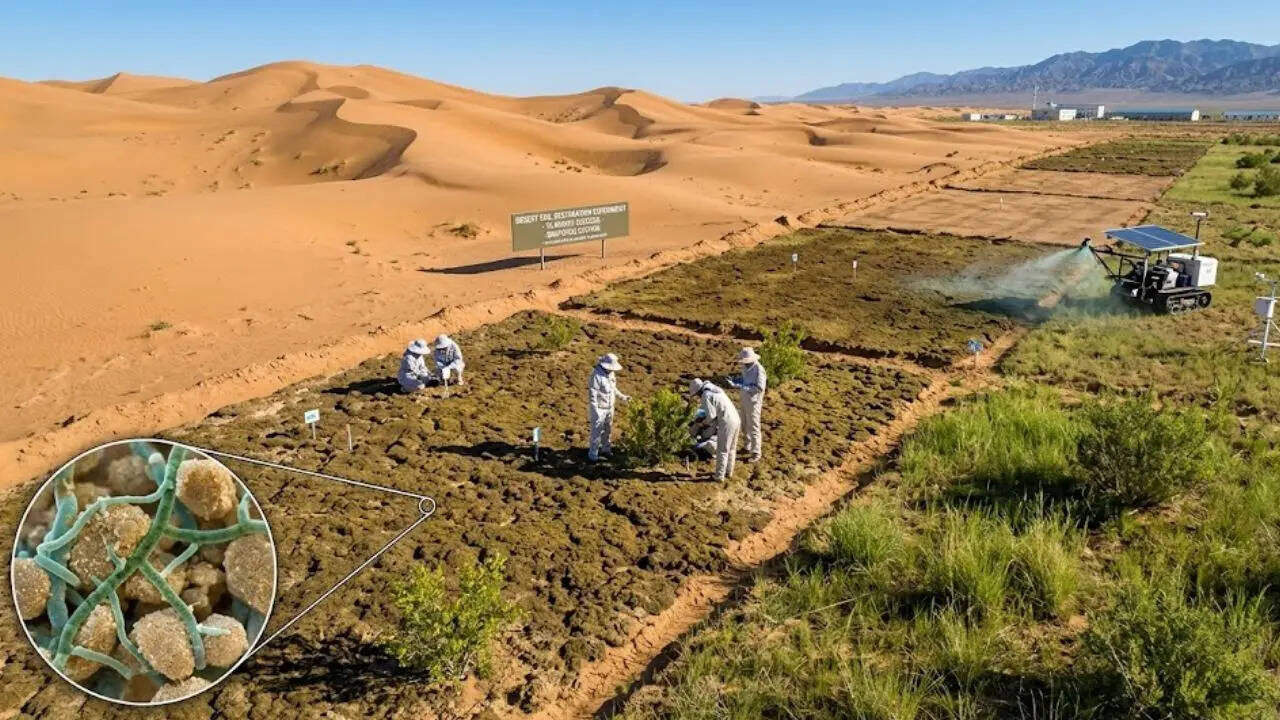
The headlines are intoxicating. Chinese scientists at Chongqing Jiaotong University claim they have cracked the code of the desert. They say they can turn shifting dunes into a lush garden in ten months using a "paste" derived from plant cellulose or "crusting" via cyanobacteria. They call it "soilization." I call it a high-stakes ecological vanity project.
The narrative is simple: we have too much sand and not enough food, so let's glue the sand together and plant some corn. It sounds like a victory for humanity. In reality, it is a fundamental misunderstanding of what a desert is and why it exists.
The Soilization Myth: Sand is Not Broken Soil
The central premise of these "miracle" breakthroughs is that sand is just "broken" soil that lacks mechanical cohesion. The researchers argue that by adding a "glue" made of sodium carboxymethyl cellulose, they can give sand the rheological properties of soil—allowing it to hold water, air, and nutrients.
This is a category error.
Soil is not just sticky sand. Soil is a living, breathing lithic-biological matrix that takes centuries to develop. It is a complex ecosystem of fungi, bacteria, minerals, and organic decaying matter. When you pour a chemical or biological adhesive over a dune, you aren't creating soil; you are creating a crust.
In the short term, yes, you can grow a crop of watermelon or sunflowers. But you are doing so on life support. You are forcing a high-metabolism ecosystem onto a landscape that lacks the hydrological infrastructure to support it.
The Water Debt Nobody Wants to Discuss
Let's talk about the math that these press releases conveniently ignore. Deserts are dry. This is not a design flaw; it is a geographic reality.
When you "green" a patch of the Ulan Buh Desert, the water for those crops has to come from somewhere. It usually comes from fossil aquifers—underground water stores that took millennia to fill and will not recharge in our lifetime.
By turning "desert into soil," we are essentially converting precious, finite liquid gold into low-value biomass for a photo op. Evapotranspiration rates in these regions are brutal. A field of corn in a reclaimed desert requires significantly more water than the same field in a temperate zone because the atmosphere is constantly trying to suck the moisture out of the leaves.
I’ve seen regional governments pour billions into these "green walls" only to watch the water table drop by meters every single year. You aren't "fixing" the desert; you are mining water and calling it "reforestation."
The Cyanobacteria Conundrum
The use of cyanobacteria to create biological crusts (biocrusts) is the more "natural" version of this tech. The idea is to inoculate the sand with organisms that secrete extracellular polymeric substances (EPS). This creates a skin that prevents wind erosion.
It’s elegant. It’s scientific. And it’s often an ecological disaster.
Deserts are not "empty" spaces waiting to be "saved." They are home to specialized species that depend on open, shifting sands. When you blanket a desert with a man-made cyanobacterial crust, you are engaging in a form of habitat destruction that we’d call a crime if it were happening in a rainforest. You are effectively "paving" the desert with a biological film, altering the albedo (reflectivity) of the surface, and heating up the ground.
Why More Arable Land is the Wrong Goal
The "people also ask" section of the internet is obsessed with one question: "Can we turn the Sahara green to stop climate change?"
The premise is flawed.
If we turned the Sahara green tomorrow, we might actually accelerate global warming. The Sahara’s white and yellow sands reflect a massive amount of solar radiation back into space. Dark green forests or croplands absorb that heat. Furthermore, the dust from the Sahara travels across the Atlantic to provide essential nutrients (like phosphorus) to the Amazon rainforest.
By "fixing" the desert, you starve the jungle.
We don't have a shortage of land. We have a crisis of distribution and a catastrophe of waste. We lose massive swaths of existing fertile land to urban sprawl and industrial degradation every day. It is cheaper, more efficient, and more ecologically sound to protect one acre of existing topsoil in the Midwest or the Yangtze River basin than it is to "manufacture" one acre of fake soil in the Gobi.
The Cost of the "Magic Paste"
The Chongqing researchers tout the low cost of their cellulose glue. But "low cost" is relative.
- Energy Inputs: Producing and transporting tons of chemical binders to the middle of a desert is a carbon-heavy enterprise.
- Maintenance: These crusts are fragile. If you stop the intervention, the desert wins. It always wins. Without constant re-application and irrigation, the "soil" reverts to sand within a few seasons.
- Biodiversity Loss: Monoculture crops grown on reclaimed sand offer zero support for local flora and fauna.
A Better Way: Embracing Aridity
If we want to be smart about deserts, we need to stop trying to turn them into something they aren't. Instead of fighting the desert, we should be leveraging its actual strengths.
- Solar Harvesting: Use the high solar irradiance for energy, but do it with "agrivoltaics"—raised panels that provide shade, reducing the water needs of the native plants underneath.
- Native Restoration: Instead of planting corn and watermelons (which have no business being in a desert), we should be supporting the growth of native xerophytes that stabilize the soil without demanding a thirsty irrigation grid.
- Halophyte Farming: Use the brackish water found under many deserts to grow salt-tolerant plants that can be used for biofuel or fodder.
The Industry Insider’s Verdict
The "desert-to-soil" breakthrough is a classic example of "Technological Solutionism." It treats a symptom (expanding deserts) while ignoring the cause (overgrazing, climate change, and poor water management elsewhere). It offers a "quick fix" that satisfies politicians looking for a legacy and venture capitalists looking for a "disruptive" play.
But you cannot "disrupt" the laws of thermodynamics. You cannot create a water-intensive garden in a water-scarce environment without eventually running out of water.
Stop cheering for the "greening" of the desert. Start worrying about why we’re so desperate to replace a functioning, ancient ecosystem with a fragile, artificial one that won't survive the century.
The desert isn't a problem to be solved. It’s a reality to be respected.
Put down the glue.