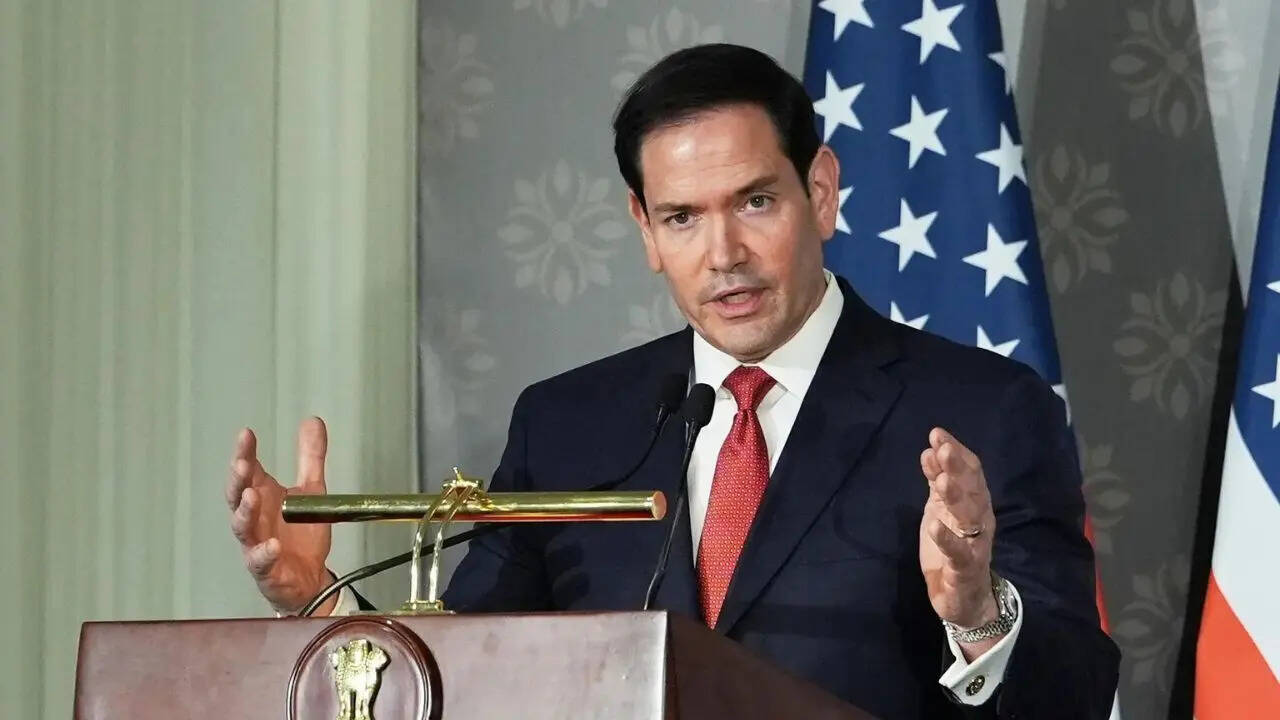
Marco Rubio wants you to believe that political vibes dictate global economics.
The political establishment is swooning over the narrative that a shared disdain for Beijing and a high-profile bromance between Donald Trump and Narendra Modi will usher in a golden era of US-India relations. Rubio recently pushed back against "anti-India rhetoric," assuring onlookers that Trump is a "big fan" of New Delhi.
It is a comforting bedtime story for foreign policy consensus-builders. It is also completely wrong.
The lazy consensus in Washington and New Delhi assumes that warm rhetoric equals economic alignment. It conflates defense-sector cooperation with structural economic compatibility. In the real world, transactions outlast transitions. When you strip away the state dinners and the rally stage handshakes, you find two fiercely protectionist economies headed toward an inevitable, structural collision.
The transactional reality of Washington and New Delhi is not a partnership built on shared values. It is a calculated standoff.
The Strategic Myth of the Anti China Pivot
The cornerstone of the Rubio-style argument is that the US and India are naturally bound by their shared containment strategy against China. This is a massive oversimplification of New Delhi's geopolitical DNA.
India does not do alliances; it does strategic autonomy.
For decades, Indian foreign policy has adhered to non-alignment. Today, they call it multi-alignment. Washington wants an anchor for its Indo-Pacific strategy—a reliable, predictable counterweight to Beijing. India, conversely, views the relationship as an à la carte menu. They will take the American defense tech, drone sales, and intelligence sharing, but they will not sign up to be Washington’s regional enforcer.
Look at the hard data on energy and trade. When the West imposed sweeping sanctions on Russian oil following the Ukraine conflict, New Delhi did not fall in line. Instead, India dramatically ramped up its imports of discounted Russian crude. By 2023 and 2024, Russia became India’s top oil supplier, accounting for over 35% of its imports at various peaks. Indian refineries processed that cheap Russian crude and exported the refined petroleum right back to Europe and the US.
The Reality Check: India will always prioritize its own domestic stability and energy security over Washington’s sanctions regimes. Assuming India will compromise its economic growth to fulfill an American geopolitical vision is a fundamental misreading of Indian history.
Tariff Man Meets Make In India
The real friction is not in the diplomatic cables; it is in the trade ledger. Donald Trump’s economic philosophy is defined by a deep aversion to trade deficits and an obsession with tariffs. He has explicitly called India a "very big abuser" of trade tariffs, pointing out that India imposes some of the highest tariffs on foreign goods among major economies.
Let's look at the actual trade mechanics. India's average statutory tariff rate sits above 17%, significantly higher than the US average of around 3.4%. On specific goods, like American motorcycles or agricultural products, Indian tariffs have historically soared up to 50% or even 100%.
+------------------------------------+------------------------+
| Country                            | Average Tariff Rate    |
+------------------------------------+------------------------+
| United States                      | ~3.4%                  |
| India                              | ~17.0%+                |
+------------------------------------+------------------------+
During his first term, Trump stripped India of its preferential trade status under the Generalized System of Preferences (GSP), which had allowed billions of dollars of Indian exports to enter the US duty-free. New Delhi retaliated with tariffs on US goods like almonds, walnuts, and apples.
Marco Rubio’s public relations offensive cannot erase these structural realities:
- Trump's Target: A proposed universal baseline tariff on all imports, alongside reciprocal tariffs targeting countries with high duties.
- Modi's Shield: The "Make in India" initiative, which relies heavily on import substitution and protective tariffs to build domestic manufacturing capabilities.
These two economic agendas are fundamentally incompatible. One cannot succeed without directly impeding the other.
The Tech and Immigration Flashpoints
The friction goes far beyond agricultural goods and manufacturing. The service and technology sectors are the true engines of the modern US-India economic relationship, and they are riddled with landmines.
The H-1B Visa Battleground
The American tech sector relies heavily on Indian engineering talent brought in through the H-1B visa program. Indian citizens routinely secure over 70% of these visas annually. Under an America First immigration framework, this pipeline face structural pressures. Increased administrative scrutiny, higher wage requirements for visa holders, and lower approval rates are not just possibilities—they are policy objectives designed to protect domestic labor markets.
Data Nationalism
India’s regulatory framework is moving rapidly toward data localization. The Digital Personal Data Protection Act (DPDPA) creates strict guidelines on how global tech giants store and process the data of over a billion Indian citizens. For American tech conglomerates, this means building expensive local data infrastructure and navigating a regulatory maze. New Delhi views data as a national sovereign asset; Silicon Valley views it as a borderless resource. This is an ideological divide that no amount of political goodwill can bridge.
Dismantling the PAA Narrative
Let's confront the questions dominating the mainstream foreign policy circuit right now. The premises behind them are fundamentally flawed.
"Will a strong personal relationship between leadership prevent a trade war?"
No. It never has. Personal rapport is a diplomatic tool, not an economic policy. A president’s primary mandate in an America First administration is to protect domestic manufacturing and shrink trade deficits. A prime minister’s mandate under "Make in India" is exactly the same. When a conflict arises between personal affection and national economic data, the data wins every single time.
"Can India completely replace China in the global supply chain for US companies?"
Not in the near term. This is a corporate boardroom fantasy. While Apple and Foxconn have successfully diversified some iPhone manufacturing to India, the structural bottlenecks are immense. India’s infrastructure, bureaucratic red tape, and labor laws present massive logistical hurdles.
Imagine a scenario where a US hardware company wants to shift 100% of its production from Shenzhen to Chennai. They quickly realize that while assembly labor is cheap, the deeply entrenched component supply ecosystem—the specialized screws, the precision optics, the display substrates—remains heavily concentrated in mainland China. Moving assembly does not eliminate the Chinese supply chain; it merely adds a shipping step.
The Hard Truth for Investors and Executives
If you are running a multinational corporation or managing a global macro portfolio, relying on the Rubio narrative is a high-risk gamble. Stop looking at the joint statements issued by the State Department. Look at the regulatory notices issued by the United States Trade Representative (USTR) and the Ministry of Commerce and Industry in New Delhi.
The downside of this contrarian view is obvious: it forces you to abandon the easy optimism of the "friendshoring" narrative. It means accepting that doing business across the US-India corridor will require navigating a persistent minefield of compliance, sudden tariff hikes, and shifting regulatory goalposts.
But the upside is clarity. By acknowledging that the US and India are economic competitors operating under protectionist frameworks, you can build supply chains and investment strategies that are resilient to sudden political shocks.
Do not be blinded by the diplomatic theater. When politicians tell you a relationship is bulletproof, check where they are pointing the revenue targets.