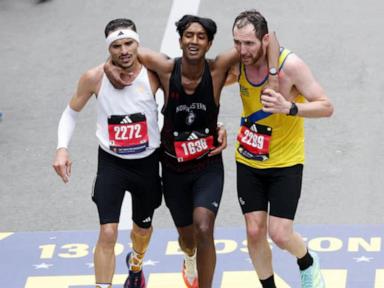
You’ve probably seen the clip by now. ABC World News Tonight anchor David Muir stops his broadcast to share a grainy, cell phone video from the Boston Marathon finish line. It isn't a video of a record-breaking sprint or a dramatic collapse. It’s a quiet moment between two people who didn’t know each other five minutes prior. This kind of story usually gets buried under political scandals or economic dread. But it didn't. It went viral.
The reason isn't just because it was "nice." It’s because the Boston Marathon carries a weight that other races don't. Since 2013, that finish line on Boylston Street hasn't just been about sports. It’s been about reclaiming a space that was once defined by tragedy. When David Muir shares a moment of kindness from that specific spot, he’s tapping into a collective memory of resilience that most of us still feel in our bones.
The Boston Marathon finish line as a symbol of recovery
Most people think of the Boston Marathon as the pinnacle of long-distance running. It is. But for the city and the world, it’s a living monument. When you see two strangers helping each other cross that blue and yellow line, you’re seeing the exact opposite of what happened during the bombings.
I’ve watched how these stories ripple through social media. They provide a necessary counter-narrative to the idea that we’re all divided. In the video Muir highlighted, you see a runner who is clearly spent. Their legs are turning to jelly. Their brain is screaming to stop. Then, someone else—another runner who is also exhausted—grabs their arm. They don't say much. They just keep them upright.
This isn't just sportsmanship. It’s a physical manifestation of empathy. You don't need a degree in psychology to understand why that hits hard. It’s raw. It’s unscripted. It reminds us that even when we’re at our weakest, humans have a weird, instinctual drive to carry each other.
Why David Muir is the right messenger for these stories
David Muir has a specific way of delivering news. He’s direct. He doesn't lean into the over-the-top sensationalism that plagues some cable networks. When he chooses to highlight a "Person of the Week" or a "Moment of Kindness," it feels intentional. It’s his way of saying, "Hey, look over here. This is actually who we are."
Journalism often focuses on the outliers of human behavior—the worst things people do to each other. That’s what makes the news. But kindness is the baseline. It’s the glue. By using his platform to amplify a stranger-to-stranger interaction at the marathon, Muir validates the common experience. He’s showing that for every act of malice we see in the headlines, there are thousands of these small, quiet supports happening every day.
We tend to ignore the mundane good. We expect people to be decent, so when they are, it’s not "news." Muir flips that. He makes decency the headline. That shift in perspective is why people keep sharing his segments. It makes them feel less alone in a world that often feels hostile.
The science behind why watching kindness feels so good
There’s actually a name for what you feel when you watch that Boston Marathon video. It’s called "moral elevation." Researchers like Jonathan Haidt have studied this for years. When we witness someone performing a virtuous act, especially one that requires effort or sacrifice, our bodies react.
- You feel a warm glow in your chest.
- Your heart rate might actually slow down.
- You feel a sudden urge to be a better person yourself.
It’s a biological reset button. In a world where we’re constantly bombarded with cortisol-spiking news, these stories act as a natural antacid. They tell our nervous systems that the world is safe. They prove that cooperation is just as "natural" as competition.
Think about the last time you saw a total stranger do something selfless. Maybe they held a door when they were in a rush, or helped someone carry a stroller up subway stairs. You didn't just notice it; you felt it. That’s the power Muir is leveraging. He’s not just reporting; he’s giving the audience a much-needed hit of oxytocin.
Lessons from the finish line you can actually use
We don't all have to run 26.2 miles to practice what we see in that video. The "kindness of strangers" isn't a phenomenon reserved for elite athletes or national holidays. It’s a choice you make on a random Tuesday.
If you’re looking to bring some of that Boston Marathon energy into your own life, stop waiting for a big moment. Kindness is usually small. It’s about being observant enough to notice when someone is struggling—even if they aren't asking for help.
The runner in the video didn't scream for assistance. They just looked like they were about to fall. The other runner noticed. That’s the key. Most of us are so stuck in our own heads or our own phones that we miss the cues. We miss the chance to be the person David Muir talks about on the news.
Stop overthinking and start noticing
If you want to be more like those runners, start by looking up. Notice the person struggling with their groceries. Notice the colleague who looks like they’re drowning in work but says they’re "fine." You don't need a grand gesture. You just need to show up.
- Acknowledge the struggle. You don't have to fix everything. Sometimes just saying "I see you" is enough.
- Act without being asked. The best help is the kind that doesn't require the recipient to admit they’re failing.
- Keep it quiet. You don't need a camera crew or a viral tweet to make an impact. The most meaningful moments are often the ones nobody else sees.
David Muir shares these stories to remind us that we have a choice. We can focus on the finish line, or we can focus on the people running next to us. The finish line is just a mark on the pavement. The person next to you is what actually matters.
Next time you’re feeling cynical about the state of the world, go back and watch that clip. Don't look at the clock or the medals. Look at the hands reaching out to catch someone they’ve never met. That’s the real story. That’s what’s worth reporting.
Start looking for those moments in your own neighborhood. They’re there. I promise you. You just have to be willing to see them.