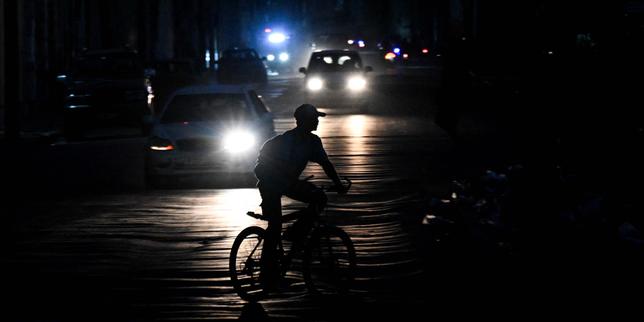
The transition from dusk to absolute void happens without warning, a sudden amputation of light that strips a city of its pulse.
In Havana, the streetlamps do not simply flicker and die. They vanish. The hum of ancient American sedans idling on the malecón suddenly stands alone against the Atlantic spray, and the familiar rhythm of neighborhood life—domino tiles slapping against wooden tables, salsa bleeding from open windows, the collective chatter of front-porch survival—collapses into a heavy, suffocating quiet.
Another blackout.
Not a localized hiccup of a single transformer blown by summer heat, but the total, catastrophic failure of the national grid. Cuba is dark again.
When the Circuit Breaks
To understand what happens when a country loses its power, you have to look past the macroeconomics of crumbling infrastructure and into the kitchens.
Consider a hypothetical neighborhood on the outskirts of the capital, though it could just as easily be in Santiago or Matanzas. Elena opens her refrigerator. The interior is already warming. Inside sit a few precious items secured through hours of queuing earlier that week: a bag of chicken meant to stretch across four days, some fresh milk for her youngest grandchild, and a small packet of medicine that requires refrigeration. She closes the door gently, as if a tight seal might somehow trap the cold inside a dead box.
She knows the math of scarcity. Without electricity, the food spoils. Without electricity, the municipal water pumps fail, leaving high-rise apartments dry within hours. Without electricity, the hospitals switch to backup diesel generators—generators that hum with a precarious cough, praying for fuel deliveries that are perpetually delayed by shipping bottlenecks and tightening sanctions.
This is not a sudden storm. It is a slow-motion structural collapse that has been decades in the making, born from an impossible collision of obsolete Soviet-era technology, chronic fuel shortages, and an economic siege that starves the state of the hard currency needed for spare parts.
The Anatomy of a National Grid on Life Support
Power grids are living organisms. They require a delicate, second-by-second balancing act between generation and consumption. When demand outstrips supply, or when a primary thermal power plant trips offline due to mechanical failure, the entire system can destabilize in milliseconds.
Cuba's primary plants—massive facilities like the Antonio Guiteras plant in Matanzas—are elderly giants. They have been patched, welded, and coaxed past their expected lifespans for decades. When one of these anchor plants stumbles, the shockwaves travel instantly through the grid, forcing protective shutdowns across smaller thermoelectric stations to prevent total catastrophic burnout.
The result is zero. Total blackout.
Restoring power to an island-wide grid from a total blackout is not like flipping a household breaker switch. It is a terrifying exercise in engineering dominoes. Operators must first start small, cranking up tiny localized generators to provide just enough juice to jump-start a larger power plant. That larger plant then sends power down the line to wake up the next station, step by agonizing step.
If a single link fails during this restart phase—if a transmission line sags too low, if a boiler overheats, if the fuel runs dry—the entire delicate chain snaps. The operators have to start over from absolute zero, staring at control boards bathed in the amber glow of emergency lights while millions of citizens wait in the dark.
The Human Cost of Waiting
For the outsider, a power outage is an inconvenience. A dead phone battery, a spoiled meal, an interrupted evening.
For the Cuban people, it is an endurance test written in daily exhaustion.
The darkness amplifies every preexisting strain. Traffic lights go blind, turning intersections into chaotic contests of raw nerve and shouted warnings. Gas stations grind to a halt, trapping drivers in endless queues that stretch for blocks, waiting for pumps that cannot run without juice. Elevators freeze mid-cable, trapping residents between floors.
And yet, in the middle of this profound vulnerability, something remarkable happens in the streets.
When the lights go out, the doors open.
Neighbors emerge from pitch-black hallways into the silver wash of the Caribbean moon. Someone brings out a battery-powered radio, its static dial tuned desperately to crackling frequencies for updates from state media. Someone else shares a thermos of sweet, dark coffee brewed on a stubborn gas burner just before the propane ran low. Children find games in the shadows, their laughter cutting through the heavy tropical heat, while adults sit on curbs and talk in low, steady murmurs about tomorrow.
It is a resilience born of necessity. When systems fail completely, human connection becomes the only infrastructure left standing.
The Long Shadow of Tomorrow
The grid will eventually be coaxed back to life. The massive boilers will fire up. The hum of the capital will return, fragile and tentative, waiting for the next strained bolt to snap under the weight of an overburdened, underfunded system.
The government will issue statements about restoration percentages and technical faults. International analysts will write reports on fuel deficits and economic paralysis.
But back in the kitchens of Havana, the ice has already melted. The milk has turned. And as the evening breeze sweeps in from the sea, carrying the distant scent of salt and diesel, the people of the island look toward the horizon, knowing that the dark is never truly gone—it is only ever waiting for the next switch to fail.