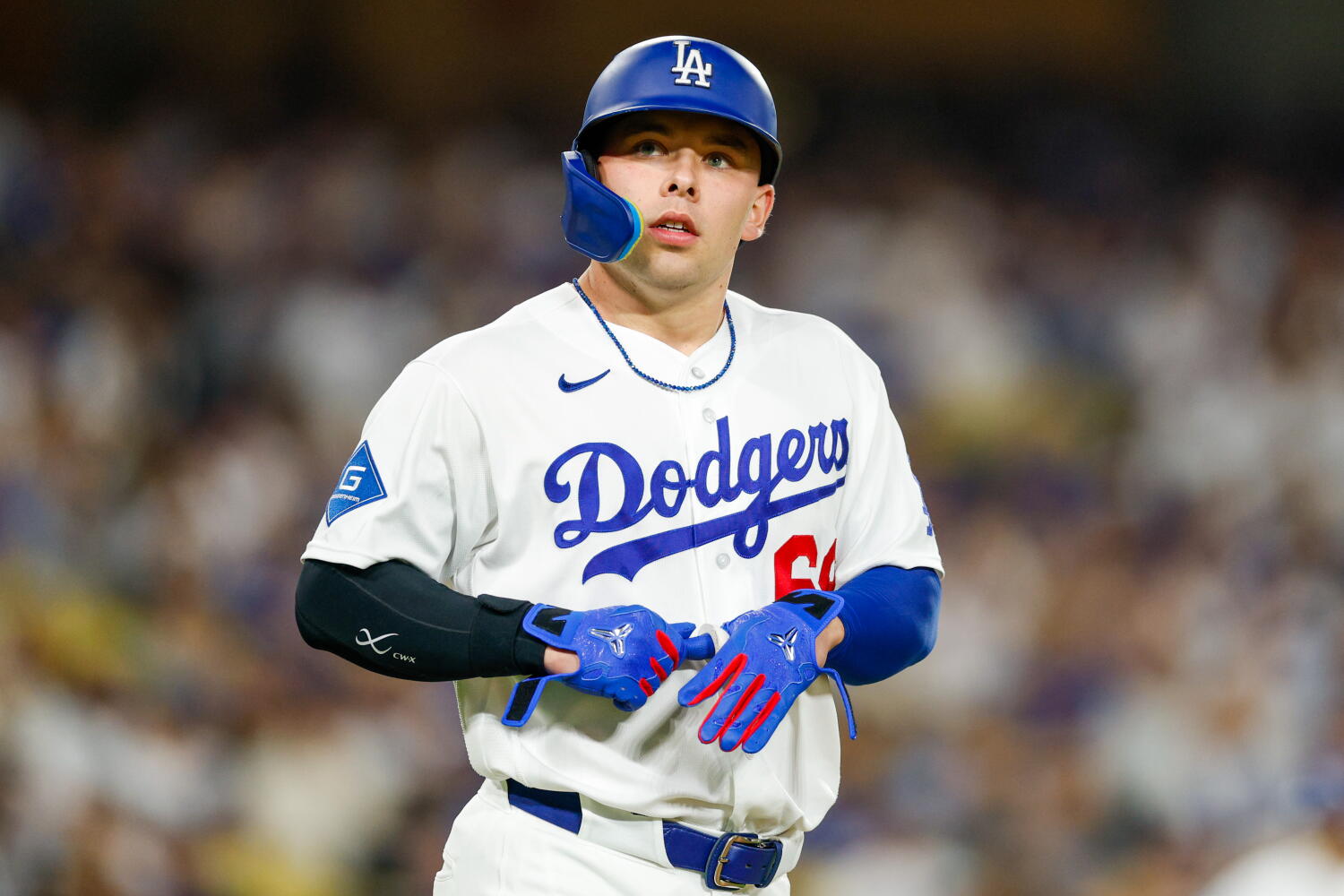
Los Angeles Dodgers catcher Dalton Rushing facing elbow surgery for a partial ulnar collateral ligament tear exposes a flaw in how modern baseball tracks non-pitching arm wear. When a catcher goes under the knife for a partial UCL tear, the injury rarely happens on a single dramatic play. It builds up over hundreds of snap throws, back-picks, and high-velocity returns to the pitcher's mound.
Fans and front offices have spent two decades obsessing over pitcher pitch counts, spin rates, and velocity spikes. Catchers get far less biomechanical scrutiny until a ligament frays. For a prospect like Dalton Rushing, whose bat and athleticism give him multi-position value, an elbow procedure changes the timeline on developmental reps and forces tough questions about how teams manage throwing volume behind the plate.
Why Catchers Tear the UCL Without Throwing 100 MPH
Pitchers take the blame for elbow epidemics because their mechanics are extreme and violent. A fastball delivery puts massive valgus stress across the medial elbow as the arm accelerates forward. Catchers do not throw ninety-eight miles per hour on every play, yet their elbows endure a relentless rhythm of sharp, short-lever snaps.
Watch a catcher fire a crisp throw to second base on a stolen base attempt. Or watch a routine snap throw back to first or third. There is often very little time for a full crow-hop or deep body rotation. When a catcher short-arms a throw from a crouch or a modified knee-down stance, the elbow and shoulder absorb torque before the lower half can transfer energy cleanly.
Do that a few times a game across a long season, plus warmups, bullpen tosses, and throwing back every pitch between batters, and the numbers add up fast. A partial tear in the ulnar collateral ligament often starts as microscopic fiber fatigue. Over time, repeated valgus loading outpaces tissue recovery.
The Hidden Cost of Modern Stances and Quick Transfers
Modern catching prioritizes pop time, framing efficiency, and quick transfers. Catchers drop into low stances, stay close to the dirt, and snap the ball out of the glove with minimal wasted motion. That helps steal strikes and cut down runners. It also alters how force travels up the kinetic chain.
When a catcher pops up quickly from a low crouch to throw, timing can get rushed. Rushing a throw—literally or mechanically—often means the arm moves ahead of the hips. Instead of a smooth, wide arc, the elbow leads the action under heavy tension.
A partial UCL tear in a position player is rarely a freak accident. It is usually the bill coming due on thousands of high-effort short throws.
Even seemingly harmless throws matter. A catcher throws back to the mound dozens of times a night. If a pitcher wants extra tempo or throws hard warmups, the catcher's arm stays engaged constantly. Add in defensive drills during spring training and minor league camp, and the elbow rarely gets true downtime.
Partial UCL Tear Means Tough Surgical Choices
Not every partial UCL tear is treated the same way, and orthopedic surgeons weigh several factors before deciding between rest, bracing, biologics, or reconstruction. The exact location of the tear, the quality of the remaining ligament fibers, the player's age, and the demands of the position all shape the call.
When conservative rehab fails—or when structural instability threatens long-term reliability—surgery becomes the practical route. Depending on what the surgeon finds inside the joint, options can include traditional Tommy John surgery (UCL reconstruction), an internal brace repair that reinforces healing tissue, or a hybrid approach.
Recovery Timelines for Catchers vs. Pitchers
People often assume a catcher recovers from elbow surgery much faster than a pitcher because a catcher does not throw high-effort pitches every fifth day. There is truth to that, up to a point. Catchers do not need the same max-effort mound buildup required of a starting pitcher.
Still, catching is uniquely demanding on the throwing arm. A catcher has to throw accurately from awkward angles, often off-balance, with runners sprinting and infielders moving. Hitting also requires healthy forearm and elbow function, especially when swinging inside or driving the ball to the opposite field.
A typical recovery timeline depends heavily on the exact procedure performed:
- Internal brace / repair protocols can sometimes move faster than full graft reconstruction, though doctors still protect the healing ligament early and build throwing gradually.
- Full UCL reconstruction generally demands a longer, more measured progression before game-speed throws are cleared.
- Hitting usually returns earlier than full-intensity throwing, allowing players to stay sharp in the cage while the arm rebuilds strength.
The biggest trap in position-player rehab is impatience. Because a catcher can run, block, and hit earlier in the process, it is easy to push throwing progression too soon. Rushing the final stages of arm buildup is how minor setbacks turn into lingering soreness.
What This Means for Dalton Rushing and the Dodgers
For Dalton Rushing, an elbow procedure is an unwelcome detour right when developmental reps and roster opportunities carry real weight. Catchers who can swing the bat—and handle secondary spots like first base or left field—have extra value precisely because their offense gives a club flexibility.
Elbow surgery does not erase a catcher's bat, and many position players return to mash after UCL procedures. What it does affect is short-term throwing freedom and defensive workload management. When a catcher comes back from elbow surgery, teams watch throw velocity, accuracy on high-pressure bases, and day-to-day fatigue closely.
From an organizational standpoint, the Dodgers have the depth to be patient. Well-run franchises rarely force a recovering prospect back into grueling catch-and-throw schedules before medical and performance staffs are confident in the arm. Still, every month spent rehabilitating an elbow is a month without live game reps behind the plate.
A Hypothetical Scenario for Workload Management
Consider a hypothetical example to see how front offices think through this. Suppose a young catcher undergoes elbow surgery in the offseason and is cleared to hit in spring training, while his throwing progression lags behind by two months. Rather than rushing him behind the plate in high-leverage games early in the year, a club might ease him back with controlled throwing intervals, spot starts, or time at another position until his arm strength and command look completely natural.
That kind of measured pacing protects both the player's long-term health and his offensive profile. Forcing full catching duties too early risks compromising mechanics just to stay on a rigid calendar.
The Blind Spot in Baseball's Arm-Care Conversation
Baseball loves clean metrics. We have exit velocity, bat speed, spin efficiency, and injury lists that read like stock tickers. Yet throwing volume for catchers remains one of the most under-examined parts of player development.
Teams track pitch counts down to the single throw on the mound. Behind the plate, tracking is far looser. A catcher might make six hard throws to second in a game, fifteen snap throws, and eighty tosses back to the mound, and none of it gets logged with the same rigor as a bullpen session.
If Dalton Rushing's partial UCL tear prompts even modest changes in how clubs monitor catching throws—especially in minor league development where prospects log heavy innings—it will have a lasting ripple effect. Catchers already take enough punishment on their knees, hips, and hands. Protecting their elbows deserves serious attention before the ligament gives out.