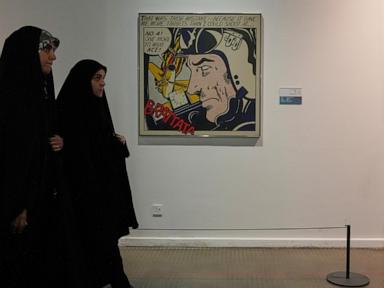
The recent exhibition of American Minimalist and Conceptual art at the Tehran Museum of Contemporary Art (TMoCA) functions as a case study in the decoupling of state-level geopolitical conflict from the institutional management of high-value cultural assets. While diplomatic relations between the United States and the Islamic Republic of Iran remain defined by maximum pressure and strategic impasse, the physical presence of works by Sol LeWitt, Donald Judd, and Dan Flavin in Tehran reveals a complex internal logic regarding asset preservation and the utility of "Western" aesthetics in a non-Western ideological framework.
This phenomenon is not merely an art show; it is an exercise in managing the friction between an inherited collection—largely acquired under the Pahlavi dynasty—and the contemporary political mandate of the state. To understand the significance of this exhibit, one must analyze the mechanisms of cultural legitimacy, the economic valuation of state-held assets, and the strategic deployment of the "American" label within a controlled information environment.
The Structural Value of the TMoCA Collection
The TMoCA collection represents a unique anomaly in global art history. Valued conservatively in the billions of dollars, it constitutes perhaps the most significant collection of modern Western art outside of Europe and North America. The strategic value of these assets is defined by three distinct drivers:
- Institutional Continuity: By maintaining and periodically displaying these works, the Iranian state asserts its role as a sophisticated global custodian. This prevents the perception of the museum as a static relic and reinforces the professional credentials of the Iranian curatorial class.
- Economic Insulation: These works are non-fungible assets that exist outside the traditional banking system. While they are not currently being liquidated, their presence on the state’s balance sheet represents a massive reserve of cultural and financial capital that provides a form of "soft" collateral in global prestige.
- Ideological Contrast: The exhibition of American art focusing on "War" or "minimalism" allows the state to frame the American experience through a specific lens—one that often emphasizes the sterile, industrial, or critical aspects of Western society, thereby aligning with the state’s broader critique of Western hegemony.
The Taxonomy of Minimalist Influence
Minimalism and Conceptualism, the movements featured in this exhibit, stripped art of narrative and emotional artifice, focusing instead on repetition, industrial materials, and geometric precision. In the context of a museum in Tehran, the display of these specific movements serves a tactical purpose in the internal cultural discourse.
The selection of Minimalist works avoids the potential pitfalls of figurative art, which can trigger religious or moral sensitivities regarding the depiction of the human form. By focusing on the "grid" and the "cube," the museum can showcase premier American talent while bypassing the ideological landmines of Western social liberalism. This creates a sanitized space where the "American" brand can be engaged as a purely technical or formal achievement, detached from the political values of the U.S. State Department.
The Mechanism of Disassociation
The primary success of the TMoCA strategy lies in its ability to separate the creator from the origin. The museum treats a Donald Judd sculpture not as a celebration of American democracy, but as a masterpiece of spatial engineering. This disassociation allows the Iranian public to engage with global art history without the perceived "contamination" of American soft power. The exhibit acts as a filter, retaining the aesthetic prestige of the West while discarding its political subtext.
Analyzing the "Reflection on War" Framework
The exhibition’s thematic focus on war provides the necessary political cover for the display of American works. By framing the art within a critique of conflict—often implicitly or explicitly linked to American foreign policy—the curators align the collection with the Islamic Republic’s official narrative. This creates a dual-layer experience for the viewer:
- Layer 1 (The Visual): The appreciation of high-level craftsmanship, color theory, and spatial organization.
- Layer 2 (The Political): The interpretation of these works as evidence of a society grappling with the consequences of its own military-industrial complex.
This framing resolves the contradiction of hosting an "American" exhibit in the "Heart of the Resistance." It transforms the museum from a passive gallery into an active site of ideological critique. The art is not invited; it is subpoenaed as a witness to the Western condition.
The Constraints of Cultural Diplomacy
It is a mistake to view this exhibition as a sign of a "thaw" in relations. Rather, it is an example of compartmentalized governance. The Iranian state manages its cultural assets through a different bureaucratic logic than its nuclear or regional security programs.
There are significant risks to this strategy. The primary bottleneck is the "reversibility" of cultural openness. Should the political climate shift toward a more hardline stance, these exhibitions can be shuttered instantly, as has happened in previous decades. Furthermore, the reliance on a collection purchased by the previous regime creates a persistent tension regarding the provenance and "revolutionary" legitimacy of the museum itself.
The Bottleneck of Global Engagement
Because of international sanctions and the lack of formal diplomatic channels, TMoCA operates in a vacuum. It cannot easily loan these works to the MoMA or the Tate, nor can it receive major international traveling exhibits. This isolation leads to a "circular" curatorial style where the same collection must be re-invented and re-framed every few years to maintain public interest. The current exhibit is a creative solution to this problem, utilizing the "American" tag to generate domestic foot traffic and international headlines without requiring a single diplomatic cable.
The Strategic Play for Institutional Survival
To maximize the utility of the TMoCA collection while navigating the constraints of the Iranian political system, the institution must transition from a "custodian" model to an "interpreter" model.
The current exhibition demonstrates the first phase of this transition: using Western art to critique Western structures. However, for the museum to maintain its global standing, it must eventually engage in "comparative curation." This would involve placing these American minimalist works in direct dialogue with Iranian contemporary artists who are working within similar formal constraints. By doing so, the museum would move beyond the "War" framework and establish a more robust, independent intellectual authority that is not dependent on the political climate of the day.
The long-term viability of this cultural asset depends on its ability to remain "untouchable" by the fluctuating tides of the executive branch. By embedding the American collection into the core of Iranian academic and artistic training, the museum ensures that these works are seen not as foreign imports, but as essential tools for the development of Iranian national art. The strategic objective is the complete indigenization of the Western masterpiece—rendering the "American" label a historical footnote to its current Iranian reality.