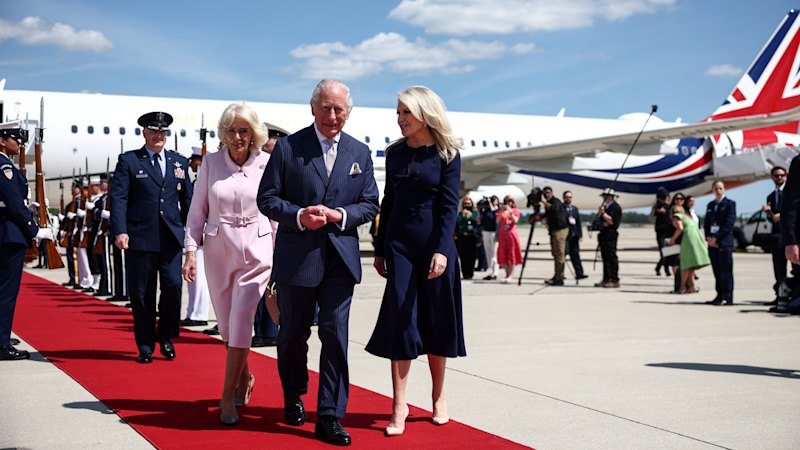
The tarmac at Joint Base Andrews has a way of swallowing sound. Even as the engines of the RAF Voyager whined down to a rhythmic hum, the heavy, humid air of the Potomac seemed to press against the metal, expectant and still. When King Charles III stepped into the light, followed by Queen Camilla, the moment felt like a deliberate slowing of the clock. Here was the physical embodiment of continuity—a man whose entire life is a rehearsal for permanence—arriving in a city that currently feels as though it is vibrating apart at the seams.
Washington D.C. is a town built on the theater of power, but rarely do its two favorite dramas play out on the same stage with such jarring contrast. On one side of the curtain, you have the State Visit: the polished silver, the rigid protocol, and the centuries-old diplomatic dance. On the other, just a few miles away in a sterile courtroom, a man named Cole Allen sat before a judge, the human embodiment of the fracture lines currently spider-webbing across the American experiment.
Politics is often discussed in terms of polls and policy papers, but the reality is lived in the nervous systems of the people watching it.
The Weight of the Velvet Glove
There is a specific kind of silence that accompanies a King. It isn’t the silence of absence, but the silence of tradition. As Charles and Camilla were greeted by the customary battery of officials, the imagery was designed to project stability. For the United Kingdom, this visit serves as a vital bridge-building exercise, a reminder that despite the churning seas of global populism, the "Special Relationship" remains anchored.
Think of a State Visit like a masterclass in soft power. It doesn’t involve signing treaties or debating trade tariffs—that’s for the gray-suited bureaucrats in the back rooms. Instead, it’s about the optics of friendship. When the King meets with the President, they aren't just two men talking; they are two nations shaking hands. In a world where digital communication has made everything feel ephemeral and disposable, the heavy physical presence of the monarchy offers a strange, if anachronistic, comfort.
But this wasn't a standard diplomatic tour. The atmosphere in the capital was thick with the scent of a city under siege by its own internal tensions. While the King prepared for the choreographed grace of a state dinner, the legal system was grinding through the gritty, terrifying details of a plot that nearly rewrote American history in blood.
The Man in the Shallows
Cole Allen does not look like a historical figure. In the courtroom, he appeared diminished, a sharp contrast to the high-stakes terror his alleged actions inspired. Charged with attempting to assassinate Donald Trump, Allen represents the dark shadow that follows the bright lights of political rhetoric.
Courtrooms are designed to be cold. The fluorescent lighting, the hard wooden benches, the measured tone of the prosecution—it is all intended to strip the passion out of a crime and replace it with the logic of the law. But you cannot easily sanitize the idea of a sniper's nest. You cannot make the intent to kill a former President feel like a mere administrative error.
The prosecution laid out a timeline that felt like a thriller novel, except the stakes were our actual lives. They spoke of surveillance, of ballistic calculations, and of a digital trail that led into the deepest recesses of extremist thought. As the details emerged, the courtroom became a microcosm of the national psyche: anxious, hyper-vigilant, and deeply weary.
We often treat these events as outliers, as "lone wolf" anomalies that exist outside the flow of normal life. But Allen’s presence in that dock suggests something more systemic. He is the extreme expression of a fever that hasn't broken. When the political discourse becomes a zero-sum game—a battle between good and absolute evil—the jump from a hateful post on social media to a physical weapon becomes tragically short.
The Collision of Two Worlds
The juxtaposition is almost too poetic to be real.
In one zip code, we have the pinnacle of inherited, stable authority. The King represents a system where the individual is secondary to the office. He is a symbol that persists regardless of who is in power. He is the "long game."
In another zip code, we have the violent rejection of that very order. The assassination attempt on Trump was an assault on the process itself. It was an attempt to bypass the ballot box with a bullet, to force a conclusion because the uncertainty of democracy had become unbearable to one man’s mind.
Imagine the dinner table in a typical American home this evening. On the television, there is a flash of a tiara and the glint of a tuxedo—a fairy tale of international cooperation. Then, the screen cuts to a mugshot and a diagram of a perimeter breach. The whiplash is exhausting. It leaves us wondering which version of reality is the "real" one. Is it the handshakes and the toasts, or is it the metal detectors and the court transcripts?
The truth is that both are equally real, and they are inextricably linked. The King is here because the world is dangerous and unpredictable; his presence is an attempt to nail down a few planks of certainty in a storm. Allen is in court because that storm has already made landfall.
The Invisible Toll on the Streets
Beyond the headlines, there is the human cost of living in a city—and a country—that feels like it’s constantly bracing for impact.
Consider the security detail. Thousands of men and women in dark suits and tactical gear, their eyes constantly scanning the crowds. For them, the arrival of a foreign monarch and the trial of a suspected assassin are two sides of the same exhausting coin. They live in the "red zone," a state of permanent high alert where every discarded backpack is a threat and every sudden movement is a potential catastrophe.
Consider the citizens of Washington. They navigate a city of rolling roadblocks and closed-off parks. For them, politics isn't a hobby; it's a logistical hurdle. Their daily commute is dictated by the movements of the powerful and the crimes of the desperate. There is a simmering resentment that bubbles just below the surface—a feeling that the "important people" are playing a game of chess while the rest of us are just trying to get to work on time.
The arrival of Charles and Camilla is meant to be a celebration of shared values. But as the King speaks of "enduring bonds," one has to wonder if those bonds are stretching thin under the weight of domestic strife. Can a foreign dignitary truly strengthen a relationship with a country that is currently struggling to maintain a relationship with itself?
The Architecture of the Aftermath
The trial of Cole Allen will move slowly. That is the nature of the beast. There will be motions, discovery phases, and long stretches of silence. But the shadow of the event will remain long after the jury delivers its verdict.
Every time a candidate steps onto a stage from now until November, the memory of that alleged attempt will be there. It will be in the height of the stage, the thickness of the glass, and the distance of the crowd. We have entered an era of "hardened" politics, where the physical space between the leaders and the led is growing wider and more fortified.
Meanwhile, the King’s visit will conclude with the usual flurry of press releases and commemorative photos. He will fly back across the Atlantic, leaving behind a trail of diplomatic goodwill. But the questions he leaves in his wake are profound.
What does leadership look like in a fractured age? Is it the quiet, steady hand of tradition, or is it the loud, combative energy of the courtroom?
The Unspoken Agreement
At the heart of both stories is a question of the social contract.
When we watch a State Visit, we are witnessing a performance of the agreement that nations will treat each other with respect and follow established rules. When we watch a criminal trial for an assassination attempt, we are witnessing the fallout of someone who has ripped that contract to shreds.
The "human element" here isn't just the individuals involved—it’s the collective anxiety of a population watching the foundations of their society being tested. We are all characters in this story. We are the ones who have to decide which narrative we believe in: the one where we work together despite our differences, or the one where we eliminate those who differ from us.
The silence at Joint Base Andrews didn't last long. The city quickly reclaimed its noise—the sirens, the shouting, the endless chatter of the news cycle. But for a few moments, the arrival of a King and the trial of a commoner held a mirror up to the soul of the nation.
It showed us a reflection of what we want to be: stable, respected, and dignified.
And it showed us the reality of what we are currently fighting against: chaos, violence, and the terrifying fragility of the peace we so often take for granted.
The silver is polished. The court is in session. The rest is up to us.