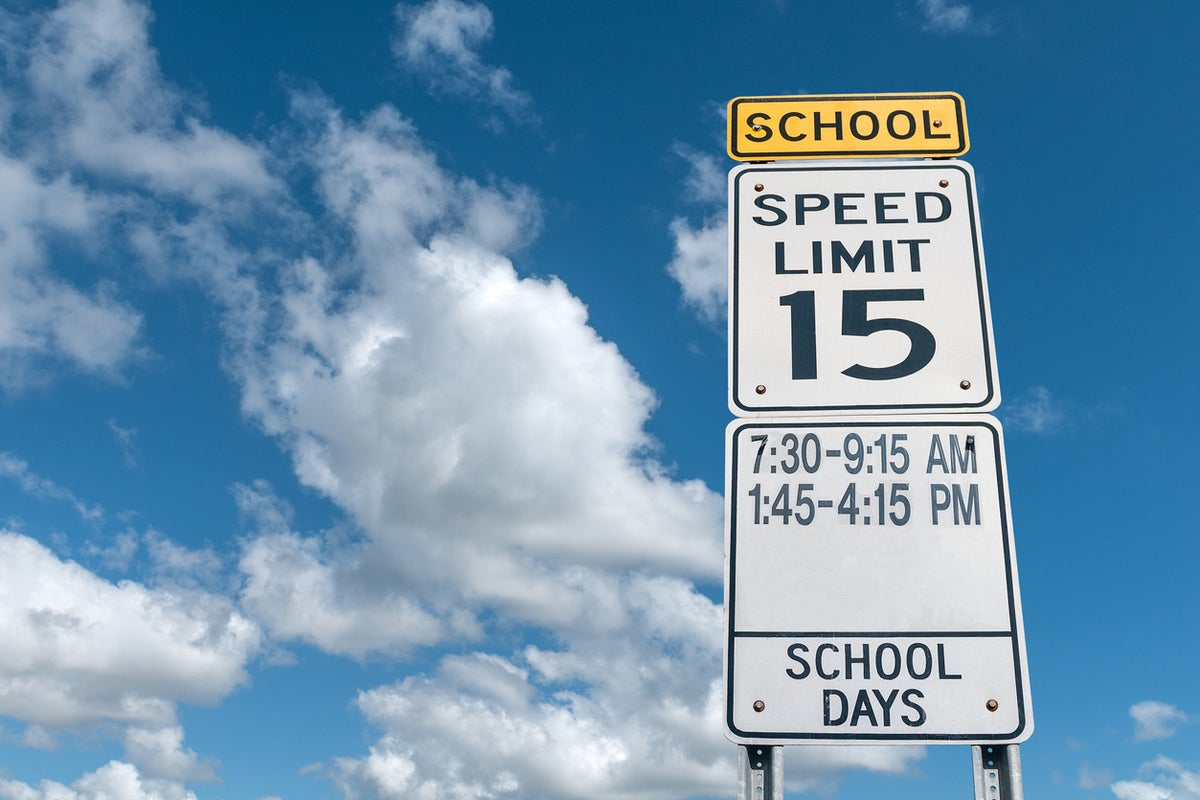
The bell rings at 2:50 PM.
Instantly, the air fills with the chaotic symphony of a school letting out. Heavy double doors slam open. Sneaker soles squeak against polished linoleum. There is the bright, unmistakable sound of high-pitched laughter, the metallic clatter of juice boxes hitting recycling bins, and the collective sigh of hundreds of children shedding the weight of the school day.
They spill onto the sidewalks of a quiet Florida town. They are thinking about video games, or soccer practice, or whether there are any Oreos left in the pantry. They are inherently, beautifully distracted.
Now, look a quarter-mile down the road.
A driver glances down at a glowing smartphone screen. A text message has arrived. It is nothing urgent—perhaps a reminder to pick up milk, or a thumbs-up emoji from a coworker. The driver's foot remains pressed firmly against the gas pedal. The speedometer reads forty-five miles per hour. The sign flashing overhead clearly states twenty.
Two seconds. That is all it takes to glance at a screen. In those two seconds, a two-ton metal machine travels more than one hundred and thirty feet through a designated school zone.
This is not a rare occurrence. It happens thousands of times a week. We know this because a group of citizens decided to stop guessing and start counting. What they uncovered was a numbers game where the stakes are measured in human lives.
The Invisible Threat in the Sunshine
When we think of modern dangers, our minds wander to abstract terrors. We worry about cybersecurity breaches, shifting economies, or global health crises. We rarely worry about asphalt.
Yet the most dangerous place in any municipality is often the stretch of road right outside the local elementary school.
Recently, local community groups equipped themselves with radar guns and data logs to monitor traffic flow during peak drop-off and pick-up hours. They did not expect a flawless display of civic obedience. They did, however, expect a baseline of human decency.
What they found instead was a staggering, relentless parade of negligence.
Over the course of their monitoring period, these citizen groups tracked more than 6,000 vehicles traveling at speeds well above the legal limit inside active school zones. Let that number sit with you. Six thousand times, a driver chose their own schedule over the safety of a child. Six thousand times, the margin for error was shaved down to a razor's edge.
This data has forced the town council into a heated debate over whether to install automated traffic enforcement cameras. To some, the cameras represent a necessary shield. To others, they look like a bureaucratic cash grab, an invasion of privacy, or an admission of failure.
But beneath the political posturing and the arguments over municipal budgets lies a deeper, darker truth about human psychology. We are terrible at calculating risk when we are behind the wheel.
The Psychology of the Windshield
Step inside a modern car, and you enter a sensory deprivation chamber. The seats are plush. The air conditioning hums a gentle, freezing lullaby to combat the humid Florida heat. The suspension absorbs the imperfections of the road, making forty miles per hour feel exactly like fifteen.
Engineers spend billions of dollars ensuring that drivers feel completely disconnected from the outside world.
This isolation breeds a dangerous form of cognitive dissonance. When you are inside the vehicle, the pedestrians outside do not look like people. They look like obstacles. They are obstacles that might slow you down, lengthen your commute, or make you late for a meeting.
Consider a hypothetical driver named Sarah. She is a working mother, inherently exhausted, rushing from a corporate office to a daycare center on the other side of town. She is not a monster. She volunteers on weekends. She loves her kids.
But as Sarah approaches the school zone, her brain is not processing the vulnerability of a seven-year-old child crossing the street. Her brain is processing a countdown clock. She sees the flashing yellow lights of the school zone not as a warning, but as an inconvenience.
"I'll just cruise through," she thinks to herself. "I'm paying attention. It will be fine."
This is the lie we tell ourselves to justify our impatience. We believe our superior driving skills can override the laws of physics. They cannot.
If a car strikes a pedestrian at twenty miles per hour, the survival rate is roughly ninety percent. If that same car is traveling at forty miles per hour, the survival rate plummets to less than twenty percent. A mere twenty miles per hour is the difference between a bruised knee and a funeral.
The 6,000 speeders caught by the citizen groups were not all malicious actors. Most of them were Sarahs. They were ordinary people wrapped in steel, completely blind to the lethality of their own momentum.
The Tech Solution and the Freedom Argument
The town's proposed solution seems straightforward on paper. By placing automated cameras in school zones, the municipality can issue citations directly to the registered owners of speeding vehicles. No high-speed police chases. No human bias. Just a camera, a radar sensor, and a ticket in the mail.
It sounds like a silver bullet. Why, then, is the town hall packed with angry residents whenever the measure is brought to a vote?
The opposition usually organizes around two central arguments: privacy and profit.
"It's Big Brother," one resident argued during a recent public comment session, his voice echoing off the concrete walls of the council chamber. "First it’s school zones. Then it’s every intersection. Where does it stop? The government doesn’t need to track my movements."
Others point to the financial structure of these camera programs. Often, the technology is leased from private, out-of-state corporations that take a significant percentage of every ticket issued. This creates an uncomfortable reality where corporate entities profit off local traffic violations. Critics argue that the cameras are not about safety at all; they are about revenue generation disguised as public virtue.
These are not entirely invalid concerns. Skepticism of government surveillance and corporate encroachment is a healthy part of the American fabric. It is easy to understand the frustration of getting a ninety-dollar ticket in the mail three weeks after you accidentally drifted a few miles per hour over the limit on a Tuesday afternoon.
But this argument collapses when we look at the alternatives.
Traditional traffic enforcement requires police officers to sit in patrol cars, clock speeders, pull them over, and write tickets on the side of the road. This method is inefficient, dangerous for the officers, and entirely dependent on limited police resources. A single officer can pull over perhaps two or three speeders an hour. Meanwhile, dozens of others fly past.
The camera does not blink. It does not take a lunch break. It does not care what color your skin is, what kind of car you drive, or whether you have a PBA sticker on your bumper. It simply enforces the law, uniformly and relentlessly.
What Happens When the Cameras Turn On
The debate in Florida is loud, but it is happening in a vacuum. We do not need to guess whether traffic cameras work. The data already exists in cities and towns across the globe that have taken the plunge.
Consider the behavioral shift that occurs when a driver knows a camera is watching.
The first week the cameras are active, ticket numbers skyrocket. The community reacts with outrage. Local social media pages fill with screenshots of citations and vows to boycott the targeted areas.
Then, something fascinating happens.
Drivers change their routes. Or, more importantly, they change their behavior. They look at the speedometer. They take their foot off the gas.
In communities that have implemented automated school zone enforcement, average traffic speeds drop significantly within the first six months. The number of repeat offenders is incredibly low—usually less than ten percent. Once a driver receives that first financial penalty in the mail, the lesson sticks. The brain redraws its internal map, marking that school zone not as an inconvenience, but as a zone of financial consequence.
The cameras do not just punish speeding; they eradicate it through behavioral modification. They rewrite the driver's risk-reward calculation. Suddenly, saving two minutes on a commute is no longer worth the guaranteed ninety-dollar penalty.
The Cost We Refuse to Face
We love to argue about numbers, technology, and civil liberties because it allows us to avoid the actual topic of conversation. It keeps us from looking at the human wreckage that occurs when the system fails.
If you want to understand the true weight of the 6,000 speeders in that Florida town, you have to talk to someone like Marcus.
Marcus does not care about the town budget. He does not care about private camera vendors or constitutional law. He is a man who keeps a bedroom in his house exactly the same as it was on an autumn morning three years ago. The twin bed is still neatly made with a blue comforter. A half-finished LEGO spaceship sits on the desk.
Marcus’s eight-year-old son, Leo, was one of the statistics. He was walking home from school, crossing at a designated crosswalk with the walk signal illuminated. A driver, running late for a hair appointment, did not see the flashing yellow lights of the school zone.
The driver was traveling thirty-eight miles per hour.
Marcus describes the sound of the phone call from the hospital as a dividing line in his existence. There is the life he had before that call, and the empty shell of a life he has inhabited ever since.
"We treat driving like it’s a right, like it’s a game," Marcus says, his voice flat, drained of all anger, leaving only an infinite exhaustion. "We argue about sixty dollars or ninety dollars. We argue about privacy. But nobody ever asks what it costs to bury a child. Nobody asks about the price of an empty chair at the Thanksgiving table."
When we frame the traffic camera debate around driver convenience or municipal revenue, we are insulting the memory of every Leo, and we are gambling with the lives of every child currently walking home from school.
Redefining the Community Compact
The real problem lies elsewhere. It is not a technological issue, nor is it a legal one. It is a cultural failure.
We have built a society that prioritizes speed over connection, convenience over safety, and individual autonomy over collective responsibility. We view traffic laws not as a sacred pact to protect one another, but as a set of loose suggestions that apply only when it is convenient.
The town council in Florida will eventually make its decision. They will either vote to install the cameras and endure the political backlash, or they will table the measure and hope that visibility alone will change driver behavior.
But a camera is just a tool. It is a digital band-aid on a spiritual wound.
True safety will not arrive because of a lens mounted on a metal pole. It will arrive when we, as a community, look at a school zone sign and see something more than a yellow light. It will arrive when we understand that the children on that sidewalk are not obstacles in our way, but the very future we are driving toward.
Until that shift happens, the cameras are our only mirror. They reflect back to us an uncomfortable truth about who we are when we think no one is watching. They show us that without a digital conscience hanging over the roadway, thousands of us will continue to choose two saved minutes over a child's life.
The bell will ring again tomorrow at 2:50 PM. The doors will open. The children will spill out into the warm afternoon air, laughing, shouting, and completely unaware of the 6,000 vectors of steel rushing toward them. They are trusting us to keep the street safe. We have to decide, block by block, if that trust is worth the price of slowing down.