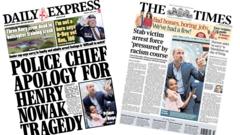
The ink on a morning newspaper is cold, but the choices that put it there are boiling.
Every night, while the cities they cover sleep, editors sit in brightly lit rooms deciding whose lives to alter. A headline is a weapon. It can defend the public interest, or it can crush a reputation before the accused even has a chance to tie their shoes. In the UK, the front pages of the morning papers tell a story far deeper than the words printed on them. They reveal a shifting cultural baseline of accountability, power, and the sudden, terrifying vulnerability of those who used to be untouchable.
Consider the weight of an official apology. It is never given freely. It is extracted, piece by piece, under the blinding glare of public scrutiny.
The Cracks in the Shield
For decades, the top echelons of law enforcement operated behind a wall of institutional certainty. The assumption was simple: the uniform carries the moral high ground. But when a "top cop" is forced to step before the microphones and say the words I am sorry, the institutional armor shatters.
This isn't just about a single administrative failure or a bureaucratic misstep. It is about the human cost of misplaced trust. When a community looks to its protectors and sees instead a reflection of negligence, the damage isn't just statistical. It is felt in the gut of every citizen who hesitates before calling for help.
Imagine a young constable patrolling a quiet street at 3:00 AM. They are carrying the weight of their superior's disgrace. Every glance from a passing driver feels suspicious. Every interaction is loaded with newfound cynicism. The institutional failure trickles down, poisoning the daily reality of the frontline worker who had nothing to do with the decisions made in the carpeted offices of leadership.
The apology itself is a performance. We watch the micro-expressions—the tight jaw, the downward glance, the careful avoidance of pronouns that might imply personal liability. The public reads between these lines. They know that an apology at this level is rarely born of sudden moral clarity. It is the final chess move when every other avenue of denial has been blocked.
The Quiet Kingdoms of the High Street
While the institutions of justice crumble and rebuild themselves in the headlines, another kind of power plays out in the commercial heart of the country. They call him the "Prince of Pubs."
It sounds romantic. It evokes images of warm hearths, frothing pints, and the timeless camaraderie of the British local. But behind the moniker lies a story of aggressive consolidation, immense financial stakes, and the quiet death of the independent publican.
The pub is not just a business. It is a social anchor. In hundreds of towns, it is the only place left where people can gather without an appointment or an algorithmic recommendation. When a single entity or a charismatic tycoon begins swallowing up these spaces, the DNA of the neighborhood changes.
The old landlord who knew your name and let you slide when you were a few pence short is replaced by a manager answering to a spreadsheet in a corporate headquarters hundreds of miles away. The beers become standardized. The prices edge upward. The quirky, tobacco-stained history of the building is scrubbed clean in favor of industrial-chic lighting and predictable menus.
The "Prince" builds an empire, but the subjects lose their sanctuary.
This tension between corporate scaling and human community is the defining conflict of our era. We want efficiency, but we crave belonging. We celebrate the tycoon's ambition while mourning the loss of the eccentric local character who used to run the place. The papers profile the wealth, the strategy, the bold market moves. They rarely profile the lonely regular who now stays home because the pub feels like a hotel lobby.
The Intersecting Lines of Power
At first glance, the disgraced police chief and the ambitious property mogul have nothing in common. One deals in public safety; the other deals in hospitality and real estate. But look closer. Both narratives are driven by the same fundamental force: the accumulation and consequence of unchecked influence.
Power behaves the same way whether it wears a badge or a tailored suit. It seeks to expand. It seeks to protect itself. And inevitably, it forgets the people it was originally meant to serve.
The reader picking up the paper at a railway station or scanning the headlines on a phone feels this intuitively. There is a collective exhaustion with the narrative of the untouchable elite. Whether it is a public official failing to uphold the law or a private billionaire rewriting the social fabric of a town, the underlying grievance is identical. People want to know that someone is looking out for the ordinary citizen.
The View from the Newsroom
Behind every one of these front pages is a team of journalists chasing leaks, verifying sources, and arguing over single words in a headline. The pressure is immense. A defamation lawsuit can kill a publication; a missed scoop can kill a career.
The newsroom is a pressure cooker where private tragedies are converted into public commodities. The reporter who broke the story about the police apology didn't do it by sitting at a desk. They did it by building relationships with whistleblowers who risked everything to expose the truth. Those sources are human beings, too. They lie awake at night wondering if the document they leaked will trace back to them, ending their careers and upending their families.
The stakes are invisible until they aren't.
We consume the news as a finished product, crisp and organized. We forget the chaos of its creation. We forget that the "Prince of Pubs" has a PR army working around the clock to kill negative stories, to reframe aggressive buyouts as community investments, and to ensure that the tycoon's legacy remains untarnished. The headline we see is the result of a violent collision between the desire to expose and the desperate need to conceal.
The Real Cost of Looking Away
When we read these stories, it is easy to become cynical. We see a cycle of scandal, apology, and corporate expansion that seems entirely detached from our daily lives. But this cynicism is a luxury we cannot afford.
The health of a society can be measured by how it reacts to its headlines. If a top cop's apology is met with a shrug, then the standard of accountability drops a little lower. If the corporate takeover of our social spaces is accepted as inevitable progress, then the quality of our community life degrades a little further.
The stories matter because they are mirrors. They show us exactly what we are willing to tolerate.
The morning paper will be lining the bottom of a birdcage by tomorrow. The digital articles will scroll off the screen, replaced by the next breaking emergency, the next celebrity gaffe, the next market fluctuation. But the decisions described in those transient pages leave permanent scars on the communities we inhabit.
The pub down the street changes hands. The police station down the road operates under a cloud of unspoken distrust. The world moves on, but it moves on a slightly different trajectory than it did the day before.
A man stands outside a brick building, watching the sign change. The old name, painted by hand thirty years ago, is being scraped away by a contractor in a high-visibility vest. A new corporate logo, sleek and devoid of personality, is hoisted into its place. Inside, the taps are being swapped out for corporate contracts.
A few miles away, an officer stares out a rain-streaked window, wondering if the public will ever look at the uniform the same way again.
The headlines have been written, printed, and read. The protagonists of the day's news go back to their private realities, leaving the rest of us to navigate the altered world they left behind.