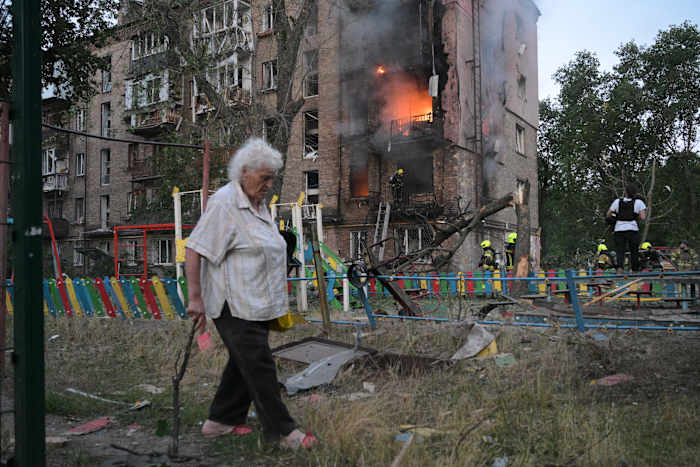
The strategic efficacy of a modern integrated air defense system is fundamentally governed by an economic and kinetic mismatch: the cost of interception routinely exceeds the cost of iteration. When Russian forces launched a large-scale strike against Kyiv on July 2, 2026, killing at least 11 civilians and wounding 54 others, the operational outcome underscored an ongoing structural bottleneck within urban defense. Rather than reflecting a total breakdown of local defense grids, the penetration of 20 residential structures and 30 distinct urban nodes highlights how saturation tactics systematically exploit the mathematical limits of surface-to-air missile stockpiles.
To understand why sophisticated defensive layers sustain structural leakage during high-density attacks, the engagement must be deconstructed through the mechanics of saturation, vector diversification, and interceptor depletion metrics.
The Tri-Vector Saturation Framework
Modern aerospace filtration relies on a multi-tiered array of sensors and launch platforms. Offensive strategies bypass these layers not by bypassing detection, but by overwhelming the computational and kinetic bandwidth of the engagement radar. The July 2 strike utilized a coordinated deployment matrix consisting of three distinct operational layers:
- Low-Velocity Loitering Munitions (Shahed-class variants): These systems possess a low radar cross-section and minimal thermal signature, serving primarily as kinetic decoys designed to force the activation of target-acquisition radars.
- Subsonic Cruise Missiles: Programmed with low-altitude, terrain-following flight paths, these vectors force defensive systems to compress their reaction windows due to horizon-masking constraints.
- High-Velocity Ballistic Missiles: Characterized by steep terminal descent angles and rapid velocities, these munitions present an extreme challenge to localized point-defense interceptors, requiring precise terminal guidance solutions.
By synchronizing the arrival times of these three distinct asset classes at the target zone, the offensive vector forces the integrated air defense grid into a severe resource allocation dilemma. Low-cost loitering munitions occupy tracking channels and exhaust ready-to-fire interceptors, creating immediate windows of vulnerability that high-yield ballistic and cruise variants exploit to strike civilian infrastructure.
The Interception Depletion Rate and Elasticity of Supply
A critical structural vulnerability within any dense urban defense grid is the finite capacity of its launch rails. Every active surface-to-air missile battery possesses a rigid quantitative ceiling on the number of targets it can track and engage simultaneously before entering a prolonged reloading cycle.
When an offensive strike scales its volume of fire past this engagement threshold, the interception rate degrades mathematically rather than mechanically. Debris distribution introduces an additional layer of complexity. The destruction of an incoming ballistic or cruise missile at a low altitude does not nullify its kinetic energy or residual payload. The resulting debris field retains significant mass and velocity, descending along a ballistic trajectory that inflicts severe structural damage on high-density residential zones.
The political demand for enhanced defensive capabilities—articulated by Foreign Minister Andrii Sybiha following the strike—faces deep supply chain friction. Western manufacturing pipelines for high-tier interceptors, such as those used in Patriot and NASAMS architectures, operate on long lead times. Production elasticity cannot adjust dynamically to a sudden increase in consumption rates on the battlefield. Consequently, an intensified rate of bombardment induces a net-negative consumption model, where the defender expends finite, high-cost stockpiles at a rate that outpaces domestic and allied replenishment schedules.
Strategic Geopolitical Trade-Offs and Long-Range Drone Parity
The escalation of strikes targeting the Ukrainian capital occurs alongside a parallel long-range drone campaign executed by Ukraine against military infrastructure and energy facilities inside the Russian Federation. This operational interaction establishes a clear tit-for-tat dynamic in theater-level logistics, though the strategic rationale diverges significantly between both actors.
- Target Selection: The Ukrainian campaign focuses primarily on refined petroleum networks, strategic storage depots, and military staging areas to induce localized fuel shortages and degrade forward logistics. Conversely, Russian strike patterns on Kyiv heavily impact civilian administration centers, residential areas, and critical urban nodes.
- Legal and Diplomatic Frameworks: This symmetric application of deep-strike capabilities introduces sharp legal friction. Ukrainian officials cite Article 51 of the United Nations Charter to validate their deep-strike operations as a legitimate exercise of the inherent right to self-defense. Moscow routinely attempts to frame its urban bombardments as retaliatory measures, a position rejected by international observers who note the disproportionate impact on non-military infrastructure.
- Resource Realignment: Forcing a state to defend every major population center creates a severe geographical distribution problem. The defender must pull advanced air defense assets away from active front-line positions to protect urban administrative hubs, directly weakening tactical cover for maneuvering ground forces.
Operational Recommendations for Urban Grid Survivability
To mitigate systemic attrition within dense urban air defense environments, allied strategic support must pivot toward a dual-track optimization model.
First, defense architectures must prioritize the deployment of low-cost, high-capacity kinetic solutions specifically designed to counter low-velocity loitering munitions. Expanding the density of mobile air defense units equipped with automated, radar-guided anti-aircraft guns or short-range laser-guided rockets prevents the exhaustion of premium anti-ballistic interceptors on low-value targets. This preservation strategy ensures that high-tier interceptor inventories remain reserved exclusively for terminal ballistic threats.
Second, international procurement must shift from a reactive supply model to a forward-deployed, continuous production framework. Establishing localized co-production facilities for critical components and securing multi-year raw material contracts is the only viable method to align the interceptor supply curve with the current rate of consumption. Without resolving this core imbalance in the cost-per-interception function, urban centers will remain vulnerable to defensive saturation during prolonged bombardment campaigns.