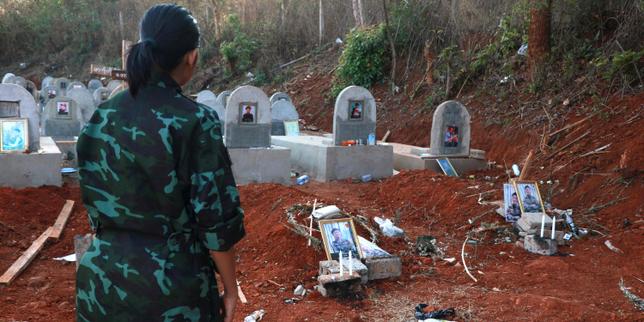
The sound of rain in Rakhine State does not wash things clean. It thickens the air, turns the red earth into a heavy paste that clings to your boots, and muffles the acoustic signature of incoming mortar fire. When you live in a conflict zone, your ears adapt before your mind does. You learn to differentiate between the dull thud of a distant artillery launch and the sharp, metallic crack of an approaching shell. You learn that a sudden silence from the birds in the canopy is a definitive signal to run.
For five years, Myanmar has been tearing itself apart in the dark.
To the outside world, the crisis is often reduced to a flickering series of headlines, quickly swallowed by newer, louder global catastrophes. It is a data point. Specifically, it is the number 100,000. That is the baseline estimate of the human toll since the military junta seized power in February 2021, according to meticulous data compiled by independent monitoring groups and non-governmental organizations.
But numbers possess a strange, numbing quality. They turn agony into algebra. When a statistic grows too large, it loses its teeth. To understand what is actually happening across the valleys of the dry zone and the hills of the borderlands, you have to stop looking at the ledger and start looking at the ink.
The Geography of the Disappeared
Consider a hypothetical village named Lin Zin. It is not on most tourist maps, but it represents hundreds of communities scattered across the Sagaing region. Before the coup, life here followed the rhythm of the harvest. Today, it follows the rhythm of the drones.
When the military column approaches, there is no formal warning. The strategy, known historically as the "Four Cuts," is designed to starve opposition forces of food, funding, intelligence, and recruits. In practice, it means burning the village to the ground. It means that an elderly woman who cannot walk fast enough is left behind in a bamboo hut that takes exactly seven minutes to turn to ash.
When we talk about 100,000 deaths, we are not just talking about soldiers on a battlefield. We are talking about the deliberate dismantling of the fabric of life.
The conflict has mutated. What began as a localized resistance by ousted politicians and civilian volunteers has transformed into a multi-front civil war. The military, facing unprecedented territorial losses to an alliance of ethnic armed organizations and People's Defence Forces, has relied increasingly on scorched-earth tactics. Air strikes have risen exponentially. Heavy artillery is deployed against civilian infrastructure. Schools and hospitals are not collateral damage; they are targets.
The data is terrifying because of its consistency. Month after month, the graph moves upward in a jagged, uncompromising line. But behind every digit in that 100,000 total is a specific room, a half-eaten meal, a pair of shoes left by the doorway.
The Invisible Ledger
How do you count the dead in a country where the internet is routinely severed and a smartphone can be a death warrant?
The process is an act of quiet heroism. It relies on networks of local volunteers, medical workers, and citizen journalists who risk everything to verify a single casualty. They use encrypted applications to transmit photographs of shrapnel, civilian ID cards, and fresh gravesites. They cross-reference reports from multiple witnesses before a single entry is added to the database.
It is a terrifyingly imperfect science.
The true number is almost certainly higher. How do you account for the diabetic grandfather who died because the military blockaded the road to the pharmacy? How do you count the infant who succumbed to preventable malaria while her family hid in the deep jungle, fleeing a helicopter strafing run? They do not always make it into the formal documentation. They are the ghost statistics of Myanmar.
The conflict has spread like an infection. Areas that were peaceful for decades are now active front lines. The Arakan Army clashes with the military in the west; Karenni forces push through the towns of the east; Kachin fighters seize outposts in the far north. The junta is losing ground, and as an army loses ground, its violence becomes less precise, more desperate.
The response from the international community has been a masterclass in collective impotence. Statements of "grave concern" are issued from clean, well-lit rooms in New York and Geneva. Sanctions are leveled, yet aviation fuel and weapons components still find a way through the porous borders. The regional bloc, ASEAN, remains paralyzed by its own doctrine of non-interference.
Meanwhile, the bodies accumulate.
The Geometry of Survival
To live through this is to understand a different relationship with time. You do not plan for next year. You plan for the next ten minutes.
In the makeshift camps for internally displaced persons that dot the borders with Thailand and India, survival is a matter of geometry. You dig a trench deep enough to shield your children from shrapnel, but angled in a way that prevents it from collapsing if a bomb lands nearby. You learn to cook only at dawn or late at night, because smoke during the day invites an airstrip target lock.
The psychological toll is a quiet, heavy weight that will outlive the war itself. An entire generation of children is growing up without formal education, intimacy with peace, or a sense of predictability. Their vocabulary is filled with the names of weapons systems rather than folk tales.
This is the real cost of the 100,000. It is the theft of the future.
The world looks away because the conflict is complicated, messy, and lacks a simple, cinematic resolution. There is no single frontline, no clear foreign intervention to cheer or condemn. It is a mosaic of small, brutal wars happening simultaneously across a landscape of incredible beauty.
But complexity is a poor excuse for apathy.
The people of Myanmar are not asking for foreign armies to save them. They have learned, through bitter experience, that no one is coming. They are asking simply that their deaths stop being invisible. They are asking that the world acknowledge the sheer scale of the sacrifice being made for the simple right to self-determination.
Late in the evening, after the monsoon rain eases, the air in the border camps turns cold. A young man sits by a small fire, cleaning a camera lens. He is nineteen. He used to study computer science in Yangon. Now, his job is to document the aftermath of the airstrikes. He shows a digital photograph of a crater where a clinic used to stand.
When asked how he copes with seeing such things every day, he does not speak of geopolitics, or strategy, or the shifting lines of control on a map. He looks down at his hands, rough and calloused from months in the forest.
Every time I write down a name, he says softly, I am keeping them from being forgotten. The junta wants them to disappear. My job is to make sure they stay.
The fire crackles, throwing long, trembling shadows against the canvas wall of the tent. Outside, the darkness of the jungle is absolute, and somewhere in the distance, the heavy, rhythmic thud of artillery begins again.