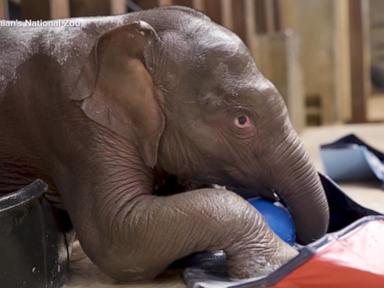
The birth of a Loxodonta africana—the African elephant—serves as a high-stakes injection of biological capital into an ecosystem defined by extreme scarcity and complex social hierarchies. While conventional media frames such events through the lens of sentimentality, a rigorous analysis identifies these births as critical data points in a long-term viability model. The arrival of a calf on Earth Day provides a quantitative anchor to discuss the stressors of recruitment, the metabolic costs of gestation, and the integration of advanced monitoring technologies in modern zoological management.
The Energetic Investment Framework
The production of a single elephant calf represents one of the most intensive biological resource allocations in the animal kingdom. To understand the scale of this investment, we must look at the physiological constraints governing the species.
- Gestation Duration and Metabolic Load: Elephant pregnancies last approximately 22 months, the longest of any land mammal. This duration is not arbitrary; it is the time required for the development of a brain capable of complex social navigation and sensory processing. The mother must maintain a caloric surplus to support fetal growth while managing her own thermoregulation in fluctuating environments.
- The 100-Kilogram Baseline: A healthy neonate typically enters the world at a mass exceeding 100 kilograms. This initial scale is a survival mechanism designed to provide physical resilience against opportunistic predators and to ensure the calf can keep pace with a mobile herd within hours of birth.
- Lactation Efficiency: Post-birth, the energy transfer shifts from the placenta to mammary glands. An elephant calf consumes roughly 10 liters of milk per day. The chemical composition of this milk—high in fat and protein—is a direct conversion of the mother’s dietary intake into rapid skeletal and muscular development.
The failure of any single component in this energetic chain results in recruitment failure, which, given the low frequency of elephant births (one every 4 to 5 years per female), represents a significant setback for the population's genetic diversity.
Social Integration and the Matriarchal Feedback Loop
An elephant calf does not exist as an isolated unit; it is a node within a decentralized yet highly coordinated social network. The survival of the calf depends on the quality of the "Matriarchal Feedback Loop," a system of shared knowledge and protection.
Allomothering as Risk Mitigation
In elephant societies, young females—allomothers—assist in the care of the neonate. This behavior serves two distinct strategic functions. First, it reduces the physical burden on the biological mother, allowing her to prioritize foraging and recovery. Second, it serves as a training ground for the allomothers, ensuring that the next generation of breeders possesses the necessary behavioral heuristics to successfully rear their own offspring.
Cognitive Mapping and Resource Acquisition
The matriarch holds the "spatial database" of the herd. Her ability to navigate to water and food sources during periods of drought determines the calf’s survival. The introduction of a new calf forces the herd to recalibrate its movement patterns. The herd’s speed is dictated by the calf’s physical limits, creating a temporary bottleneck in resource acquisition efficiency. This trade-off—lower mobility for future population growth—is a fundamental tension in megafauna ecology.
The Role of Precision Monitoring in Modern Conservation
The debut of a calf in a managed environment allows for the deployment of monitoring technologies that provide insights impossible to gain in the wild. These facilities act as laboratories for understanding the species' requirements.
Biosensor Integration
Managed herds are increasingly monitored via non-invasive biosensors. These devices track heart rate variability, core temperature, and movement acoustics. By analyzing the "acoustic signature" of a calf's vocalizations, researchers can map the development of social communication. These data points are then used to calibrate thermal imaging drones used in wild population counts, allowing conservationists to more accurately estimate the age and health of calves from the air.
Genetic Diversity and the Studbook System
In managed settings, births are often the result of complex genetic matching algorithms. The goal is to maximize the Effective Population Size ($N_e$).
The formula for $N_e$ in a simplified model is:
$$N_e = \frac{4N_m N_f}{N_m + N_f}$$
Where $N_m$ is the number of breeding males and $N_f$ is the number of breeding females. By managing these ratios and ensuring that the new calf represents an under-represented genetic lineage, conservationists hedge against the risks of inbreeding depression, which can manifest as reduced immune function or physical deformities.
Environmental Stressors and the Earth Day Paradox
While Earth Day serves as a symbolic backdrop for a debut, the actual environmental conditions facing elephants are deteriorating. The "Earth Day Paradox" lies in the fact that while we celebrate a single birth, the global habitat for the species is shrinking at an accelerating rate.
- Habitat Fragmentation: The primary threat to the calf’s future is not poaching alone, but the loss of migratory corridors. When herds are confined to "islands" of protected land, the local vegetation is often over-exploited, leading to a collapse of the local carrying capacity.
- Climate-Induced Desynchronization: Shifts in rainfall patterns can lead to a mismatch between the birth of calves and the peak availability of high-protein grasses. If a calf is born during a prolonged dry spell, the mother’s milk production may drop, leading to stunted growth or mortality.
Operational Logistics of a Public Debut
The transition of a calf from a secluded birthing area to a public-facing environment is a calculated operational move. It involves several stages of risk management.
- Imprinting and Bonding Phase: The first 48 to 72 hours are dedicated to ensuring the calf has successfully latched and that the mother has accepted the offspring. Interference during this period is minimized to prevent stress-induced rejection.
- Sensory Desensitization: Before public exposure, the calf is gradually introduced to the sights and sounds of the larger facility. This prevents the "startle reflex," which could lead to injury in a high-mass animal.
- Visual Documentation for Public Engagement: The use of high-definition video and live streams serves a pragmatic purpose. It generates the "charismatic megafauna" effect, which is the primary driver for conservation funding. This funding is the fuel for less visible but equally vital work, such as protecting the invertebrates and flora that form the base of the African ecosystem.
Strategic Forecast
The long-term viability of the African elephant depends on transitioning from reactive protection to proactive landscape management. The data gathered from the development of this new calf must be integrated into broader ecological models.
The immediate strategic priority is the expansion of trans-boundary protected areas. Isolated populations are evolutionary dead ends. To ensure that the calf born today contributes to the species' survival, the focus must shift toward "Total Ecosystem Architecture"—the engineering of corridors that allow for the natural flow of genes and energy across the continent. Conservation groups should prioritize the acquisition of "buffer zones" between human settlements and elephant habitats, using seismic sensor arrays to provide early warnings of human-elephant conflict. This technological "fence" replaces physical barriers, allowing for a more fluid and resilient landscape.