Dust.
That was the primary currency of Memphis in the summer of 1936. It clung to the collars of men standing in breadlines, settled into the cracked leather boots of farmers who had lost everything to the dirt, and coated the political promises of a nation choking on the Great Depression. Yet, right in the middle of this financial ruin, a city decided to build a whisper.
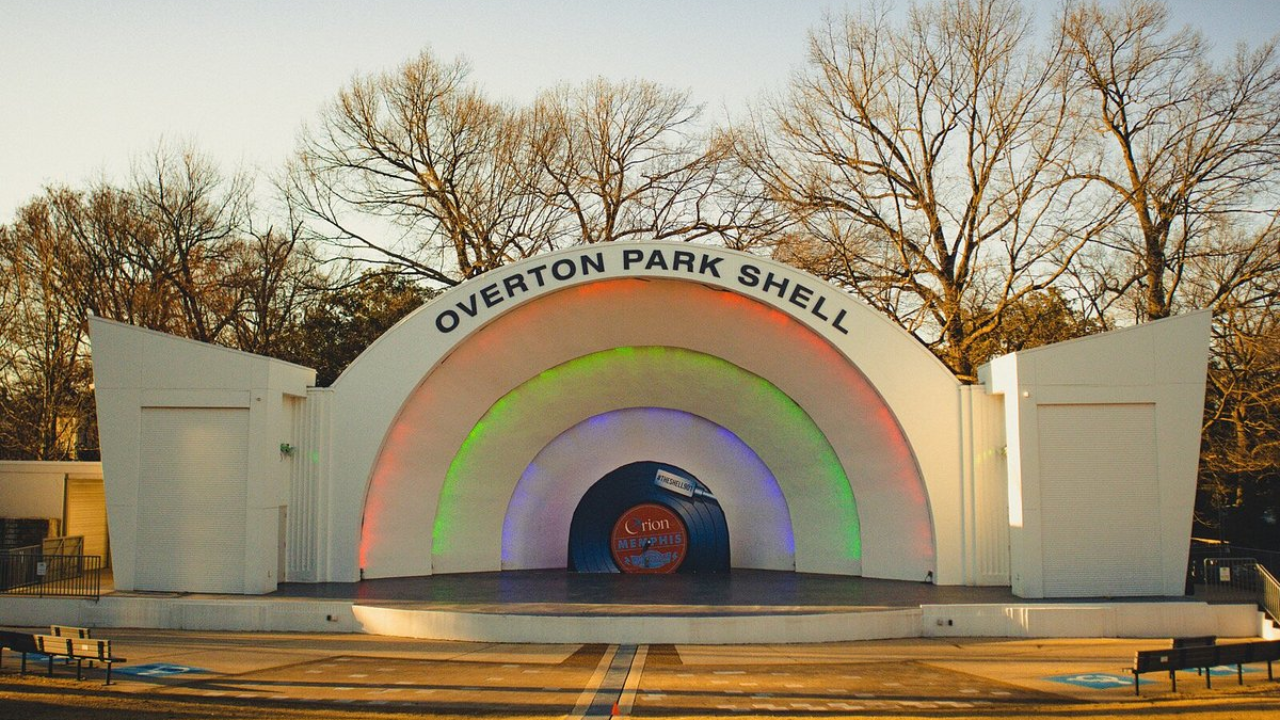
They called it the Overton Park Shell.
To read the municipal ledger books of that era is to look at a statistical impossibility. Fourteen thousand dollars. That was the total price tag for a curved monolith of concrete and rebar designed to catch the wind and throw human voices across a grassy bowl. Consider what fourteen thousand dollars bought you then, and what it buys you now. A modern suburban park pavilion costs exponentially more for a fraction of the architectural ambition. But in 1936, backed by federal relief funds and local sweat, those fourteen thousand dollars bought an acoustic sanctuary. Architect Max Furbringer did not just pour concrete. He sculpted an acoustic ear. The parabolic curve of the structure meant that a singer standing at its exact focal point could be heard clearly by thousands sitting on the slope without the aid of copper wires, vacuum tubes, or electronic amplification.
Imagine Arthur.
Note: Arthur is a hypothetical character introduced to ground the historical architecture in human reality.
Arthur was a city laborer whose calloused hands helped smooth the wet cement of the shell in the stifling Tennessee heat. He wiped grease and grit from his forehead, squinting against the blinding glare of the southern sun, wondering if anyone would ever care about a fancy bandstand in the middle of a park while people were starving three miles away in downtown alleys. Arthur did not know about rock and roll. He did not know about radio towers or vinyl records spinning at forty-five revolutions per minute. He just knew his back ached, the concrete was setting fast, and the city fathers wanted a place where local orchestras could play Sousa marches on sticky July evenings.
History has a strange sense of humor about what it chooses to preserve.
For eighteen years, the Overton Park Shell played its designated role. It was a respectable, polite venue. Civic groups gathered there. Choirs sang hymns of quiet comfort. Ballet dancers balanced precariously on temporary wooden floors while crickets provided the percussion. It was an orderly world, stitched together by civic pride and the slow, heavy rhythm of mid-century southern life.
Then came 1954.
The air in Memphis that summer was thick enough to chew. Outside the recording studios on Union Avenue, a nineteen-year-old kid who drove a delivery truck for Crown Electric was figuring out how to combine the raw, weeping sorrow of the blues with the manic, jumping joy of hillbilly music. His name was Elvis Presley. He wore loose pink pants and a black shirt with a collar wide enough to catch a breeze, and his knees were shaking so hard they threatened to knock his boots together.
On the night of July 30, 1954, the Overton Park Shell hosted a bill headlined by Slim Whitman, a polished country star known for his immaculate yodel and pristine white suit. Presley was third on the bill. He was an opening act, a local curiosity, an awkward boy with grease in his hair and an acoustic guitar slung low across his hips.
When his name was called, the step from the wings onto the stage of the Overton Park Shell was a crossing over an invisible threshold.
Arthur, our hypothetical laborer, might have been older by then, sitting in the back with a paper cup of lemonade, watching the crowd shift. Something strange happened when that teenager stepped up to the microphone. The polite applause faltered. Presley did not just sing; he moved. He shook his leg—a nervous tic born of sheer terror that the teenage girls in the front rows misread as a declaration of war against convention. The sound that came out of him was sharp, electric, and entirely unhinged from the polite traditions of the previous two decades.
The crowd gasped. Some older patrons crossed their arms in quiet disapproval. But the young people, the ones who had grown up on radio static and secret nocturnal broadcasts, stood up.
That single night at the Overton Park Shell became the ignition point. It was the exact moment when the polite, acoustic engineering of 1936 collided with the atomic energy of youth culture. The concrete curve designed for a quiet soprano suddenly found itself echoing with the frantic rhythm of "That's All Right," a song that had just hit the local airwaves a few weeks prior.
We often think of cultural revolutions as sweeping, abstract tides that alter society from the top down. We talk about decades and movements and demographic shifts as if they happen in boardrooms. But history is actually built in places like this. It is built in municipal bandstands funded by desperate relief programs. It is built when an architectural design meant for classical restraint accidentally captures the thunder of a new era.
The Overton Park Shell did not change because its stones were replaced. The physical footprint remained identical to the day Arthur smoothed the final trowel mark across the floor. The magic was in the acoustic trap. The curved wall that was meant to amplify a trumpet found itself amplifying a cultural tremor that would soon shake the entire globe.
Decades later, the shell would face its own trials. There were threats of demolition, years of quiet neglect, and bitter legal battles over the parkland surrounding it. People forgot, as people often do, what happened in the dark shadows of that concrete archway on a hot southern night. They saw only an old, weathered structure sitting quietly behind the trees, waiting for someone to remember its name.
Yet, the shell survived. It stands today not just as a relic of New Deal architecture, but as a silent witness to the exact second the twentieth century found its voice.
Next time you walk past a forgotten piece of civic concrete, do not look at it as dead stone. Look closer. Underneath the moss and the weathering lies the latent potential of human expression, waiting for the right vibration to shatter the silence.
The stage was built for fourteen thousand dollars. The currency that detonated it was priceless.