The air in Kansas City carries a specific weight. It is the scent of woodsmoke from the pits, the humid breath of the Missouri River, and the low, constant hum of a city that has spent a century trying to decide if it is a small town or a metropolis. For decades, the Kansas City Royals have lived on the edge of that identity, tucked away at the Truman Sports Complex, separated from the city's pulse by a sea of asphalt and an interstate moat.
Now, the moat is being bridged.
The numbers are staggering, the kind of figures that feel like Monopoly money until you realize they represent the physical reshaping of a skyline. We are talking about $1.9 billion for a ballpark and a total $3 billion investment to stitch a new heart into the downtown landscape. But behind the decimal points and the architectural renderings lies a fundamental gamble on the soul of a city.
The Ghost of the Parking Lot
To understand why a team would walk away from the iconic fountains of Kauffman Stadium, you have to stand in the current parking lot after a Tuesday night game in July. It is quiet. Too quiet. When the final out is recorded, twenty thousand people climb into their SUVs and vanish. They don't linger. There is nowhere to go. The economic energy of a professional sports franchise simply evaporates into the night air, leaving behind nothing but empty beer cans and tire tracks.
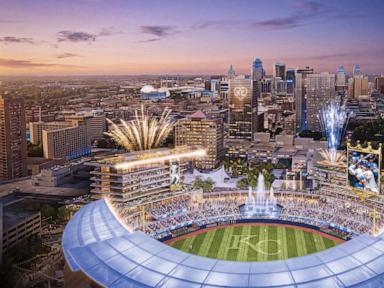
Contrast this with a hypothetical Tuesday in 2028. Let’s call our witness Elias. Elias is a junior accountant who works in a glass tower near Crown Center. Under the new plan, he doesn’t have to check his watch to beat the stadium traffic. He walks three blocks. He grabs a taco from a vendor whose rent is paid by the foot traffic of eighty home games a year. He meets friends at a rooftop bar that overlooks the diamond, where the roar of the crowd isn't a distant echo, but the literal soundtrack of the neighborhood.
This is the "ballpark village" concept stripped of its corporate gloss. It is about density. It is about making a city feel like a living, breathing organism rather than a collection of disconnected islands.
The Crown Center Pivot
The decision to anchor this massive redevelopment at Crown Center—a site already steeped in the legacy of Hallmark and the late Joyce Hall—is a calculated move to leverage existing gravity. By placing the $1.9 billion stadium here, the Royals aren't just building a playground; they are participating in a $3 billion surgical graft.
The project aims to connect the disparate pieces of Kansas City’s core. To the north, the Power & Light District; to the south, the historic Union Station and the National WWI Museum and Memorial. For years, these landmarks have been like stars in a constellation that hasn't quite formed a recognizable shape. The new ballpark is intended to be the North Star.
But the stakes are invisible and high. Critics rightfully point to the ghosts of stadiums past. They worry about displacement, about the rising cost of a hot dog for a family of four from Wyandotte County, and about whether the promised "economic engine" will actually provide fuel for everyone or just the people in the luxury suites.
Building the Cathedral
The architecture of a $1.9 billion stadium isn't just about steel and glass. It is about sightlines. It is about how the sun hits the grass at 7:05 PM. The new design moves away from the sprawling, brutalist footprints of the 1970s and toward something more intimate, more porous.
Imagine the materials: local limestone, sleek metal finishes, and greenery that echoes the city’s park system. The goal is to create a space that feels like it has always been there, even as it looks like the future. This isn't just a place to watch a game. It is a civic plaza that functions 365 days a year.
Consider the logistics of the $3 billion total investment. It includes residential units, retail spaces, and office buildings. The Royals are essentially becoming real estate developers who happen to play baseball. This is the modern sports business model. The game on the field is the loss leader; the lifestyle around the field is the product.
It is a jarring shift for fans who grew up with the simplicity of "The K." There is a legitimate grief in leaving behind the stadium where George Brett tripled and Salvador Perez solidified his legend. You cannot buy history, and you certainly cannot move it with a crane.
The Invisible Infrastructure
Beneath the turf of the new stadium will lie miles of fiber optic cables and advanced water management systems, but the most important infrastructure is human. A project of this scale requires a social contract.
The Royals have leaned heavily on the promise of jobs—thousands of construction roles and permanent service positions. They speak of community benefits agreements and keeping the team accessible to the blue-collar fans who are the team's bedrock. But skepticism is a Kansas City tradition. People remember the promises made during the renovation of the Truman Sports Complex. They want to see the receipts.
The reality of urban redevelopment is often messy. It involves eminent domain, tax incentives that draw fire from school districts, and years of orange barrels and jackhammers. The "cold facts" say this will generate billions in spending over the next few decades. The "human truth" says that for the next five years, downtown will be a wound of open earth and diverted buses.
A City Reimagined
Is a baseball team worth $3 billion?
If you look at the balance sheet of a city, the answer is complicated. But if you look at the psyche of a city, the answer changes. Kansas City has spent years fighting the "flyover country" label. It has invested in streetcars, in a world-class airport, and in a burgeoning tech scene. A downtown ballpark is the final piece of that rebranding. It is an assertion that Kansas City is a destination, not a stopover.
The invisible stakes are found in the kid from the East Side who sees the stadium lights from his bedroom window and feels like the center of the world is within reach. They are found in the small business owner who finally sees enough foot traffic to keep the lights on past 6:00 PM.
We are watching the death of the suburban stadium model. The era of the isolated concrete bowl is over. In its place, we are building cathedrals of commerce and community, stitched into the very fabric of our streets.
The blueprints are drawn. The land is being prepared. The money is moving through the veins of the city like a stimulant. Soon, the first shovel will hit the dirt at Crown Center, and the transformation will be irreversible. Kansas City is doubling down on itself, betting that a game played with a ball and a bat can be the glue that holds a modern metropolis together.
The fountains will still flow, but they will flow in the shadow of skyscrapers. The roar of the crowd will mingle with the sirens and the streetcar bells. It will be louder, tighter, and infinitely more complicated. It will be the sound of a city finally deciding who it wants to be.
The lights will rise over the Missouri soil, and for three hours a night, the distance between the players and the people will vanish into the humid summer air.