The rain in Fanling does not fall so much as it drifts, a pale grey smear that blurs the boundary between the rusted iron scaffolding of the village houses and the bruised sky above. Out here, on the northern edge of Hong Kong where the city gives way to tangled vegetable patches and corrugated tin roofs, things have a way of hiding in plain sight.
You can walk past a nondescript village house for a decade and never wonder about the lock on the heavy steel door. You assume it belongs to an elderly couple who moved away to the public housing estates downtown, or a mechanic storing spare parts for tractors that stopped running years ago. You do not think about industrial-scale chemistry. You do not think about twenty-three million dollars.
Consider what happens when that door finally gives way.
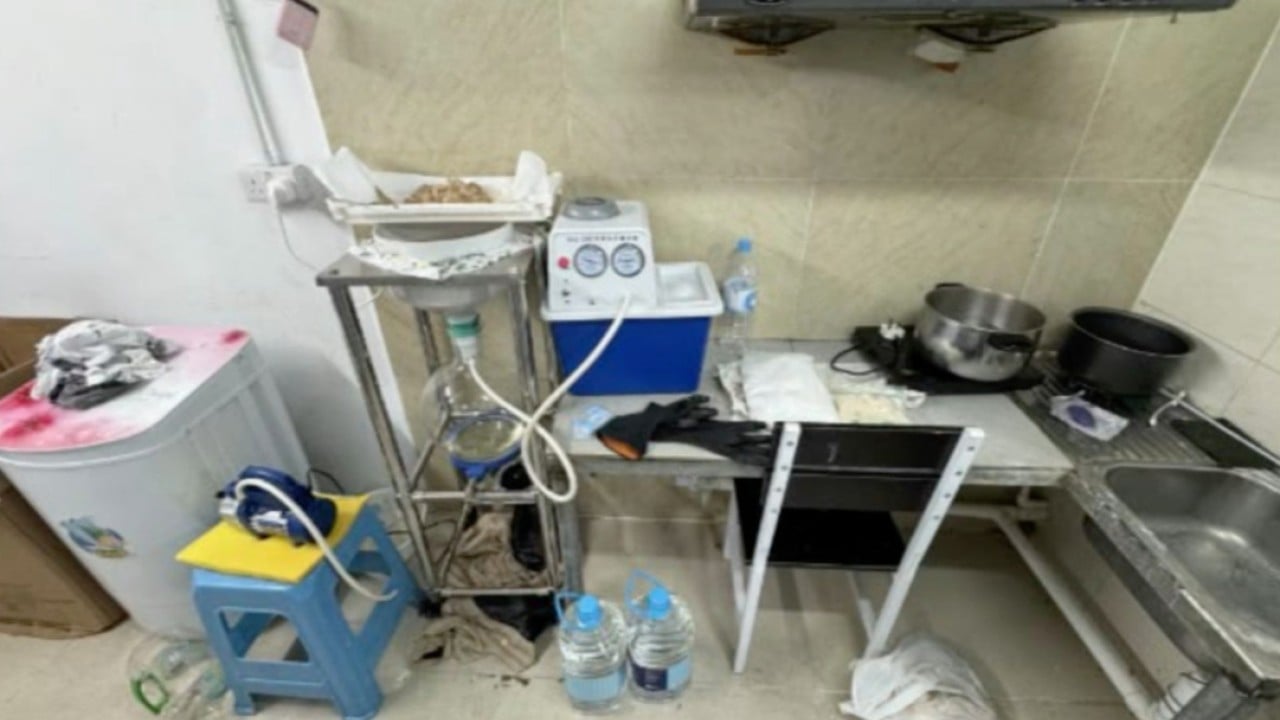
It does not open to smoke and sirens like the movies promise. It opens to silence. The heavy, stagnant air of a place where human lungs have not breathed freely in months, thick instead with the sharp, chemical reek of acetone and ephedrine. On the concrete floor, stacked with the neat, terrifying precision of a supermarket warehouse, sit ordinary cardboard boxes. Inside those boxes, wrapped in brown tape and plastic sheeting, lies crystal methamphetamine. Ice. Twenty-three million Hong Kong dollars worth of crystallized ruin, sitting quietly beneath a bare fluorescent bulb.
The police report filed after the raid on that Fanling village house will use clean, sterile nouns. Operation. Seizure. Suspects detained. It will mention the Narcotics Bureau and the tactical units moving in at dawn, their boots wet on the narrow gravel paths. But statistics are a coward's way of measuring catastrophe. They reduce human tragedy to a ledger entry.
To understand what twenty-three million dollars of synthetic poison actually means, you have to trace its shadow backward. You have to look past the three men arrested inside the house—pawns in a sprawling, anonymous supply chain—and think about the veins it was meant to fill.
Chemistry is neutral. A molecule of methamphetamine does not hate you. It is merely a rearrangement of carbon, hydrogen, nitrogen, and oxygen atoms designed to hijack the human brain’s most ancient reward system. It forces the floodgates open, releasing a torrential wave of dopamine that makes ordinary life look like a grey, unlivable desert by comparison. It promises godhood for twelve hours and delivers a hollowed-out shell by sunrise.
The men who rented that Fanling house likely never touched the product they guarded. In the modern narcotics trade, proximity is liability. You pay desperate hands a few thousand dollars to sit in the damp dark, watching security monitors and listening to the cicadas, while invisible architects orchestrate the flow from across borders.
Hong Kong has always been a city of transit. Its deep-water harbor built an empire on movement, on cargo containers sliding off massive cranes into the belly of the world. But the same infrastructure that brings us fresh fruit from the mainland and electronics from overseas also provides a ghost highway for transnational syndicates. Cargo doesn't care whether it's silk or poison. It only cares about the manifest.
When customs officials and police intercept a haul like the one in Fanling, the public breathes a collective, fleeting sigh of relief. They caught it. The streets are safer.
We want to believe that crime is an infection that can be excised with a single sharp cut. We want to imagine that locking three men in a holding cell somewhere in Kowloon somehow restores the moral balance of the territory. But the drug trade is not a tumor; it is an economic ecosystem driven by desperation and bottomless appetite. For every stash house raided in the New Territories, another is being scouted in an industrial block in Kwun Tong or a subdivided flat in Sham Shui Po.
Step inside the mind of the average user for a single moment, not with judgment, but with brutal clarity. Nobody sets out to become a cautionary tale. They start with an eighty-hour work week, or the crushing weight of a family debt, or an intolerable numbness that won't lift after the third shift of the week. The first hit is rarely a dark alley encounter; it is a whispered solution offered by someone who looks just as tired as you are.
By the time the chemistry takes root, choice is an illusion. The brain has been rewired to treat the drug not as a pleasure, but as a survival necessity, right alongside water and air. And behind that individual compulsion sits an industrial machine capable of turning out tons of crystal powder in makeshift laboratories hidden behind innocent facades.
The house in Fanling is quiet now. The police tape has fluttered in the damp wind until the adhesive failed, leaving only faint marks on the doorframe. The suspects are facing courts that deal in decades.
Yet the machinery of addiction continues to hum in the dark margins of the metropolis. It operates in the silent midnight text messages, the quick handoffs in stairwells, the cold calculation of syndicates that view human lives as acceptable collateral damage in a game of infinite accumulation.
We tell ourselves stories about crime to make the world feel orderly. We draw a sharp line between the law-abiding citizens walking beneath the neon lights of Nathan Road and the criminals hiding out in the rural fringes. But the twenty-three million dollars of Ice seized in Fanling did not come from nowhere, and its destruction does not end the story. It merely pauses the chapter.
Until we find the courage to look at the hunger that feeds the supply, the quiet village houses of the New Territories will keep their secrets, waiting for the next locked door to swing open into the dark.