The sun over Calgary in July does not feel like a threat. It feels like a gift. After months of gray, bone-chilling winter, the blue sky opens up, the thermometer hits 28°C, and the city collectively turns its eyes toward the water. The Bow and Elbow rivers look less like bodies of water and more like central plazas—vibrant, moving highways of neon rafts, inflatable inner tubes, and laughter that carries across the current.
You pack the cooler. You grab the cheap plastic raft you bought on sale. You kick off your shoes. It feels like freedom. Recently making waves in this space: Why Blasterbating Needs to Stop Right Now.
But rivers are master illusionists.
Underneath that sparkling, sunlit surface is a complex, indifferent engine of physics and geometry. Every year, emergency crews pull hundreds of people from Calgary’s waters. Most of them did not set out to be reckless. They were just hot, tired, and profoundly unaware of the invisible mechanics working beneath their rafts. To understand why Calgary officials issue their annual, urgent warnings before every long weekend, you have to look past the sunshine. You have to look at what happens when human psychology meets moving water. Further insights regarding the matter are explored by Refinery29.
The Illusion of the Lazy River
We tend to view rivers through the lens of a backyard swimming pool. A pool is static. It is contained. If you get tired in a pool, you float, or you swim to the concrete edge.
A river is an entirely different animal. It never stops moving, and it possesses an incomprehensible amount of mass. One cubic meter of water weighs exactly one metric ton. When you are sitting in a raft on the Bow River, you are not floating on a passive surface; you are balancing on top of thousands of tons of moving weight pushing forward at several kilometers per hour.
Consider a common scenario. A group of friends ties three inflatable rafts together so they can drift and chat without separating. It seems logical. It feels safer, even. But as they approach one of the concrete bridge pillars near Prince's Island Park, the current splits. One raft wants to go left; the other wants to go right.
Suddenly, that combined mass becomes a massive liability. The river traps the raft against the pillar. The force of the water—remember, tons of moving weight—pushes down on the upstream edge of the vinyl. In less than three seconds, the raft flips. The ropes that tied them together, meant to keep them safe, now tangle around legs and wrists underwater.
This is what emergency responders call a "strainer" scenario, and it is remarkably common. The water keeps moving, but the people do not.
The Shock to the System
Then there is the temperature. This is where the gap between perception and reality becomes genuinely dangerous. On a sweltering August afternoon, the air might feel like a furnace, but the Bow River is fed by glacial meltwater from the Rocky Mountains. It rarely rises above 10°C to 12°C, even in the dead of summer.
When a person unexpectedly falls into water that cold, the human body reacts automatically. It is a primitive, physiological reflex called the cold shock response.
You do not gasp because you choose to; your lungs hyperventilate instantly as a neurochemical panic response to the sudden drop in skin temperature. If your head happens to be underwater during that initial, involuntary gasp, you inhale water instead of air. Your heart rate skyrockets. Your blood vessels constrict violently, driving your blood pressure up.
For a young, fit swimmer, this shock is terrifying but survivable if they keep their head above water. For someone older, or someone with an underlying cardiac condition, it can be fatal before they even have a chance to swim.
Even if you survive the first two minutes of cold shock, the clock is ticking. Within ten minutes of immersion in glacier-fed water, deep tissue cooling begins. The body pulls warm blood away from the extremities to protect the core organs. Your fingers stiffen. Your forearms lose their strength. You lose the fine motor skills required to grab a rescue rope, hold onto a slippery overturned raft, or unzip a life jacket pocket. You become physically incapable of swimming, not because you lack the will, but because your muscles have quite literally shut down.
The Geometry of the Riverbed
To navigate Calgary's waters safely, you also have to understand that a riverbed is not a smooth, paved highway. It is a chaotic terrain of shifting gravel bars, submerged logs, and sharp drop-offs.
The Elbow River, for instance, looks shallow and gentle enough for toddlers to splash in near Sandy Beach. But rivers dig holes. The current carves out deep pools right beneath steep banks or around sharp bends. A person wading in knee-deep water can take one step and suddenly find themselves in water over their head, caught in a swirling eddy that pulls them away from the shore.
On the larger Bow River, the hazards are scaled up. Heavy springtime runoff frequently alters the river's layout, washing massive trees downstream. These trees often get wedged into the riverbed, creating what rescuers call "sweepers." The branches sit just beneath or at the surface of the water. To a rafter drifting down the river, it looks like a few harmless leaves dancing on the current.
But underneath, those branches act like a giant broom, sweeping anyone who hits them clean out of their watercraft and trapping them underwater against the submerged trunk. The force of the current makes it nearly impossible to push yourself away.
The Anatomy of a Safe Launch
When Calgary’s Fire Department and bypass teams urge water safety, they are not trying to ruin the city's summer fun. They are trying to shift the culture from passive recreation to active navigation. Navigating a river requires preparation, respect, and the right gear.
The strategy for a safe day on the water is straightforward, but it requires breaking old habits.
- The Life Jacket is Non-Negotiable: A life jacket stored under the seat of a raft or used as a cushion is completely useless when a raft flips in a split second. By law, there must be a properly fitted life jacket or personal flotation device (PFD) for every person on board, and it needs to be worn. If you hit cold water and experience cold shock, that piece of foam is the only thing keeping your airway above the surface when your muscles refuse to work.
- Ditch the Pool Toys: Cheap, single-chamber vinyl rafts designed for a calm backyard swimming pool have no place on a moving river. One sharp rock or submerged branch will puncture them instantly, deflating the entire craft in seconds. Calgary waters require durable, multi-chambered rafts or kayaks designed to withstand abrasions and maintain buoyancy even if one chamber is compromised.
- Scout the Route: You need to know where you are getting in, where you are getting out, and what lies in between. Harvie Passage, located on the Bow River near the Pearce Estate Park, is a prime example. While it was redesigned to be safer for recreation, it still features rapid whitewater channels that can easily overwhelm inexperienced paddlers. Signs along the river warn boaters to portage around certain sections, but those signs are only useful if you are actively looking for them.
- The Zero-Alcohol Rule: Alcohol alters your judgment, slows your reaction times, and accelerates the onset of hypothermia. Sun, dehydration, and moving water already mimic the effects of fatigue; adding alcohol to the mix dramatically increases the likelihood of a miscalculation.
The Quiet Reality of Rescue
Every summer evening, as the sun finally begins to dip behind the mountains and the air cools, the riverbanks grow quiet. The rafts are packed away, the empty coolers are loaded into trunks, and the city goes home.
But occasionally, the silence is broken by the sharp, rhythmic wail of sirens heading toward the water.
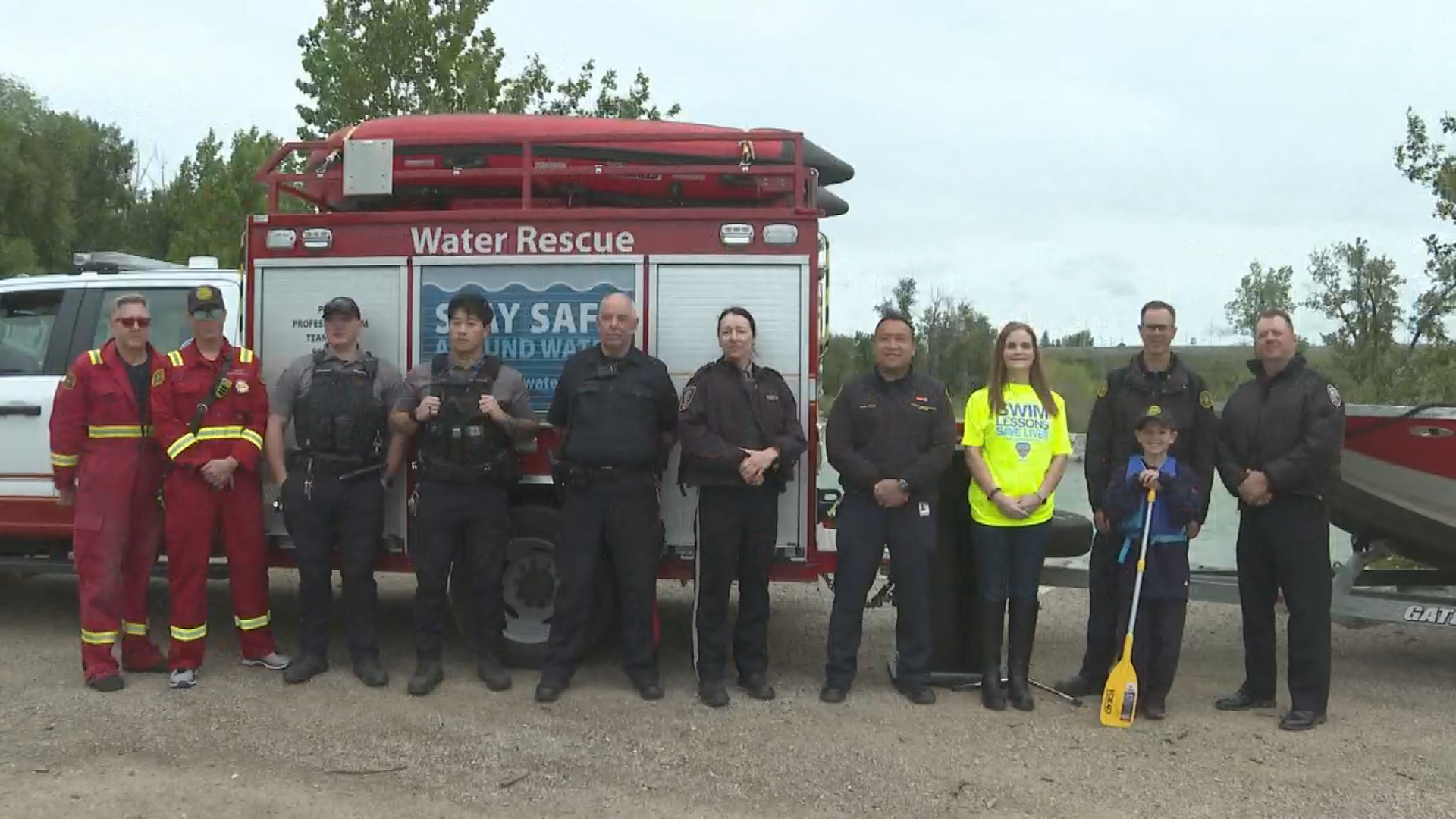
Members of the Calgary Fire Department’s aquatic rescue team don thick neoprene drysuits, launch motorized zodiacs, and scan the dark water with high-powered searchlights. They look for the gleam of a plastic paddle, the neon orange of a life jacket, or a hand gripping a slippery rock in the middle of the current.
Most of the people they pull out of the water are cold, shivering, embarrassed, and deeply shaken. They always say the same thing to the paramedics wrapping them in warm blankets: I didn't think it would happen so fast.
The river does not wait for you to realize you are in trouble. It does not pause to let you adjust your posture or rethink your path. It simply keeps moving, beautiful and indifferent, carrying everything in its path according to the laws of nature. Enjoying it means understanding those laws, respecting that power, and deciding to be ready for the cold reality that lies just beneath the summer sun.