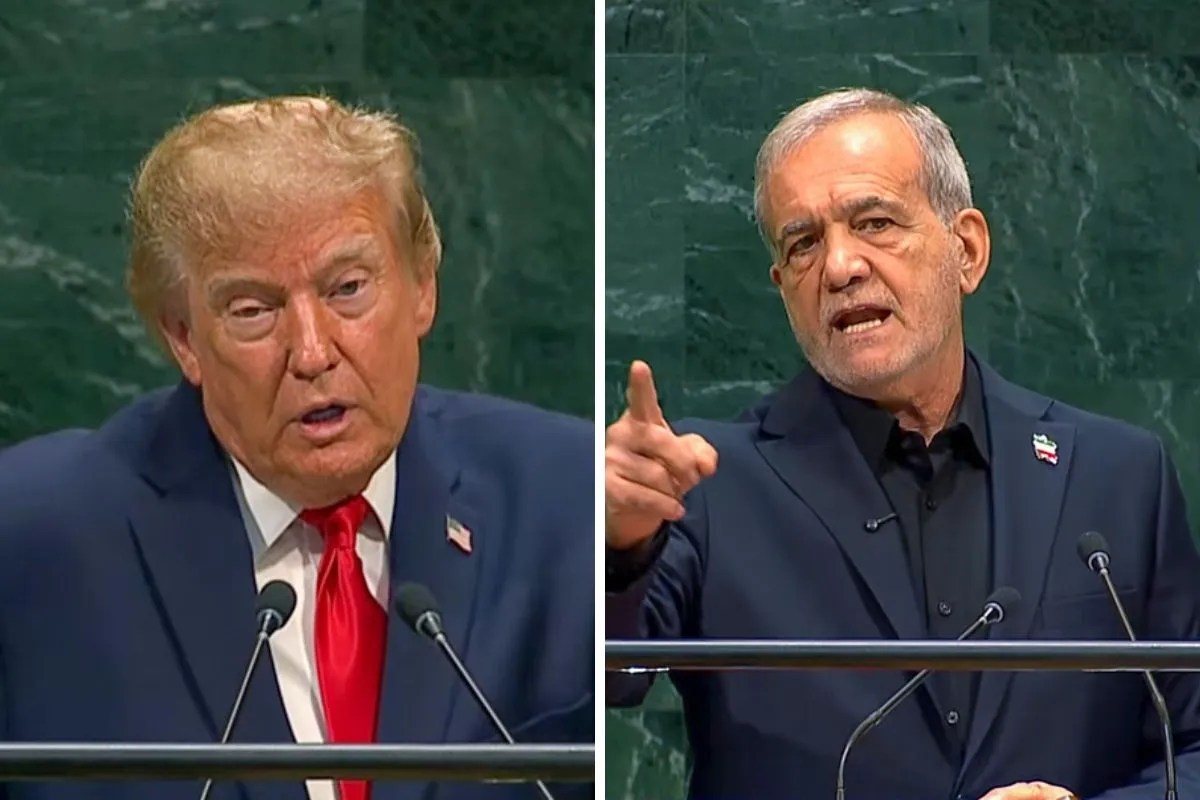
Negotiations conducted under active military threats and naval blockades fail whenever the target perceives compliance as existential capitulation rather than a rational concession. In October and November 2026, Iranian President Masoud Pezeshkian rejected bargaining under coercion while signaling willingness to reach an agreement on terms of mutual respect, sanctions relief, and the reopening of the Strait of Hormuz. Standard wire-style coverage reports these statements as a binary clash of toughness—Washington issuing warnings and Tehran refusing to yield. A rigorous strategic breakdown moves past headline bravado to examine the incentive structures, bargaining preconditions, maritime choke points, and domestic political constraints driving the standoff between the United States and Iran.
Deconstructing the Headline Narrative and Its Analytical Blind Spots
Conventional reporting on the exchange between Tehran and Washington treats public rhetoric as an immediate indicator of policy flexibility or rigidity. When Pezeshkian states that talks cannot proceed amid threats, encirclement, and sanctions, surface-level summaries often read the remark as a flat refusal to negotiate. In practice, such statements function simultaneously as a domestic legitimacy shield, a signal to regional intermediaries, and an opening anchor in high-stakes bargaining.
Headline coverage frequently compresses distinct diplomatic moves into a single posture. During meetings with Pakistani leadership in late October 2026, Pezeshkian linked the cessation of pressure and the lifting of sanctions to future negotiations while blaming U.S. escalation for regional instability and disruptions around Hormuz. Around the same period, Iranian officials emphasized that dialogue remains viable if framed around fairness and sovereignty, while also noting that supreme leadership had authorized addressing issues previously treated as off-limits to resolve the prolonged conflict. Treating these signals as pure contradiction misses how authoritarian and hybrid decision-making systems separate public defiance from backchannel concessions.
Three analytical blind spots weaken standard coverage of this crisis:
- Conflating bargaining preconditions with permanent rejection: Demanding sanctions relief, an end to naval blockades, or security guarantees prior to formal talks defines the entry price of negotiation, not necessarily an unwillingness to bargain if intermediate steps are met.
- Ignoring mediator architecture: High-visibility speeches grab attention, yet indirect diplomacy mediated through regional actors such as Qatar carries the actual mechanics of proposal exchange.
- Overlooking domestic political calendars: Both Washington and Tehran operate inside domestic pressure environments—including U.S. voters' sensitivity to war fatigue and inflation, and internal Iranian debates over economic strain and escalation risk.
Bargaining Theory Applied to Coercive Pressure
In bargaining theory, coercive diplomacy relies on manipulating the opponent's expected cost of continued resistance versus the perceived cost of concession. When one side pairs threats of strikes or blockades with demands for major strategic shifts, the other side faces a credibility dilemma: conceding immediately under visible pressure signals weakness to domestic audiences and regional rivals, raising the future cost of deterrence.
Credibility works in both directions. Pezeshkian's insistence that Iran will not bow to force or intimidation addresses an audience inside Iran that watches for any sign of capitulation. At the same time, past breakdowns or perceived reversals on prior agreements create deep commitment problems. When neither side trusts the other to honor concessions once leverage shifts, each prefers strict preconditions—such as unfreezing assets, halting hostilities, or easing maritime restrictions—before making irreversible moves.
Consider a stylized bargaining trade-off. Suppose State A threatens military strikes unless State B curbs sensitive programs, while State B demands sanctions relief and an end to maritime interdiction before serious talks advance. If State B yields right after a threat or strike, its leadership pays a sharp domestic sovereignty penalty. Conversely, if State A lifts pressure first without verifiable reciprocity, it risks looking indecisive. That symmetry explains why crises stall in an expensive equilibrium of threats, counter-warnings, and slow indirect exchanges.
The Four Pillars of the Negotiation Standoff
To make sense of why talks remain contentious despite repeated assertions that dialogue is possible, the dispute can be organized into four structural pillars. These are analytical categories derived from reported positions and diplomatic mechanics rather than invented metrics.
Sovereign Framing and Anti-Coercion Posture
Tehran consistently frames its position around national rights, dignity, and resistance to external diktat. In political terms, rejecting talks "under threat" preserves regime autonomy even while diplomats engage indirectly. The practical mechanism is clear: the more public the ultimatum from Washington, the harder it becomes for Iranian officials to appear to be complying on command.
Sanctions, Frozen Assets, and Economic Leverage
Economic pressure sits at the center of the impasse. Sanctions, restrictions on oil exports, naval blockades, and disputes over frozen funds directly affect Iran's fiscal breathing room and trade flows. From Tehran's perspective, negotiating while under active economic strangulation treats economic pain as a baseline rather than a bargaining chip. From Washington's perspective, retaining leverage until tangible security or maritime commitments are secured prevents giving away pressure prematurely.
Maritime Chokepoints and the Strait of Hormuz
The Strait of Hormuz acts as a physical multiplier on diplomatic friction. Disruptions, naval blockades, attacks on commercial shipping, or disputes over freedom of navigation turn a bilateral political quarrel into a global energy and trade problem. Linking waterway access or reopening timelines to broader demands—such as lifting sanctions or ending blockades—gives Tehran asymmetric leverage over global markets even when conventional military balance favors the United States.
Escalation Control and Backchannel Mediation
Even amid harsh rhetoric and sporadic strikes, both sides face incentives to avoid an uncontrolled spiral. Indirect talks—with regional mediators like Qatar passing messages and testing interim formulas—allow negotiators to probe compromises without staging a public climbdown. This dual track creates friction between what leaders say at microphones and what envoys test behind closed doors.
Cause-and-Effect Chains Standard Coverage Misses
Surface reporting often lists events in sequence without tracing the causal loops connecting them. Three cause-and-effect chains shape how this standoff evolves.
First, public threats harden domestic negotiating ceilings. When U.S. leaders warn of strikes or broader action alongside talk of a deal, Iranian leaders face heightened pressure to prove they are not yielding to intimidation. That dynamic raises the political cost of compromise inside Tehran, narrowing the room for negotiators even when backchannels are active.
Second, maritime friction converts bilateral leverage into third-party pressure. When tensions disrupt shipping or tanker safety near the Strait of Hormuz or Gulf waters, energy importers, Gulf states, and regional neighbors feel the spillover. Those affected parties gain a strong interest in urging restraint and supporting mediation, altering the diplomatic environment around both Washington and Tehran.
Third, unresolved grievances lengthen negotiation timelines. Disputes over past broken commitments, frozen assets, reparations, or security guarantees mean neither side starts from a baseline of trust. Instead of a single comprehensive bargain, parties often gravitate toward phased or interim arrangements—such as narrow understandings on maritime transit or specific asset releases—because sweeping agreements require levels of trust that do not exist.
Known Facts Versus Educated Hypotheses
Separating verified developments from analytical inference keeps strategic assessment grounded.
Known facts established by public reporting include:
- Iranian President Masoud Pezeshkian has repeatedly stated that Iran will not negotiate under threats, pressure, or coercion, while expressing readiness for talks based on respect, fairness, and lifting sanctions or blockades.
- Regional diplomacy and indirect negotiations—including mediation involving Qatar and contacts with neighboring states—have continued alongside military tensions, strikes, and disputes over the Strait of Hormuz.
- Iranian officials have pointed to supreme leadership authorization to pursue a resolution ending prolonged conflict/stalemate dynamics through diplomatic channels where possible, while warning against renewed military attacks.
Educated hypotheses based on bargaining dynamics and institutional incentives include:
- Publicly rejecting talks under threat is likely calibrated in part to prevent domestic rivals from portraying any diplomatic outreach as surrender.
- Incremental, step-for-step understandings—such as conditional moves on maritime transit paired with targeted financial or sanction adjustments—are more probable in the near term than a rapid, comprehensive grand bargain.
- Any sudden spike in kinetic strikes or maritime incidents risks resetting talks by forcing both sides to prioritize deterrent signaling over compromise.
Operational Playbook for Tracking and Navigating the Standoff
For analysts, risk managers, and decision-makers monitoring U.S.–Iran developments, relying on presidential speeches alone produces noisy signals. A structured four-step workflow yields better situational awareness.
- Separate rhetorical posture from mediating mechanics. Track whether indirect channels, envoy meetings, and regional mediators are actively exchanging drafts even when public statements sound uncompromising.
- Watch sequencing on concrete preconditions. Distinguish between broad political slogans and specific operational triggers—such as maritime transit terms, blockade adjustments, or access to frozen funds—that indicate real bargaining movement.
- Monitor domestic pressure windows on both sides. Look for shifts in political incentives tied to economic strain, inflation, election cycles, or internal leadership alignment that can either push leaders toward an interim off-ramp or tempt them toward escalation.
- Stress-test scenarios around maritime choke points. Evaluate supply-chain, insurance, and routing exposure around the Strait of Hormuz under both prolonged stalemate and sudden flare-ups, without assuming that diplomatic talks prevent tactical incidents.
Every analytical framework has limits. Open-source observation cannot see classified backchannel offers, internal factional deliberations in real time, or unannounced military rules of engagement. Moreover, even well-sequenced diplomatic steps can fail abruptly if an unintended clash occurs at sea or in the air. No single indicator reliably predicts a breakthrough.
The most effective strategic move for decision-makers exposed to this conflict is to treat public ultimatums as bargaining noise, anchor risk models to verifiable changes in maritime security and financial access, and hedge against sudden escalation while indirect talks remain fragile.


