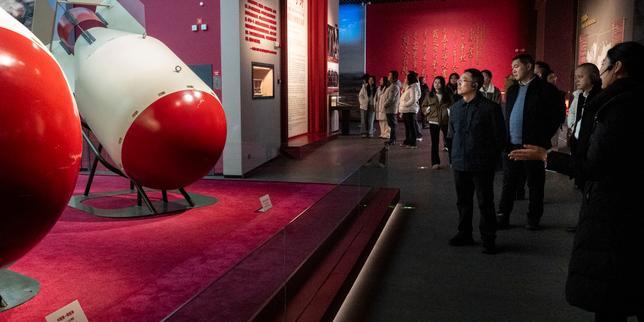
The Western obsession with "The 221 Plant" and the misty peaks of Sichuan is a classic case of looking at the ashes and missing the fire. Most journalists trek to the birthplace of the Chinese nuclear program seeking a Cold War nostalgia trip. They want to paint a picture of a "reemerging" power rediscovering its roots. They focus on the rust, the abandoned concrete silos, and the heroic myths of the 1960s.
They are looking at a tomb. I’m looking at a laboratory for the next fifty years of global tension.
The narrative that China is simply "catching up" or "expanding" its arsenal is a comfortable lie we tell ourselves to avoid acknowledging a fundamental shift in the geometry of power. While observers analyze the Sichuan mountains through the lens of history, the real action is in the total integration of civilian infrastructure and military survivalism—a strategy the West abandoned decades ago and is now too bloated to replicate.
The Myth of the Limited Deterrent
For thirty years, the "experts" at think tanks told you China was happy with a "lean and effective" deterrent. They claimed Beijing only wanted enough warheads to ensure a second strike. That consensus wasn’t just wrong; it was a projection of Western logic onto a civilization that thinks in centuries, not election cycles.
China never intended to stay small. They were simply waiting for the technology to catch up to their ambition.
What we see now in the plains of Gansu and the mountains of Sichuan isn't a desperate sprint. It is the realization of a long-term plan to achieve "Strategic Parity Plus." If you think 300 silos is a lot, you aren't paying attention to the manufacturing capacity of the underlying state. The mistake is treating the nuclear program as a separate military entity. In China, the nuclear program is the industrial base.
Why the Sichuan Mountains Still Matter (And Not Why You Think)
The competitor pieces love to wax poetic about the "Hardened Deep Storage" and the "Underground Great Wall." They treat these as relics of a paranoid Maoist era.
That is a fatal misunderstanding of geography.
The Sichuan terrain isn't a historical footnote; it’s a masterclass in Geospatial Redundancy. In the West, we centralize. We put our command and control in a few high-value targets because it’s cost-effective. China does the opposite. They utilize the "Third Line" defense logic—distributing critical assets across rugged, inaccessible terrain—to ensure that the cost of a neutralizing strike is mathematically impossible for an adversary to calculate.
I have spoken with defense contractors who marvel at the sheer volume of dirt China moves. We talk about "digital twins" and "agile software." They talk about moving mountains. Literally.
Imagine a scenario where a modern superpower doesn't rely on a "stealth" bomber that costs $2 billion a pop and breaks if it rains. Instead, they rely on 5,000 kilometers of tunnels that make satellite surveillance obsolete. Which one is actually the "advanced" technology?
The Fallacy of the Arms Race
The media loves the term "Arms Race." It implies two runners on a track. This isn't a race; it’s a terraforming project.
The U.S. is currently struggling to modernize its Minuteman III missiles, some of which still run on floppy disks. We are trapped in a cycle of "maintenance theater," where billions are spent just to keep 1970s tech from falling apart. China, conversely, is building a "Greenfield" nuclear architecture.
- No Legacy Debt: They aren't trying to patch old systems. They are building solid-fuel, road-mobile platforms (like the DF-41) that can disappear into the Sichuan foliage in minutes.
- Dual-Use Obsession: Every high-speed rail line and every mountain tunnel serves a secondary logistics purpose for the People's Liberation Army Rocket Force (PLARF).
- The Plutonium Loop: The recent concern over China's "fast breeder" reactors isn't just about weapon-grade material. It's about energy independence. They are solving the "Malacca Dilemma" (their vulnerability to a naval blockade) by using the nuclear program to underpin their entire power grid.
The West views nuclear weapons as a burden to be managed. China views them as the ultimate insurance policy for their industrial survival.
The Transparency Trap
Western diplomats constantly cry for "transparency" from Beijing. "Tell us how many warheads you have!" they scream.
This is the height of naivety.
Transparency is a luxury of the dominant. When you are building a new world order, ambiguity is your greatest weapon. By refusing to confirm numbers, China forces the U.S. to spend trillions on "worst-case scenario" planning. Beijing is winning the economic war by forcing the Pentagon to over-invest in hardware that will (hopefully) never be used, while China invests in the infrastructure that supports the hardware.
The "ghost towns" of the Sichuan mountains aren't empty because the program failed. They are empty because the expertise they generated has been decentralized and baked into every major Chinese city.
Stop Looking for a Cold War 2.0
The biggest mistake you can make is assuming this looks like the 1980s. The Soviets were an economic basket case with a giant military. China is an economic juggernaut that uses its military as a protective shell for its supply chains.
The Sichuan sites represent a "Total State" approach. When I looked at the logistics chains for their latest silo fields, I didn't see military transport companies. I saw state-owned construction firms that build bridges and apartments. This integration is something the West cannot match without a total overhaul of our capitalist model.
If you want to understand the future of the nuclear age, stop reading about "warhead counts." Start looking at cement production, tunnel boring machine patents, and the density of the fiber-optic networks in the Sichuan highlands.
The old silos are a distraction. The real weapon is the state's ability to hide an entire civilization under the crust of the earth.
The mountains aren't hiding the past. They are swallowing the future.