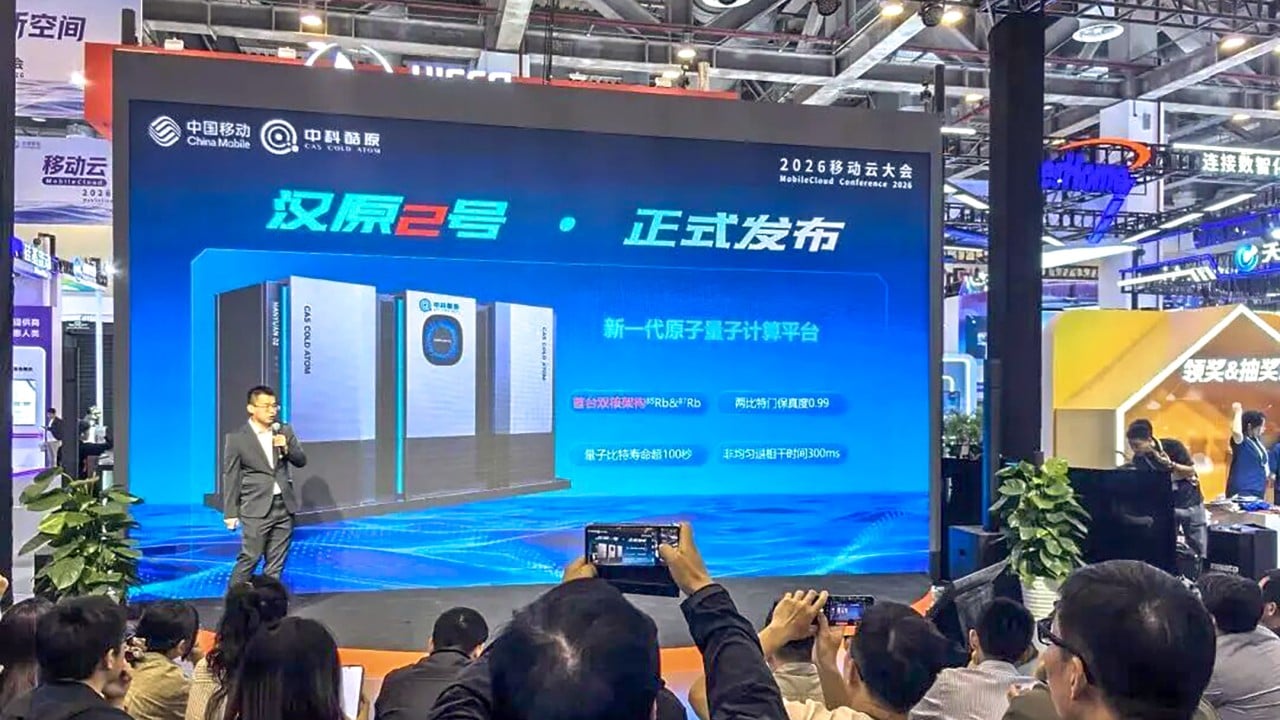
The press release cycle for the Hanyuan-2 is a masterclass in linguistic gymnastics designed to fool venture capitalists and nervous policy makers. By slapping the label "dual-core" onto a quantum system, the Origin Quantum team has successfully tricked the tech media into applying classical computing logic to a machine that doesn't obey those laws.
Calling a quantum computer "dual-core" is like calling a teleportation device a "two-wheeled bicycle." It is a fundamental category error. In classical architecture, adding a core means adding an independent execution unit to handle more threads. In the quantum world, adding a "core" usually just means you’ve figured out how to link two separate dilution refrigerators or two distinct chips because you couldn't fit enough qubits on one without them collapsing into thermal noise. Learn more on a related issue: this related article.
The headlines are screaming about a breakthrough in processing power. The reality is a desperate workaround for the "connectivity bottleneck" that has haunted superconducting qubits since day one.
The Scalability Trap
Mainstream reporting suggests that doubling the cores doubles the performance. This is the first lie. In quantum mechanics, the power of a system scales with its ability to maintain entanglement across all participating qubits. If you have two "cores" that are not perfectly, coherently linked, you don't have a 2x quantum computer. You have two half-capacity computers that are incredibly difficult to synchronize. Additional journalism by TechCrunch delves into similar perspectives on the subject.
I have watched research teams burn through nine-figure budgets trying to solve the "interconnect problem." When you separate qubits into different cores, you introduce latency and decoherence. Every time you move quantum information from Core A to Core B, the signal degrades.
To understand why "dual-core" is a marketing gimmick, we have to look at the SWAP gate overhead.
$$F_{avg} = \int d\psi \langle \psi | \mathcal{E}(\psi) | \psi \rangle$$
In a single-core chip, qubits can often talk to their neighbors with high fidelity ($F$). When you bridge two cores, you are forced to use "quantum teleportation" or microwave links. These methods are notoriously leaky. The moment your error rate on the bridge exceeds the threshold for error correction, your "dual-core" advantage evaporates. It becomes a liability.
The Qubit Count Obsession is Killing Progress
The Hanyuan-2 is being touted for its qubit density, but the industry is ignoring the only metric that matters: Gate Fidelity.
We are currently in the NISQ (Noisy Intermediate-Scale Quantum) era. In this stage, 100 perfect qubits are worth more than 10,000 noisy ones. China’s push for higher qubit counts via multi-core architectures is a brute-force approach to a problem that requires surgical precision.
Most people asking "How many qubits does it have?" are asking the wrong question. You should be asking "How many T-gates can I run before the whole thing turns into a random number generator?"
The Hanyuan-2's architecture relies on the assumption that we can coordinate two chips via a specialized interface. However, the thermal constraints are nightmarish. Each core generates heat. In a dilution refrigerator operating at 10 millikelvin, even a microscopic amount of heat from a chip-to-chip interconnect can cause decoherence.
If the Hanyuan-2's "dual-core" setup isn't running at a fidelity of at least 99.9%, it isn't a computer. It's an expensive heater that occasionally does math.
The Geopolitical Smoke Screen
Why call it "dual-core"? Because it sounds familiar. It sounds like the Intel vs. AMD wars of the late 90s. It suggests a roadmap that the public can understand. It implies that "Quad-core" and "Octa-core" quantum computers are just a few years away.
This is a tactical deception. Classical scaling (Moore's Law) happened because we could shrink transistors without changing the underlying physics of how electrons move through silicon. Quantum scaling is different. As you add more qubits—and especially as you split them across "cores"—the complexity of the control electronics grows exponentially, not linearly.
I've sat in rooms with hardware engineers who admit, off the record, that the cabling alone for a 1,000-qubit system is physically impossible to fit inside a standard cryostat. By splitting the system into two cores, the Hanyuan-2 is likely trying to solve the physical space problem of the wiring, not the computational problem of the logic.
Your "Quantum Advantage" is Still Decades Away
The Hanyuan-2 is being framed as a tool for immediate industrial use in chemistry and finance. This is the most dangerous myth of all.
To run Shor’s algorithm and actually break RSA encryption, or to simulate a caffeine molecule with 100% accuracy, you need Logical Qubits. A logical qubit is a collection of hundreds or thousands of physical qubits working together to correct each other's errors.
If the Hanyuan-2 has, say, 400 physical qubits across two cores, it might only represent one or two high-quality logical qubits.
You cannot run a bank on two logical qubits.
The "dual-core" breakthrough is a milestone in packaging and cryogenics, but it is a footnote in the history of actual computation. We are still using vacuum tubes while the world thinks we just invented the microprocessor.
The Brutal Reality of Software Portability
Everyone talks about the hardware, but nobody talks about the compiler.
Writing code for a single-chip quantum processor is already a nightmare. You have to map your algorithm to the specific physical topology of the qubits. Some qubits can talk to others; some can't.
Now, introduce a "dual-core" boundary.
Your compiler now has to decide which parts of the quantum circuit stay on Core A and which move to Core B. Every "move" operation is a high-risk event for decoherence. If the software isn't aware of the physical distance between the cores, the program will fail every single time.
There is no "Standard Library" for dual-core quantum machines. There is no "Write Once, Run Anywhere." Every algorithm for the Hanyuan-2 has to be hand-tuned by a PhD who understands the specific microwave pulse timings of that specific machine.
Stop Waiting for the Quantum Revolution
Investors keep asking how to "leverage" (to use their favorite disgusting word) this technology today.
My advice: Don't.
Unless you are a state-sponsored research lab or a pharmaceutical giant with billions to waste on "maybe," the Hanyuan-2 is a spectator sport. The "dual-core" moniker is a signal that the hardware has hit a wall. They can't make the chips bigger, so they're trying to stick them together.
We are seeing the birth of "Quantum Sprawl." It's messy, it's inefficient, and it's being sold as a sleek evolution.
The Hanyuan-2 isn't the beginning of the dual-core era. It’s a confession that single-chip scaling has failed.
If you want to understand the future of this field, stop looking at the number of cores and start looking at the error rates. Until those numbers drop by two orders of magnitude, the number of cores is just a measure of how much extra junk you're cooling to absolute zero.
Don't buy the hype. The "dual-core" quantum computer is a hardware hack dressed up as a revolution.
The core is a lie. The entanglement is everything. And right now, the entanglement is falling apart.


