The morning air smelled of damp grass and anticipation. Thousands of people stood shoulder to shoulder in an open field, their faces upturned, wearing dark, oversized cardboard glasses that made them look like a convention of time travelers. Nobody spoke loudly. A collective murmur hung over the crowd, like the sound of wind moving through a pine forest.
They had traveled for hours, some for days. They came with lawn chairs, heavy telephoto lenses wrapped in plastic, and thermos flasks of lukewarm coffee. They were all waiting for a precise, cosmic alignment.
Darkness. In the middle of the day.
The Geometry of Wonder
To understand why thousands of strangers would gather in silence to stare upward, you have to look past the poetry and into the cold, indifferent mechanics of the solar system.
It is a cosmic coincidence of staggering proportions. The sun is about four hundred times wider than the moon, but it is also roughly four hundred times farther away. Because of this proportional quirk, both bodies appear almost exactly the same size in our sky. When the moon passes directly between the Earth and the sun, it can block the solar disk with absolute, breathtaking precision.
Scientists call this totality. Everyone else calls it magic.
For centuries, these shadow bands struck terror into human hearts. Ancient civilizations saw the sudden disappearance of daylight as a celestial predator devouring the sun. Drums beat. Prayers rose. People hid in their homes, waiting to see if the world would end.
Now, we calculate the path of totality down to the exact second. We know the speed of the lunar shadow—racing across the Earth’s surface at over a thousand miles per hour. Yet, despite all our satellites, orbital mathematics, and precision instruments, the modern gathering feels remarkably similar to the ancient ones. When the light fades, modern humans fall silent, too.
The Chill in the Air
Consider what happens next.
The temperature drops. It is not a subtle shift; it is a sudden, physical shock. The cicadas stop buzzing, confused by the premature twilight. Birds fall silent, heading for their roosts under the mistaken impression that night has fallen twice in one day.
Elena, a retired physics teacher who drove six hours to reach the path of totality, clutched her binoculars tighter as the crescent sun grew thinner.
"You read about it in textbooks," she whispered, her breath misting slightly in the unexpected cold. "You know the math. You know the moon's orbit has an inclination of about five degrees. But knowing the numbers doesn't prepare your skin for the chill. It doesn't prepare your stomach for the drop."
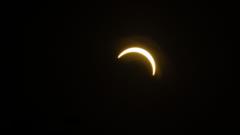
The sky shifts from blue to an eerie, metallic indigo. The horizon glows in all directions like a permanent sunset, ringed in an apricot-colored smear of light.
Then, the last sliver of the sun vanishes.
The Crown of the Sun
Suddenly, the world changes.
The blinding disk of the sun is gone, replaced by a black hole in the sky, framed by the blinding, pearly white tendrils of the solar corona. This is the sun’s outer atmosphere, a million degrees hot, usually invisible against the fierce glare of the solar surface. It streams out into space like ghostly hair.
Gasps ripple through the crowd. Someone drops a camera lens cap; nobody looks down to pick it up.
For a few fleeting minutes, the hustle and noise of modern life simply evaporates. Emails remain unanswered. Traffic jams miles away are forgotten. There is only the shadow, the glowing halo, and the sudden, overwhelming realization of our place in a vast, silent universe. We are passengers clinging to a spinning rock, hurtling through a dark void, guided by invisible clockswork we had no hand in building.
The Return of the Light
A diamond ring flashes on the edge of the dark lunar disk.
A single point of sunlight bursts through a crater on the moon, brilliant and blinding. The spell breaks. The sky instantly floods back with daylight, harsh and unapologetic. The streetlights click off. The cicadas resume their frantic rhythm.
People blink, laughing nervously, rubbing the bridge of their noses where the cardboard glasses left red indentations. They start folding their lawn chairs. They pack away their tripods. They check their phones for missed calls.
But as they walk back toward their cars, the chatter is different. Strangers nod at one another with a shared, unspoken camaraderie. They have just witnessed the universe pull back its curtain, if only for a few minutes, to reveal the raw machinery of the heavens.
The traffic on the highway home is immense, stalled for miles in a creeping river of brake lights. No one honks. Everyone is too busy looking out the window, glancing sideways at the sky, already wondering where the next shadow will fall.