The room smells of old mahogany, expensive wool, and panic.
It is a specific kind of panic, the sort muffled by hundreds of thousands of dollars in tailoring. Somewhere in the middle of a crowded, dimly lit auction room, a wooden gavel is raised. The air goes rigid. For a fraction of a second, nobody breathes.
Then, the crack of wood on wood.
Sold. For $181 million.
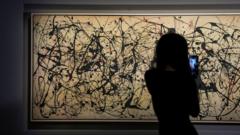
The object in question is not a superyacht. It is not a beachfront estate in Malibu, nor is it a rare, multi-carat diamond mined from the deepest recesses of the earth. It is a canvas covered in house paint, aluminum enamel, and dirt. Specifically, it is a painting by Jackson Pollock. To the uninitiated, it looks like a crime scene. To the art world, it is the holy grail. To the person who just parted with a fortune equivalent to the gross domestic product of a small island nation, it is an obsession made tangible.
We live in a world obsessed with order. We track our steps, optimize our schedules, and build algorithms to predict the exact second a package will arrive at our doorstep. Yet, the most expensive human expressions are often born from absolute, terrifying chaos.
What drives a human being to spend $181 million on a visual scream?
The Myth of the Mess
To understand the price tag, you have to understand the myth.
Let us construct a hypothetical observer. We will call him Arthur. Arthur is a pragmatic man. He understands the value of a dollar, the cost of lumber, and the price of steel. Arthur stands in front of this record-breaking Pollock painting, squints, and feels a rising sense of profound irritation.
"My six-year-old could do that," Arthur mutters.
It is the oldest cliché in modern art criticism. It is also entirely wrong.
When Jackson Pollock walked into his barn in Springs, New York, in the late 1940s, he was not trying to paint a picture. He was trying to catch lightning. He took the canvas off the easel—the traditional, civilized anchor of the Western art tradition—and ripped it down. He laid it flat on the floor.
Think about that shift. An easel forces the painter to look the world in the eye. Putting a canvas on the floor forces the painter to look down into an abyss.
Pollock did not use fine camel-hair brushes. He used sticks, trowels, and hardened syringes. He bought cans of liquid, industrial gloss paint from the local hardware store. Then, he danced. He moved around the perimeter of the canvas like a man possessed, dripping, flinging, and pouring paint in loops and arcs.
But here is the secret that separates the master from Arthur’s hypothetical six-year-old: physics.
Scientists have spent years analyzing the geometry of Pollock’s drips. They discovered something staggering. His patterns are not random. They are fractals—repeating geometric patterns that occur in nature, like the branching of trees, the structure of snowflakes, or the jagged edge of a coastline. Pollock had figured out how to paint the underlying mathematics of the universe by letting go of his own hands.
He was not painting a thing. He was painting time.
The Billionaire’s Mirror
So, why $181 million? Why now?
The art market is a strange, distorting mirror of global wealth. When a painting fetches a sum that could fund public school systems or launch satellites, it ceases to be mere decoration. It becomes an asset class. But it is a unique asset class because it carries no intrinsic utility. You cannot live inside a Pollock. You cannot drive it. You cannot eat it.
Its value exists purely because a collective group of incredibly wealthy individuals have agreed that it possesses value.
Consider the psychology of the ultra-high-net-worth buyer. In an era where digital currencies fluctuate wildly and real estate markets can collapse overnight, a masterpiece is an anchor. It is scarce. There will never be another Jackson Pollock painting from his peak era. The supply is permanently capped by a tragic car crash on a dark road in East Hampton in 1956.
But there is a deeper, more vulnerable truth beneath the financial strategy.
Imagine being a person who controls corporations, directs thousands of lives, and navigates the hyper-rational world of global commerce. Every day is a battle of spreadsheets, metrics, and cold logic. Then, you come home. You sit in a room, and on your wall hangs a visual representation of pure, unadulterated freedom.
The buyer isn't just purchasing canvas and pigment. They are buying an antidote to their own rigid lives. They are buying a piece of a man who refused to follow the rules, who drank too much, loved too hard, and broke the boundaries of what humans were allowed to create. They are buying the wildness they had to suppress within themselves to become successful enough to afford it.
The High-Stakes Theater of the Auction
If you have never stood in a major evening auction at Christie's or Sotheby's, the atmosphere is difficult to describe. It feels less like a retail transaction and more like a high-stakes poker game where the players are blindfolded.
The room is tight. The air conditioning is cranked up high to keep the sweat from ruining the clothes. The auctioneer stands on a podium, a conductor of ego and ambition.
"We begin at one hundred million dollars," the auctioneer says, their voice smooth, almost casual, as if discussing the price of a mid-sized sedan.
The bids do not happen with frantic hand-waving like you see in old movies. They happen with the slightest nod of a head. A raised finger. A subtle signal from a specialist on a bank of phones at the side of the room, communicating with an anonymous billionaire sitting in a penthouse in Tokyo, a villa in Monaco, or a compound in Silicon Valley.
Ten million. Twenty million. Fifty million.
The numbers lose all meaning. They become abstract concepts, mere scoreboard points in a game played by the global elite.
But as the price climbs past $150 million, the room thins out. The casual observers stop whispering. The air grows thick. The bidding becomes a duel. Two forces, hidden behind telephone lines, refusing to blink. It is a public display of financial dominance, an assertion of existence. To lose the bid is to admit a limit to your power. And for the people in this tier of the world, limitation is an intolerable concept.
When the gavel finally falls at $181 million, the release of tension is palpable. A collective sigh ripples through the crowd. Someone applauds, a lonely, sharp sound that quickly dies out. The painting is wheeled away by handlers wearing white cotton gloves. It will vanish into a private collection, perhaps never to be seen by the public again for a generation.
What We Leave Behind
It is easy to look at this transaction with cynicism. It is easy to be disgusted by the sheer concentration of wealth, to see it as a symptom of a broken cultural compass. And perhaps it is.
But there is another way to look at it.
Long after the buyer is gone, long after the currency used to purchase it has evolved or vanished, the painting will remain. The silver enamel will still catch the light. The thick, tar-like black lines will still slash across the canvas. The tiny bits of gravel and cigarette ash that Pollock accidentally tracked onto the floor of his barn, forever trapped in the drying paint, will still be there.
The painting is a fossil of a human moment.
We spend our lives building walls, painting inside the lines, and trying to make sense of the world. Pollock looked at the blank space and chose to embrace the storm. That choice, preserved in oil and household gloss, is apparently worth $181 million to someone.
But its true value is something else entirely. It is the reminder that beneath all our structures, our systems, and our polite conversations, we are all just trying to leave a mark on the floor before the night closes in.