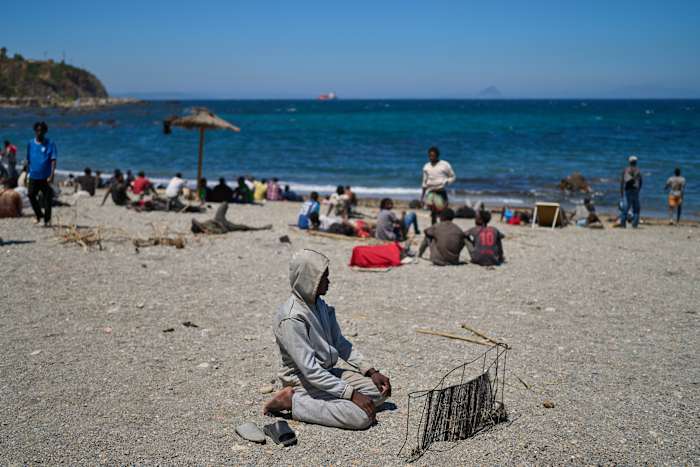
The standard narrative around Ceuta is a masterclass in comforting self-deception. Open any mainstream dispatch, and you will read the same lazy consensus: thousands of migrants sit on Spanish soil at the northern tip of Africa, clinging to romanticized dreams of crossing the Mediterranean to mainland Europe. They are portrayed as passive dreamers, waiting out the clock in temporary limbo.
The media loves this framing. It is neat. It is digestible. And it is entirely wrong. Recently making headlines in related news: Why Blaming Hyderabad Floods On Civic Incompetence Is Lazy Thinking.
I have spent years navigating the border apparatus of North Africa, watching the revolving door of European policy design. I have seen millions in security infrastructure spent on an illusion. The people stuck in Ceuta are not waiting to reach mainland Spain because mainland Spain is rarely the operational endgame anymore. They are trapped in a high-tech open-air containment zone that serves a very specific, cynical purpose for Brussels and Madrid.
Ceuta is not a gateway. It is a parking lot. More information on this are covered by NBC News.
The Geography of Illusion
To understand why the mainstream framing fails, look at the physical reality of the enclave. Ceuta spans roughly nineteen square kilometers. It shares a heavily fortified double fence with Morocco, bristling with razor wire, thermal cameras, and biometric surveillance.
The lazy consensus assumes that if you just cross that fence, you have cracked the code of European migration.
That is an amateur mistake. Crossing the fence into Ceuta does not mean you have entered Europe in any practical, functional sense. It means you have entered a legal black hole. You are on sovereign Spanish territory, yes, but you are physically stranded on a tiny peninsula jutting out of Morocco. You cannot simply buy a ferry ticket to Algeciras and walk off into continental Europe. Spanish authorities enforce strict controls on travel from the enclaves to the mainland. Ferries require rigorous identification checks. If your papers are tied to an asylum application processed within Ceuta, you are legally prohibited from leaving the city until your case is adjudicated—a process that can take years, if it moves at all.
Note: The entire architecture of the border is designed to create friction, not to stop movement entirely. Friction wears people down. It destroys capital, shatters mental health, and turns active agents into passive dependents.
We need to redefine what Ceuta actually is. It is a biological buffer. Morocco uses it as pressure valve for its own labor surplus and geopolitical leverage against Spain. Spain uses it as a remote containment facility to keep migration out of Madrid's political spotlight.
Dismantling the Myth of the Open Door
Let us look at the numbers and the legal reality that journalists routinely gloss over.
When migrants scale the fence or swim around the breakwaters, they enter the Tarajal system. They are processed into local centers—temporary holding facilities that quickly become permanent bottlenecks. The capacity of these centers is routinely overwhelmed, yet expansion is deliberately sluggish. Why? Because a fast, efficient processing system defeats the entire psychological objective of the enclave.
The objective is deterrence by exhaustion.
Imagine a scenario where Spain immediately transferred every person who crossed into Ceuta directly to processing centers in Barcelona or Madrid. The political shockwave on the mainland would force an immediate, radical overhaul of European foreign policy. Instead, by trapping thousands in a geographic cul-de-sac, the state keeps the crisis out of sight and out of mind for the average voter in Seville or Bilbao.
The migrants know this. Contrary to the patronizing portrayal of wide-eyed dreamers "clinging to hope," the people living in Ceuta's margins are hyper-rational actors. They are executing a cost-benefit analysis under brutal constraints. Many realize that the legal route to the mainland is a statistical dead end. Their presence in Ceuta is sustained not by blind optimism, but by the lack of any viable alternative route backward or forward.
The Economic Engine of Containment
Let us talk about the invisible industry profiting from this misery.
Migration control is a massive economic sector. Billions of euros flow from the European Union to North African partners to secure borders, build fences, and train security forces. On the micro-level within Ceuta, an entire local economy depends on the migrant presence and the security apparatus managing it.
Security contractors, logistics firms, local NGOs, and government bureaucrats all have a vested interest in the status quo. If the enclave were suddenly depopulated and the border rationalized, millions in public funding would dry up.
This is the uncomfortable truth behind humanitarian rhetoric. The system is not broken; it is functioning exactly as designed. It manages flow without stopping it, and it punishes without resolving. The mainstream media laments the "plight" of the migrants while ignoring the structural mechanics keeping them there. They focus on the human interest stories—the tearful phone calls home, the makeshift soccer matches on dusty patches of earth—while missing the macro-economic reality: Ceuta is a holding pen designed to absorb the political liability of European border enforcement.
The Unconventional Reality Check
If you want to understand how migration actually works in the twenty-first century, stop looking at border crossings as humanitarian crises and start looking at them as administrative markets.
Supply meets demand, regardless of fences. When physical entry becomes too costly, smugglers pivot to digital fraud, document falsification, or high-risk maritime routes bypassing the enclaves altogether. The people trapped in Ceuta represent the casualties of a transitional phase in border technology.
What is the actionable takeaway from this mess?
Stop treating enclaves like Ceuta as anomalies or waiting rooms. They are permanent structural features of a fractured global economy. Until policymakers admit that geographic containment policies only generate underground markets and human suffering without reducing migration pressures, the situation will remain static.
The dream of reaching mainland Spain from Ceuta is largely a ghost story told by a system that needs an excuse for why thousands of human beings are left to rot in a nineteen-square-kilometer cage.
Stop looking at the hope. Look at the fence. It is not there to keep people out. It is there to keep them trapped.