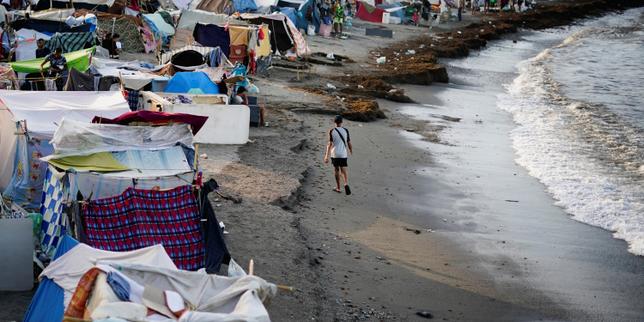
The standard narrative coming out of the Spanish enclave of Ceuta sounds like a humanitarian victory on paper. Move the migrants off the open beaches. Put them into tents inside the port area. Problem solved, right?
Wrong.
We are watching policymakers dress up containment as progress. Shifting human beings from sand to canvas inside a secure perimeter does not solve a structural migration bottleneck; it simply hides the friction from the tourist eye and makes the holding pattern look orderly. I have spent years tracking border logistics across Southern Europe, and every time authorities trade a visible beach camp for an industrial tent zone, they are not fixing a crisis. They are optimizing a parking lot.
The conventional reporting focuses on sanitary conditions, shelter upgrades, and the logistics of the transfer. That completely misses the economic and geopolitical mechanics at play. Temporary tent cities inside port infrastructure do not reduce migratory pressure. They institutionalize limbo.
The Port Container Fallacy
Look closely at what happens when populations living rough on Mediterranean beaches are funneled into controlled port zones. The immediate response from municipal leaders is relief because the shoreline is cleared for commerce and local optics. Beachgoers stop posting photos of makeshift camps on social media. Local politicians can claim they restored public order.
This is an illusion built on administrative sleight of hand.
A tent inside a concrete port facility is still a cage, just one with better zoning permits. When governments prioritize clearing public vistas over addressing the structural velocity of migration, they create a permanent holding architecture. Migrants stuck in port compounds face identical legal vacuums, processing delays, and economic exclusion as those sleeping on the sand. The only variable that changes is the backdrop of their daily stagnation.
Imagine a warehouse manager who sweeps dust under a heavy rug and declares the floor clean. That is the exact policy playbook governing EU border enclaves today.
Why Containment Economics Always Fail
Critics of open beach encampments argue that health hazards and public safety require immediate intervention. That argument is technically correct and entirely superficial. Shifting people to port tents fails because it treats a systemic supply chain failure as a local sanitation issue.
Border governance in geographic bottlenecks like Ceuta and Melilla operates under a false premise: that if you make the waiting environment slightly more organized, the pressure of human movement will somehow dissipate. History proves the opposite. As long as the structural economic disparities between North Africa and mainland Europe persist, physical relocation within a border zone acts as an invitation for endless backlogs.
Port infrastructure is built for freight, cargo transfer, and commercial vessel turnaround. It is fundamentally unequipped to serve as a human processing hub without turning into a bureaucratic black hole. When you lock down access to the broader economy while keeping people trapped at the geographical threshold, you generate chronic dependency.
Dismantling the Humanitarian Cosmetic Trade
Let us address the core question reporters love to ask: How do we humanely manage sudden influxes at European land borders on African soil?
The question itself is flawed. It assumes the primary objective of border management is the efficient management of waiting lists. It is not. The objective should be the elimination of multi-year purgatory through rapid, transparent legal processing or immediate transit integration.
When authorities substitute tents for beaches, they buy time for politicians who lack the political will to negotiate real jurisdictional frameworks. They create a sanitized environment that shields the public from the human cost of bureaucratic inertia.
I have watched migration agencies pour millions into temporary housing upgrades while ignoring the terminal lack of throughput in asylum adjudication systems. Upgrading the roof over someone's head without fixing the pipeline that determines their legal status is cruelty disguised as compassion. A tent in a port does not accelerate a visa hearing by a single second.
The Uncomfortable Truth About Border Thresholds
The uncomfortable reality that neither activists nor hardliners want to admit is that containment zones serve both sides of the political spectrum. For defenders of strict border controls, tents in ports keep unauthorized arrivals out of mainland sightlines. For short-sighted humanitarian advocates, tents offer a visual upgrade from bare earth.
Both groups are cheering for the wrong metric.
True reform would require tearing down the artificial barriers that turn border cities into permanent parking brakes for human ambition. It requires acknowledging that geographic choke points cannot absorb the weight of global demographic shifts through localized tent deployment.
Stop praising logistical shuffles that merely sweep human reality behind port security gates. Until policymakers confront the broken processing engines behind the tents, every relocation is just a reshuffling of deck chairs on a stalled vessel.


