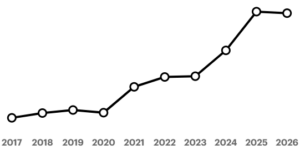
Contemporary Amperex Technology Co. Limited (CATL) serves as the primary arbiter of the global electric vehicle (EV) supply chain, yet its recent 8.1% equity depreciation following a $5 billion private placement signals a critical tension between industrial dominance and capital efficiency. The market response reflects a fundamental revaluation of how the world’s largest battery manufacturer manages its weighted average cost of capital (WACC) against a backdrop of aggressive capacity expansion and diminishing marginal returns on lithium-ion technology. To understand this move, one must deconstruct the interplay between secondary market liquidity, the "CapEx Treadmill," and the geopolitical shifts in battery chemistry hegemony.
The Trilemma of Scale-Driven Depreciation
The immediate 8% drop in share price is not a commentary on CATL’s operational viability, but rather a reaction to the Dilution-Risk-Opportunity Framework. When a dominant market leader seeks $5 billion in fresh equity, it signals three distinct structural realities that the market must price in instantly. Learn more on a connected subject: this related article.
- Immediate EPS Compression: The issuance of new shares increases the denominator in the earnings-per-share calculation. For institutional investors, this represents a transfer of value from existing holders to the new capital pool unless the Return on Invested Capital (ROIC) from the new $5 billion exceeds the current cost of equity.
- The Signal of Overvaluation: Under the Pecking Order Theory of corporate finance, firms prefer internal financing first, debt second, and equity last. By opting for a massive equity placement, CATL management implicitly suggests that the current share price is a more attractive "currency" for fundraising than taking on further bank debt or utilizing cash reserves, which often triggers a bearish correction.
- The CapEx Absorption Rate: CATL is currently caught in a cycle where maintaining a 30% plus global market share requires constant, multi-billion dollar infusions to build Giga-factories that take 24 to 36 months to reach peak utilization. The market is questioning whether the global EV demand curve can absorb this volume fast enough to prevent a glut in the mid-2020s.
The Cost Function of Global Energy Storage Leadership
CATL’s dominance is built on a specific cost function that prioritizes vertical integration and massive volume to drive down the Levelized Cost of Storage (LCOS). This $5 billion placement is the fuel for a specific three-pronged strategic offensive.
1. Lithium Iron Phosphate (LFP) Supply Chain Moats
While Western manufacturers have historically focused on Nickel Manganese Cobalt (NMC) chemistries for energy density, CATL has mastered the LFP cycle. LFP is cheaper, safer, and does not require cobalt—a mineral fraught with supply chain volatility. However, LFP’s lower energy density requires larger-scale production to achieve the same economic utility. The capital infusion is likely earmarked for the expansion of LFP-specific lines and the development of M3P technology, which introduces manganese to boost density while retaining the LFP cost profile. More journalism by Forbes highlights comparable perspectives on this issue.
2. The Geographic Pivot: Circumventing Trade Barriers
The "China-Plus-One" strategy is no longer optional. With the United States’ Inflation Reduction Act (IRA) and the EU’s evolving battery regulations, CATL cannot rely solely on its Ningde production hub. This capital allows CATL to establish physical footprints in regions that qualify for local subsidies, effectively buying its way into Western markets through joint ventures or localized assembly. The cost of building a GWh of capacity in Europe or North America is significantly higher than in mainland China; the $5 billion serves as a "localization premium" to ensure CATL remains the default partner for Ford, BMW, and Tesla.
3. R&D as a Defensive Barrier
CATL is moving beyond liquid-state batteries. A portion of this capital is a bet on the Transition Logic of Solid-State and Sodium-Ion.
- Sodium-Ion: Bypasses the lithium supply bottleneck entirely.
- Condensed Battery Technology: Targets the aviation and heavy-duty transport sectors.
- Solid-State: The long-term hedge against potential disruption from Toyota or QuantumScape.
The Geopolitical Risk Premium
The 8% plunge cannot be viewed in a vacuum; it is inextricably linked to the Geopolitical Risk Multiplier. Analysts are pricing in the probability of "regulatory decoupling." If CATL is restricted from the U.S. market via Entity List designations or aggressive tariff structures, its projected volume growth is halved.
The $5 billion placement provides a massive cash buffer, effectively turning the balance sheet into a fortress. In a high-interest-rate environment where smaller competitors face insolvency or expensive debt, CATL's equity-funded "war chest" allows it to play a game of attrition. It can afford to lower margins to squeeze out second-tier manufacturers in China and Southeast Asia, consolidating the market further during a downturn.
The Margin Compression Paradox
A critical oversight in standard reporting is the Scale vs. Scarcity Paradox. As CATL scales, it gains power over suppliers, but it also becomes the largest buyer of raw materials like lithium carbonate and spodumene. This creates a feedback loop: every GWh of capacity CATL adds puts upward pressure on the very raw materials it needs to remain low-cost.
The $5 billion is a strategic move to move further upstream. By owning the mines and the processing facilities, CATL transforms from a manufacturer into a vertically integrated energy utility. The market's "plunge" reflects a short-term fear of dilution, but the long-term logic is the creation of a "Battery OPEC" where CATL dictates the pricing floor for the entire transport sector.
Assessing the Structural Bottlenecks
Despite the massive capital injection, three bottlenecks remain that money alone cannot solve:
- The Talent Scarcity in Electro-Chemistry: There is a finite global pool of engineers capable of optimizing cell-to-pack (CTP) efficiency.
- Grid Integration Latency: Producing 500 GWh of batteries is useless if the charging infrastructure and power grids cannot handle the throughput.
- Recycling Loop Closure: Until CATL can recover 90% plus of its materials through black mass processing, it remains a slave to primary mining cycles.
The Strategic Play for Institutional Allocators
The 8% drawdown represents a fundamental entry point for those who prioritize structural market dominance over short-term EPS fluctuations. The $5 billion placement is a signal of aggression, not distress. CATL is effectively "over-capitalizing" to ensure that when the inevitable shakeout of the 200+ global battery startups occurs, it is the only entity with the liquidity to acquire distressed assets and the capacity to meet the procurement needs of the world’s Top 10 OEMs simultaneously.
Investors should monitor the Utilization Rate of New Capacity. If CATL’s utilization drops below 70%, the $5 billion was a misallocation of capital. If it stays above 85%, the dilution will be neutralized by 2027 through sheer volume-driven profit growth. The play here is not on the battery itself, but on the management of the global lithium-ion supply chain. CATL is no longer a technology company; it is a specialized financial institution that happens to manufacture electrochemical cells. The final strategic move for the firm is the transition from a hardware seller to an "Energy-as-a-Service" provider, utilizing its massive battery footprint to stabilize global power grids, a move that would decouple its valuation from the cyclical nature of the automotive industry entirely.