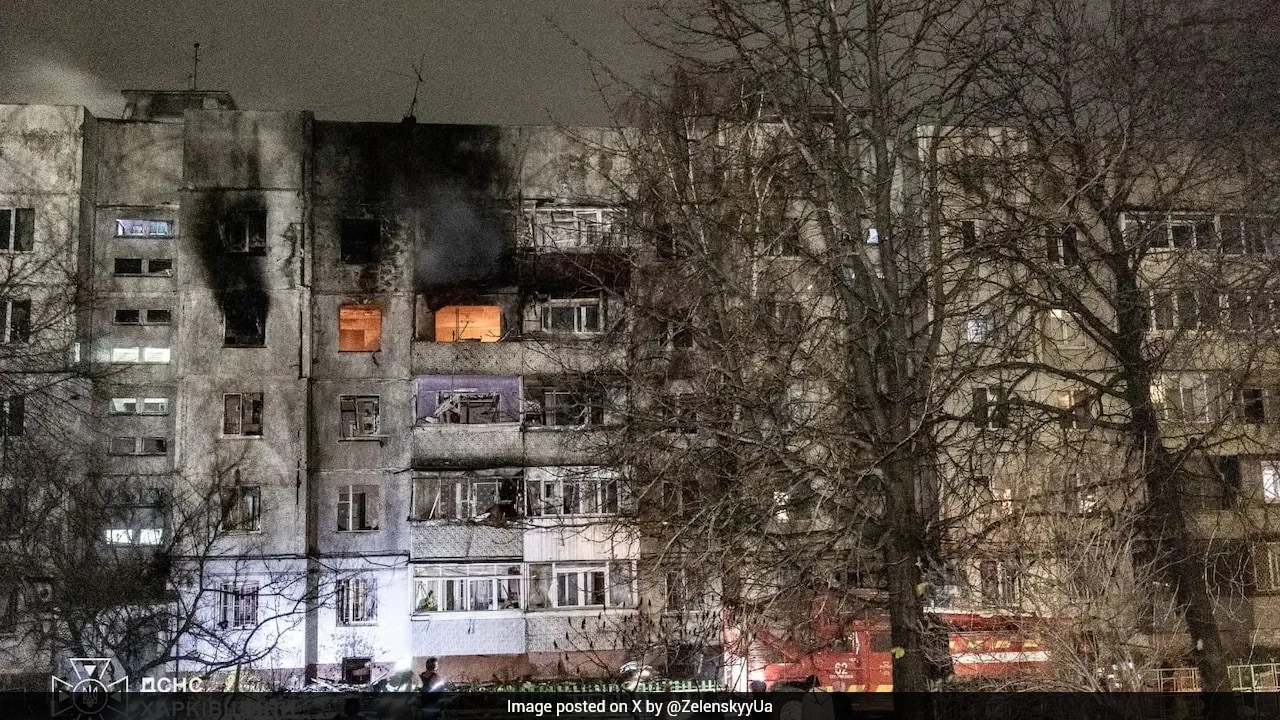
Moral outrage makes for great headlines, and terrible military analysis.
When Volodymyr Zelensky brands Vladimir Putin a "killer" following a Russian double tap missile strike, the Western media machine locks into a familiar, predictable rhythm. Newsrooms publish the quote. Pundits express shock. Readers nod along, feel a brief spike of righteous anger, and scroll to the next story. It is the lazy consensus of modern war coverage. By framing calculated military doctrine as mere cartoon villainy, analysts blind the public to why these strikes happen, how they actually function on the modern battlefield, and why moral condemnation does zero to stop them.
Calling the orchestrator of an invasion a killer is like calling water wet. It states the obvious while obscuring the mechanics. A double tap strike is not an emotional outburst from an unhinged autocrat. It is a cold, mathematically derived military tactic designed to maximize attrition, paralyze emergency infrastructure, and break the logistical spine of a defending nation. If you want to understand how Ukraine survives this—or how modern warfare is evolving—you have to stop looking at the moral labels and start looking at the targeting doctrine.
The Anatomy of a Double Tap Is Pure Attrition
Most civilians think a double tap strike is just firing two missiles at the same spot because the first one missed. That is completely wrong.
In military terminology, a double tap strike is a staggered engagement. The first munition hits a target—often a dual-use facility, a command post, or a dense urban hub. Then, the attacker waits. They do not wait five seconds. They wait anywhere from ten to forty minutes. Using overhead reconnaissance drones, they watch the exact window when first responders, paramedics, firefighters, and military recovery teams converge on the blast zone. Then, they drop the second munition directly onto the rescue effort.
I have spent years analyzing post-strike telemetry and asymmetrical conflict patterns. Every time a major news outlet reduces this tactic to a headline about personal evil, they miss the terrifying efficiency of the strategy.
Consider the math from a purely cynical, militaristic perspective:
- Destroying a building costs money and achieves temporary disruption. Concrete can be cleared. Generators can be wheeled in.
- Eliminating specialized human capital causes permanent systemic paralysis. You cannot manufacture a veteran trauma surgeon, a trained combat medic, or an experienced structural rescue engineer in a factory.
By targeting the rescue phase, the attacker forces the defender into an impossible operational dilemma. If emergency services rush in immediately, they get wiped out. If they hold back to wait out the secondary strike window, people bleed out under the rubble, fires spread unchecked, and public trust in state protection collapses. That is not blind rage. That is cold-blooded systems engineering applied to human misery.
Why Moral Outrage Is a Strategic Trap
Zelensky knows exactly what he is doing when he uses words like "killer." He is not speaking to military historians; he is speaking to Western voters and hesitant lawmakers in Washington, Berlin, and London. He needs to keep the moral clarity of the conflict sharp so that air defense shipments keep flowing. That is his job as a wartime president.
The failure lies with the media and the analysts who parrot the framing without dissecting the underlying reality. When the public is fed a steady diet of moral labels, they begin to believe that wars are won by having the moral high ground.
History shows the exact opposite. Under the Geneva Conventions—specifically Protocol I, which protects medical personnel and civil defense organizations—deliberately targeting first responders is a textbook war crime. International humanitarian law is crystal clear on this point. Yet, international law has no enforcement mechanism without overwhelming kinetic force backing it up.
Imagine a scenario where a neighborhood is hit by a ballistic missile. Ten minutes later, a second missile strikes the ambulances parked outside. The international community issues a wave of strongly worded statements condemning the "barbaric" and "murderous" act. Does that put a single Patriot interceptor battery on a cargo plane? Does it harden a single electrical substation? No. Moral condemnation functions as a psychological release valve for Western observers. It lets people feel like they have done something by agreeing that the bad guy is bad, all while avoiding the hard, expensive conversations about air defense saturation and long-range strike permissions.
The Historical Precedent Nobody Wants to Mention
To treat double tap strikes as a uniquely Russian pathology is another massive blind spot in mainstream reporting. If you look at the history of modern conflict, this tactic has been used across multiple theaters by state and non-state actors alike.
During the Syrian Civil War, Russian and Syrian regime forces systematically used double tap strikes against White Helmets rescue workers in Aleppo and Idlib. The pattern was identical: barrel bombs or precision strikes followed twenty minutes later by secondary hits on the exact same coordinates. It was a deliberate campaign to turn rebel-held cities into uninhabitable wastelands where even the prospect of medical rescue was erased.
Before that, insurgent groups in Iraq and Afghanistan perfected the low-tech version of the double tap using Improvised Explosive Devices. A small blast would disable a Humvee or draw a crowd of local police; a much larger, command-detonated device hidden nearby would wipe out the quick reaction force. Even Western counterterrorism drone campaigns in the 2010s faced intense scrutiny from legal scholars and organizations like Human Rights Watch over "follow-up strikes" on individuals attempting to rescue victims of an initial Hellfire missile hit.
The point is not moral equivalence. A democratic state agonizing over collateral damage in a counterinsurgency is worlds apart from an authoritarian regime leveling sovereign cities. The point is tactical reality. The double tap exists because, in purely cold military terms, it works. It exploits the most predictable human instinct on earth: the urge to run toward the sound of an explosion to help the wounded.
What People Actually Need to Understand About Modern Air Defense
When readers see headlines about double tap attacks, they usually ask the wrong questions. They ask why international courts do not arrest the leaders, or how a human being can order such a thing. Those questions lead to dead ends. The real questions are operational, and the answers are deeply uncomfortable.
Why cannot air defenses stop the second missile?
Because air defense is a game of math and magazine depth, not an impenetrable dome. When Russia launches a complex strike package, they mix cheap decoys, slow-moving Shahed drones, cruise missiles, and quasi-ballistic missiles like the Iskander-M. The first wave forces Ukrainian air defense batteries to fire their interceptors and reveal their radar emissions. While those batteries are reloading or relocating to avoid counter-battery fire, the second wave slips through the gap. Calling it a failure of morality ignores the brutal reality of interceptor depletion.
Does labeling Putin a war criminal change Russian military behavior?
Not in the slightest. The International Criminal Court already issued an arrest warrant for Putin in 2023. Once a leader is sanctioned, isolated from Western financial systems, and indicted internationally, the deterrent value of further moral condemnation drops to zero. You cannot threaten a pariah with becoming a pariah. At that stage, the only metric that alters battlefield behavior is the physical destruction of the launch platforms—the bombers, the naval vessels, and the ground-based transporter-erector-launchers.
How do emergency services actually adapt to double tap threats?
They have to rewrite their entire emergency response playbook, often at the cost of civilian lives. Standard firefighting and paramedic doctrine relies on the "golden hour"—getting trauma care to victims as fast as possible. Under a double tap regime, rushing in immediately is suicide. Ukrainian first responders have been forced to implement mandatory waiting periods, deploy armored vehicles for urban rescue, utilize drones to assess blast sites before sending in human teams, and disperse medical units so a single blast cannot wipe out an entire shift.
The Downside of Cold Strategic Realism
Stripping away the moral language to focus purely on military mechanics carries a real risk, and it would be dishonest to ignore it.
If you look at war exclusively through the lens of attrition rates, interceptor ratios, and targeting doctrine, you risk normalizing atrocities. You start talking about dead paramedics as "depleted human capital" and bombed apartment blocks as "dual-use infrastructure." That clinical detachment is precisely how militaries slide into total war, losing sight of the human beings at the center of the conflict. Moral clarity is essential for maintaining the political will to resist aggression. Without the visceral outrage sparked by leaders like Zelensky, public apathy sets in, and democracies abandon their allies.
The trick is holding two truths in your head at the same time. You can recognize the absolute moral depravity of targeting rescue workers while simultaneously refusing to let moral outrage substitute for hard-nosed strategic analysis.
Stop Consuming Outrage and Start Demanding Strategy
The next time a missile hits a Ukrainian city and a second one follows thirty minutes later, watch how the coverage unfolds. You will see the same quotes, the same expressions of shock, and the same surface-level commentary painting the event as an isolated burst of cruelty.
Reject that framing. Recognize it for what it is: a distraction from the hard material realities of the war. Double tap strikes are a signature feature of modern attrition warfare, enabled by persistent drone surveillance and gaps in air defense coverage. They will not be stopped by speeches, hashtags, or diplomatic condemnations. They are only stopped by layered air defense networks, electronic warfare dominance, and the ability to strike the launchers before they fire.
Stop mistaking moral labeling for strategic action.