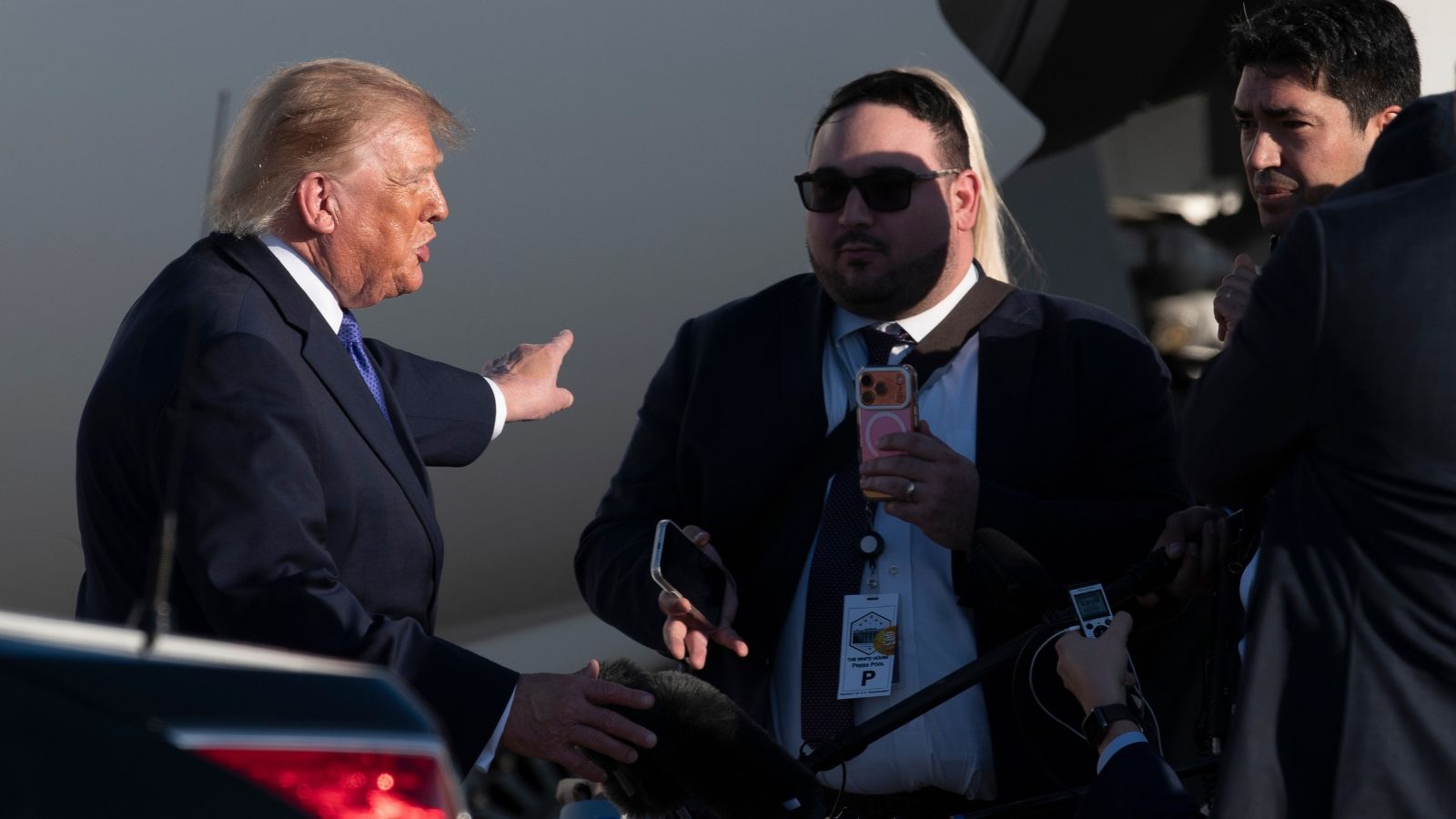
When Donald Trump publicly berates a reporter’s physical appearance after being pressed on a canceled campaign rally, the outburst is rarely a momentary lapse in discipline. It is a deliberate, well-rehearsed media strategy designed to hijack the news cycle and bury an embarrassing operational failure under a mountain of outrage. By targeting a journalist's body, the campaign shifts the public conversation from logistical incompetence—such as low ticket demand, unpaid venue bills, or shrinking donor enthusiasm—to a familiar, polarizing spectacle of cultural grievance.
Most political coverage falls directly into this trap. Reporters rush to document the cruelty of the insult, media critics debate the erosion of democratic norms, and cable news panels spend forty-eight hours dissecting the exact phrasing of the attack. Meanwhile, the original question about why a major campaign event abruptly vanished from the schedule goes entirely unanswered.
The Anatomy of a Distraction
To understand why personal insults remain a staple of modern political communication, you have to look at the mechanics of the attention economy. Traditional political damage control relies on minimization. When a standard candidate cancels a rally due to poor turnout or logistical failures, their communications team releases a dry statement citing "scheduling conflicts" or "inclement weather" and hopes the story dies on page fourteen.
Trump’s media operation operates on the exact opposite principle. Instead of minimizing a bad story, they flood the zone with an even bigger, louder controversy that forces the press corps to pivot.
Consider how this plays out in real time. A journalist asks a sharp, grounded question about a canceled rally—a metric that directly reflects campaign health, grassroots enthusiasm, and financial stability. Answering that question honestly requires admitting weakness, which is fatal to a political brand built entirely on the projection of relentless momentum and inevitable victory. Deflecting with policy talk is boring and easily ignored. Attacking the questioner’s appearance, however, guarantees instant, wall-to-wall coverage.
The insult acts as a smoke grenade. Within minutes, the clip is trending across social media platforms. Outraged commentators share the video to condemn the behavior, inadvertently amplifying the distraction to millions of users. Supporters share the exact same clip as evidence that their candidate is fighting back against a hostile press. In both cases, the canceled rally is forgotten. The operational failure has been successfully erased from the public consciousness.
Why Body Shaming Works as a Political Tool
Personal attacks on journalists are not chosen at random. They are calibrated to exploit specific vulnerabilities in how newsrooms operate and how audiences consume political conflict.
For decades, political operatives have understood that ad hominem attacks—targeting the person making an argument rather than the argument itself—are uniquely effective on television and social media. Complex logistical explanations require context, nuance, and attention spans that fragmented digital audiences rarely possess. A visceral, schoolyard insult requires zero context. It is immediately understood, emotionally charged, and endlessly repeatable in short video clips.
Furthermore, targeting a reporter’s physical appearance serves a secondary purpose within the broader anti-media ecosystem. By reducing a credentialed investigative journalist to a physical caricature, the speaker attempts to strip away their professional authority. The implicit message to the audience is clear: do not listen to this person's reporting on our campaign's struggles, because they are beneath respect.
It also puts the targeted journalist and their news organization in an impossible bind. If the reporter pushes back or defends themselves, they risk validating the narrative that they are an active combatant rather than an objective observer. If they ignore the insult and repeat the question, they often get talked over or cut off, leaving the audience with only the spectacle of the abuse.
The Hidden Costs of Canceled Rallies
What gets lost in the noise over the insult is why a canceled rally actually matters. In modern presidential politics, large-scale rallies are not merely pep rallies for the faithful; they are massive logistical undertakings that serve as critical data-harvesting and fundraising engines.
Every time a campaign books an arena or an outdoor fairground, they are making a calculated financial bet. Advance teams must secure permits, hire local security, contract audiovisual vendors, and coordinate with local law enforcement. More importantly, the ticketing process allows the campaign to capture cell phone numbers, email addresses, and zip codes of attendees, feeding vital voter data into their digital fundraising apparatus.
When a rally is abruptly canceled, it usually points to one of several uncomfortable realities behind the scenes:
- Anemic RSVP numbers: Campaigns closely track digital ticket requests in the days leading up to an event. If the numbers fail to hit internal benchmarks, the campaign faces the nightmare scenario of television cameras panning across thousands of empty seats. Canceling the event is often seen as less damaging than broadcasting visual proof of declining enthusiasm.
- Cash flow bottlenecks: Holding a major rally can easily cost hundreds of thousands of dollars once venue rentals, private security, and travel logistics are factored in. Several municipalities across the country have publicly pressed campaigns over unpaid invoices from previous election cycles, forcing advance teams to demand upfront payments that cash-strapped operations may struggle to meet.
- Strategic triage: When polling data shows a state slipping out of reach—or conversely, when internal numbers suggest a region is already locked up—campaign managers will ruthlessly cut scheduled appearances to reallocate scarce resources to tighter battlegrounds. Admitting this publicly, however, demoralizes local volunteers and donors.
A reporter asking about a canceled rally is pulling on a thread that leads directly to these operational realities. By responding with a vicious personal attack, the candidate slams the door on that line of inquiry before the public ever realizes what was behind it.
The Media’s Complicity in the Cycle
If this tactic is so transparent, why does it continue to work year after year? The answer lies in the perverse incentives governing modern political journalism.
Newsrooms are businesses competing for clicks, ratings, and engagement in a brutal media market. A nuanced, data-driven report examining municipal permit filings, campaign finance disclosures, and venue capacities to explain why a rally was scrapped will attract a modest, policy-minded readership. A thirty-second video clip of a political figure calling a reporter "disgusting" will generate millions of views, thousands of angry comments, and hours of lucrative cable news panel discussions.
Editors know this. Producers know this. Even the reporters standing in the press pen know this.
When a shock-jock tactic is deployed, the institutional reflex of the press corps is to treat the outrage itself as the primary news event. Headlines are written around the exact quote of the insult, relegating the underlying context—the canceled rally—to a subordinate clause at the very end of the sentence. The journalist who asked the tough question becomes the story, while the evasion of the answer becomes a footnote.
This dynamic creates a self-reinforcing loop. Politicians learn that the fastest way to kill an uncomfortable investigative thread is to insult the reporter pursuing it. The media, addicted to the engagement that outrage provides, dutifully amplifies the insult and drops the investigation.
Historical Precedents and Escalation
Weaponizing insults against the press is hardly a new invention in American politics, though the brazenness of targeting physical appearance marks a distinct escalation.
Throughout the nineteenth century, partisan newspapers routinely traded vicious personal barbs with politicians, often mocking physical deformities, drinking habits, and personal hygiene. In the modern broadcast era, however, an unspoken truce generally held. Presidents from Lyndon B. Johnson to Richard Nixon harbored deep, visceral hatred for specific journalists and worked behind the scenes to ruin their careers or audit their taxes, yet they largely maintained a veneer of civility when the cameras were rolling.
Spiro Agnew, Nixon’s vice president, famously broke that mold in the late 1960s by attacking the press corps directly in speeches, labeling them "nattering nabobs of negativism." Yet even Agnew’s attacks were aimed at the perceived ideological bias and elitism of the media establishment as a whole, rather than the physical body of an individual reporter standing ten feet away.
What has changed in the current era is the collapse of shame as a regulatory mechanism in public life. Previously, a politician who mocked a reporter's weight or appearance on live television risked alienating moderate, suburban voters who valued basic decorum. Today, the complete polarization of the media ecosystem ensures that such behavior is instantly rationalized, defended, or celebrated by partisan media outlets as an act of strength against a corrupt institution.
Breaking the Distraction Loop
For journalists covering high-conflict political figures, navigating these ambushes requires a fundamental shift in how press interactions are framed and reported. The goal cannot be to win a shouting match at the podium; the speaker holds the microphone, controls the room, and thrives on the chaos of a public brawl.
Instead, the discipline must happen in the editing room and on the broadcast desk. When a politician uses a personal insult to dodge a substantive question about campaign operations, legal troubles, or policy failures, the coverage must treat the insult as what it is: an evasion.
A handful of seasoned political reporters have already demonstrated how to neutralize this tactic. Rather than taking the bait or responding emotionally in the moment, they simply absorb the blow, keep their composure, and immediately repeat the original question on the record. When writing the story afterward, they lead with the unanswered operational failure and mention the personal attack only as evidence of the candidate’s refusal to address the facts.
Audiences, too, have a role to play in recognizing when their attention is being manipulated. Every time a viral clip of a political insult dominates the timeline, it is worth pausing to ask a simple question: what happened right before the camera started rolling? Almost without exception, you will find a quiet, uncomfortable truth that someone desperately wanted you to ignore.