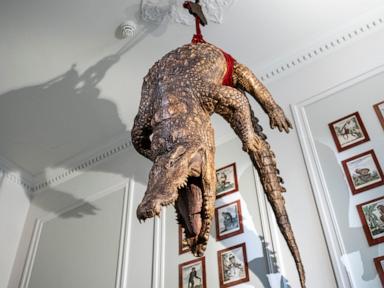
Walk through the entrance of Amsterdam's Art Zoo, look up, and a 12-foot crocodile stares straight down with its mouth wide open. Meanwhile, you're the one standing behind black metal bars.
That role reversal is the whole point of Art Zoo, the museum created by Dutch artists Jaap Sinke and Ferry van Tongeren inside a 17th-century canal house on Herengracht. Instead of putting preserved animals behind glass or iron while people stroll freely past them, the building wraps visitors inside caged zones while hundreds of taxidermied creatures, skeletons, and oddities occupy the open rooms around them. Honestly, it feels unsettling right away—and that friction is what makes it stick in your head long after you step back onto the canal street.
How Amsterdam's Art Zoo Flips the Museum Script
Traditional natural history museums usually try to disappear into the background. Their dioramas aim for scientific accuracy and quiet realism: a wolf mid-stride on painted tundra, a bird perched neatly on a branch that looks like the wild.
Sinke and van Tongeren aren't trying to mimic nature. As van Tongeren explained to the Associated Press, their work leans into storytelling, drama, and attitude rather than strict lifelike imitation. You don't just see specimens cataloged by species. You see a cheetah lounging in an alcove beneath a watching cassowary, a Japanese giant spider crab stretching six-foot legs above a doorway, and mastodon leg bones rising toward the ceiling.
Putting people inside cages while the animals appear to roam free turns the architecture itself into part of the piece. When you're the one looking out through bars at a gaping crocodile or a prowling feline, your usual tourist detachment gets rattled. Even casual visitors have described the sensation as a little creepy—in a way that makes you pay closer attention to how humans have historically framed and controlled the natural world.
Cabinets of Wonder in a Former Biblical Museum
The concept isn't pulled out of thin air. Sinke and van Tongeren draw heavily on 16th- and 17th-century wunderkammers—the encyclopedic curiosity cabinets where wealthy Europeans mixed natural specimens, fossils, and strange objects to spark awe. Back then, wonder and weirdness lived side by side before modern museums split art, science, and history into neat departments.
Charles Darwin sits right at the center of that creative spirit for the pair. They often talk about him almost as a third collaborator, framing the space as a return to Darwinian wonder. One display lines up busts of Darwin turned sideways so their distorted profiles seem to watch guests moving between caged rooms.
There's extra irony in the address. The canal house previously housed the Biblical Museum, making a bold, playful Darwin tribute inside those walls feel even sharper. It's a classic Amsterdam mix of old-world grandeur, dark humor, and theatrical provocation.
What's Actually Real Inside the Collection
When people hear about a museum packed with dead animals and giant sea creatures, two questions usually pop up immediately: where did all these animals come from, and is everything genuine?
On sourcing, Sinke has stated that none of the animals were taken from the wild for the collection, noting that specimens come from zoos where they died of natural causes, mostly sourced within Europe so the artists can track their backgrounds. Anyone who has worked around museum collections or wildlife regulations knows that paperwork isn't a minor detail—tracking provenance and permits across European institutions takes serious legwork, especially when moving from art-world exhibitions to a permanent public venue.
Long before opening the Amsterdam museum, Sinke and van Tongeren already made waves in contemporary art, including back in 2015 when artist Damien Hirst purchased their entire collection at a London art show. Still, working with taxidermy and animal remains inevitably raises ethical debates. Even when specimens come from natural zoo deaths rather than poaching or hunting, some visitors feel uneasy seeing exotic wildlife posed dramatically for aesthetic impact. Acknowledging that tension is part of being honest about what kind of place this is: it's an artistic statement first, not a conventional wildlife sanctuary or textbook biology hall.
Not everything in the building is a straightforward biological specimen either. Below the large crocodile display are Jenny Hanivers—ray carcasses altered by 16th-century sailors and passed off to gullible buyers as mythical sea monsters. Including historical hoaxes right next to real bones and taxidermy reminds you how easily human imagination blends fact and fantasy.
Common Misconceptions About Art Zoo
Because viral headlines love shock value, a few assumptions tend to travel faster than the facts:
- It's a traditional natural history museum: Not really. Labels and specimen notes exist in standard museums to teach taxonomy and ecology, whereas Art Zoo prioritizes mood, staging, and visual juxtaposition.
- Every creature is a pristine "wild" pose: Traditional taxidermy aims to recreate life in the wild. Sinke and van Tongeren lean into theatrical staging and eccentric proportions instead.
- You're locked in a tiny cell the whole time: The caged framing is an architectural and experiential device around the rooms and walkways, meant to invert observer and observed rather than lock people into punishment cells.
Practical Tips If You Plan to Visit
If you're mapping out a trip to Amsterdam and thinking about putting Art Zoo on your list, a few practical details will help you get more out of it:
- Check current hours, tickets, and pricing before you go: Museum schedules, admission rates, and pass rules can shift after opening, so verify official details directly on Art Zoo's website or via local listings like DutchNews.
- Pair it with a contrasting museum: Because the rooms are dim, dramatic, and heavy on taxidermy and bones, balancing it with a bright painting collection or a canal walk keeps the day from feeling one-note.
- Go with an open, curious mindset: If you expect quiet wildlife photography or a kid-friendly petting zoo, you'll be caught off guard. Treat it like a dark, theatrical art installation inside a historic canal house, and take your time noticing the smaller historical details alongside the big showstoppers.