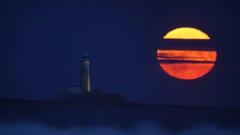
Every July, millions of skywatchers step outside with high expectations. They look toward the horizon hoping to witness a massive, amber-hued orb dominating the night. Instead, they often find a washed-out, ordinary-looking white dot sitting high overhead. The discrepancy between sensationalized media coverage and actual observational reality frustrates amateur astronomers every single summer.
The July full moon, traditionally known as the Buck Moon, suffers from intense overhype. Publications roll out identical guides year after year, promising monumental celestial spectacles. They skip the physics, ignore atmospheric conditions, and gloss over timing mechanics. Observers head out blindly based on flawed hype, only to miss the actual window of visual distortion that makes low-hanging moons look impressive.
Understanding how to properly view the July full moon requires stripping away the folklore and examining the orbital mechanics and atmospheric optics at play.
The Optical Illusion Behind the Giant Moon
The primary driver of the July full moon's internet fame is the moon illusion. When the satellite sits close to the horizon, human brains perceive it as drastically larger than when it hangs high in the zenith.
Scale perception relies heavily on terrestrial objects. Trees, buildings, and distant hills provide a frame of reference that tricks the visual cortex. Without a scale reference overhead, a high moon looks small. Near the ground, your brain compares the lunar disk to familiar neighborhood architecture and inflates its perceived dimensions.
Physical size remains completely constant throughout the night. Angular diameter changes slightly due to elliptical orbital geometry, but night-to-night variations are negligible to the naked eye. The massive orb photographed over city skylines relies on telephoto compression lenses, not raw human eyesight. Photographers use long focal lengths to magnify foreground elements alongside the lunar disk, creating an exaggerated composition that reality rarely matches unaided.
Atmospheric Scattering and the Amber Hue
Color alteration creates another layer of misunderstanding. Observers expect a glowing orange or red ember, but frequently get blinding white light instead.
Earth's atmosphere acts as a selective filter. Sunlight reflected off the lunar surface must travel through a much thicker slice of air when the moon hugs the horizon than when it sits straight up. Gas molecules and airborne particulates scatter shorter wavelengths like blue and violet in all directions. Longer wavelengths, including reds and oranges, punch through the dense air columns to reach human eyes.
Air pollution, humidity, and wildfire smoke heavily influence this coloration process. A completely clear, dry night yields a much paler yellow or brilliant white even at moonrise. Expecting a deep crimson fire-moon every July ignores local meteorological variables.
Timing the Optimal Viewing Window
Most casual observers check a generic calendar date, walk outside at midnight, and wonder why the moon looks ordinary. Timing is everything, and the best viewing window is remarkably brief.
Peak illumination occurs at an exact planetary coordinate, but that moment rarely aligns with local moonrise. The crucial moment happens during twilight. If the moon crests the horizon just as the sun dips below the opposite side, ambient sky brightness balances out the blinding lunar glare. This equilibrium allows both the rich color and the foreground scenery to register simultaneously on the human retina and camera sensors.
- Check exact moonrise times for specific geographic coordinates rather than general regional estimates.
- Arrive at an observation point thirty minutes before calculated moonrise to set up equipment and locate landmarks.
- Face toward the eastern horizon with unobstructed views.
- Allow eyes fifteen minutes to dark-adapt away from artificial light pollution.
Once the moon climbs more than ten degrees above the horizon, the atmospheric filtering effect drops away. The illusion fades. The color shifts from amber to stark, clinical white. The window closes within an hour of initial appearance.
Deconstructing the Buck Moon Name
Folklore surrounding lunar monikers often gets treated as ancient, immutable science. The term Buck Moon originates from the seasonal biology of male white-tailed deer. Antlers grow rapidly during July, hardening into velvet-covered bone structures.
Colonial American and Native American traditions tracked seasonal shifts through animal behavior, agricultural cycles, and weather patterns. Different tribes utilized distinct naming systems based on local ecology. Calling July's lunar event the Buck Moon represents one specific regional lexicon popularized through almanacs over centuries.
Other historical designations include the Thunder Moon, referencing frequent mid-summer convective storms, and the Salmon Moon in Pacific coastal regions. Treating these labels as official astronomical classifications misunderstands their cultural origins. Modern science utilizes numerical cataloging and precise orbital coordinates, leaving colloquial names to cultural historians and lifestyle magazines.
Practical Observation Challenges
Urban light pollution remains the silent killer of amateur astronomy. Streetlights, commercial signage, and ambient city glow wash out low-contrast celestial features. While a full moon cuts through light pollution better than faint nebulae or distant galaxies, hazy urban air scatters moonlight uniformly, destroying the crisp horizon contrast needed for the best visual experience.
Cloud cover presents an equally persistent obstacle. July brings high humidity and convective weather patterns across vast regions, transforming clear afternoon skies into overcast night blankets with little warning. Relying on single-night plans often leads to disappointment. Smart observers monitor satellite loops and upper-level moisture charts rather than trusting static weather apps.
Binoculars offer an accessible upgrade for casual watchers. Naked-eye viewing reveals general brightness and maria shadows, but low-power binoculars or a spotting scope resolve crater rims, ray systems, and highland plateaus with stark clarity. High magnification during a full moon can cause temporary eye strain due to extreme surface albedo reflection. Direct sunlight bouncing off white lunar regolith creates a harsh glare that benefits from polarizing filters during extended telescopic sessions.
Moving Beyond the Hype
Astro-tourism has grown into a massive industry, driving traffic to remote dark-sky parks and coastal lookouts every time a notable lunar event hits social media feeds. This commercialized excitement frequently sets impossible expectations.
Real observation requires patience, preparation, and an acceptance of natural variables. The universe does not stage performances to match promotional calendar graphics. Understanding the physics behind atmospheric refraction and optical processing turns a potentially disappointing night into an exercise in applied earth science.
The next time a glowing July headline promises an otherworldly spectacle, skip the generic hype, check the local horizon clearance, and watch the physics unfold in real time.