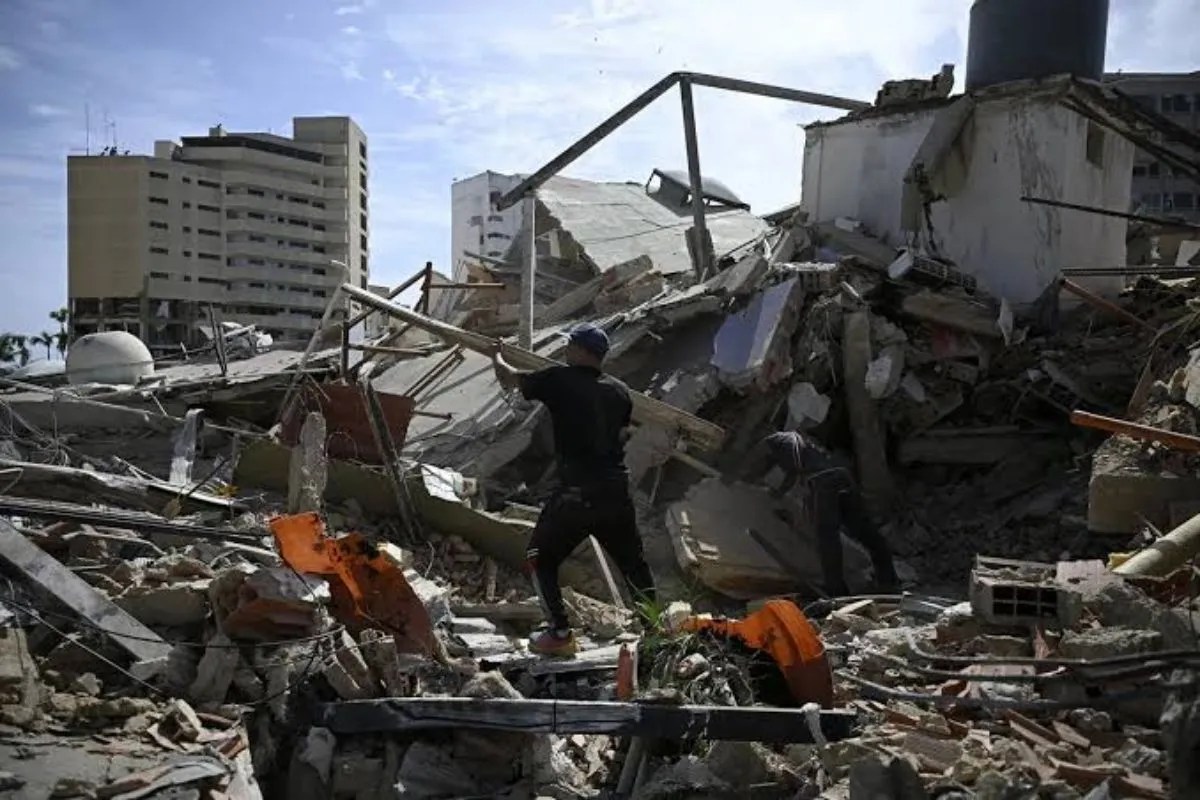
The death toll from the devastating twin earthquakes that struck northern Venezuela has climbed to 3,342, with more than 16,740 people injured and thousands left homeless. On June 24, 2026, a 7.2 magnitude shock followed just 39 seconds apart by a 7.5 magnitude tremor brought down hundreds of buildings across the north-central region, primarily flattening coastal towns in La Guaira state. Emergency responders, international task forces, and thousands of local volunteers are currently working through aftershocks to recover victims and manage an unprecedented humanitarian crisis that has exposed severe structural vulnerabilities and sparked intense political friction.
A Nation Shattered in Thirty-Nine Seconds
Nature rarely deals its heaviest blows sequentially with such speed. The initial 7.2 magnitude tremor struck along the San Felipe–Yumare–Montalbán axis, catching millions of residents by surprise during the late afternoon. Before citizens could escape trembling concrete or process the danger, the second, more powerful 7.5 magnitude earthquake ruptured. This compounding seismic movement proved fatal for structures already weakened by the first shock wave.
Entire neighborhoods crumbled. In the coastal cities of Caraballeda and Caribe, located within the hard-hit state of La Guaira, the destruction resembles a war zone. Official figures from the Communication and Information Ministry indicate that at least 856 buildings sustained severe damage. Among those, 190 structures collapsed completely into mounds of tangled rebar and pulverized concrete.
The immediate aftermath was chaotic. Hospitals in Caracas and neighboring states found themselves overwhelmed within hours, forced to handle mass casualty intake while suffering from intermittent power outages and severed municipal water lines. Public health networks are currently facing surgical backlogs, particularly in trauma orthopedics and neurosurgery, as medical staff work under severe emotional and physical strain.
The Hidden Scale of the Missing
The officially reported death toll of 3,342 is devastating. Yet, it does not tell the full story of this catastrophe. Local families and international monitors warn that the ultimate cost could be drastically higher due to the staggering number of individuals who remain unaccounted for.
United Nations estimates suggest that up to 50,000 people are still missing. The disparity between official counts and field realities stems from the dense, informal urban settlements flanking the mountainsides of northern Venezuela. Many of these poorly documented housing units slid down fragile hillsides during the twin tremors, leaving entire families buried beneath mud and brick.
"Every grave carried the same date of death," noted local workers who assisted in burying over 150 unidentified bodies at the La Esperanza cemetery over the weekend. White wooden crosses now mark rows of fresh earth, serving as a grim testament to the scale of the immediate fatalities.
The government has established a digital platform and helpline to track missing persons, logging tens of thousands of inquiries from desperate relatives. For many, hope is turning into agonizing frustration. In public plazas near flattened commercial zones, residents sleep in the open air, refusing to leave sites where they believe their children or parents remain trapped.
Infrastructure Collapse Met with Political Defiance
The scale of this disaster is a direct reflection of long-standing infrastructure decay. Years of economic volatility left the nation’s building codes largely unenforced and emergency stockpiles depleted. The concrete structures that failed during the June 24 disaster often lacked basic seismic reinforcement, turning residential apartment blocks into vertical traps.
Public anger is boiling over. Residents in hard-hit communities openly complain that initial relief efforts were severely delayed, leaving neighbors to dig through heavy concrete blocks with bare hands and primitive tools for the first 48 hours.
The political leadership has pushed back sharply against accusations of neglect. Acting President Delcy Rodriguez defended the state response during an Independence Day speech, pointing to the deployment of nearly 30,000 military and police personnel alongside 27,000 volunteers. The administration claims that emergency assistance has reached more than 86,000 families, distributing over 9,500 metric tons of food and 669,000 liters of water. However, independent observers on the ground note that distribution remains highly uneven, concentrated heavily in visible urban hubs while isolated coastal pockets remain without consistent aid.
The Geopolitical Shift in Disaster Response
Disaster diplomacy has forced unusual alliances in a polarized region. The presence of international search and rescue teams has fundamentally altered the dynamics of the recovery operation.
More than 4,000 international workers have arrived to assist local personnel. Most notable is the substantial logistical footprint provided by the United States military. Over 900 American personnel under US Southern Command are on the ground, actively participating in search operations and repairing damaged infrastructure at the primary international airport serving Caracas. An additional 800 troops are providing heavy airlift capability from regional logistics bases in Puerto Rico and Curacao.
| Metric | Official Count |
|---|---|
| Confirmed Fatalities | 3,342 |
| Injured Persons | 16,740 |
| Displaced Individuals | 17,345 |
| Fully Collapsed Buildings | 190 |
| Recorded Aftershocks | 995 |
This sudden influx of foreign military assets and global aid groups has created a complex operational environment. While US forces use high-altitude surveillance assets to map damaged transport arteries and identify unstable structures, local military units maintain strict checkpoints around sensitive zones. The United Nations estimates the direct infrastructure damage at roughly $6.7 billion, representing approximately six percent of the nation's gross domestic product. Rebuilding a shattered coastline under these conditions requires prolonged international financing that the country's fragile economy cannot sustain alone.
The immediate rescue window has closed, transitioning into a grim recovery phase. Seismologists continue to log hundreds of minor aftershocks that shake remaining foundations daily, threatening the lives of recovery workers clearing debris. True recovery will not be measured by the speed at which rubble is removed from coastal highways, but by whether the nation addresses the systemic structural failures that transformed a predictable natural event into a humanitarian catastrophe.