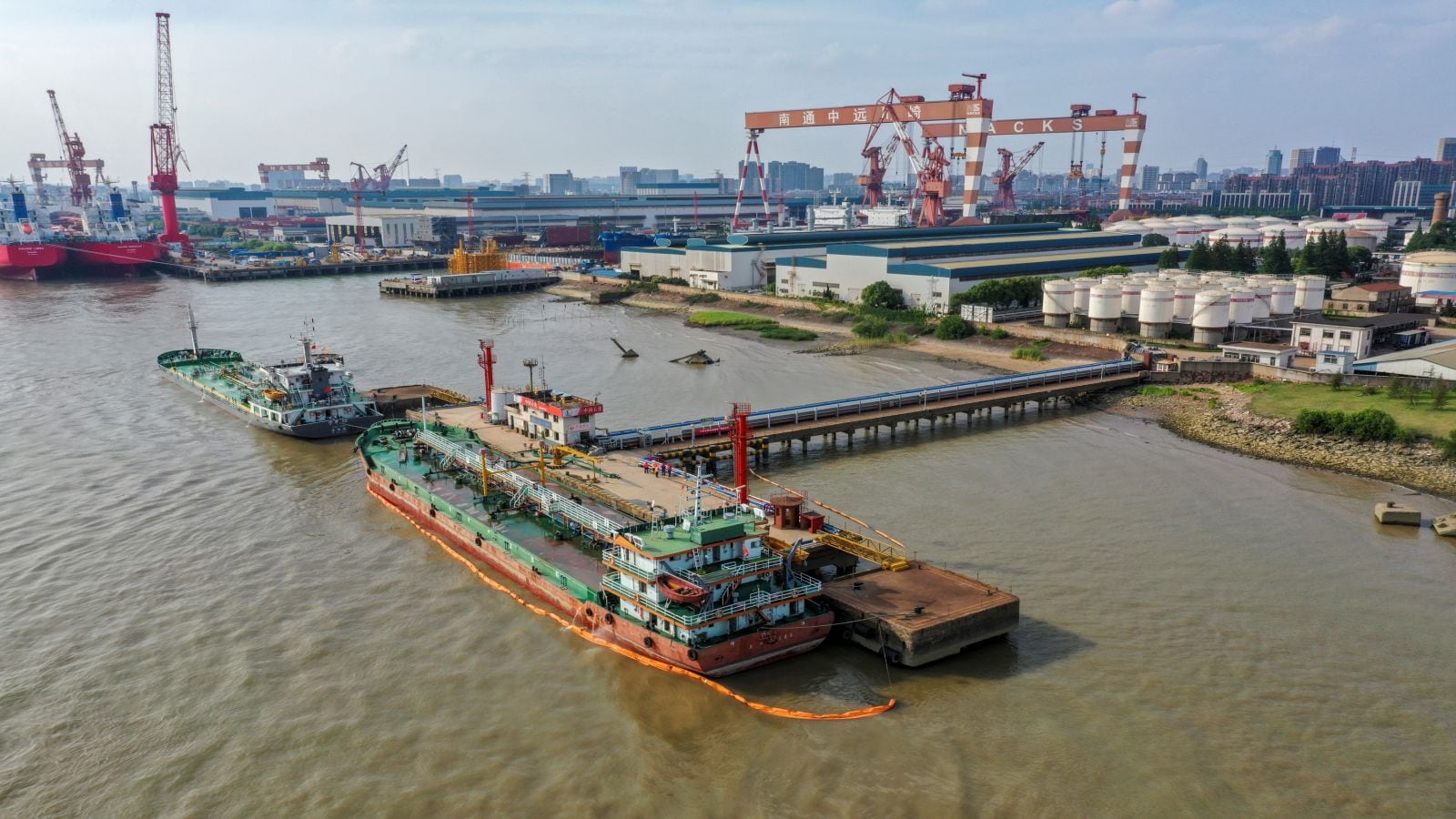
The fragile diplomatic architecture designed to keep global energy markets from collapsing just vaporized in the waters of the Strait of Hormuz. When the U.S. Treasury Department abruptly revoked its short-lived general license authorizing the sale of Iranian crude oil, the immediate 5% spike in Brent and West Texas Intermediate futures was entirely predictable. Mainstream financial commentators quickly fell back on old talking points, blaming the rally on sudden military escalation and a fresh exchange of missile fire between Washington and Tehran.
That explanation misses the point entirely.
The real reason oil prices are on a renewed tear is not the localized exchange of fire, but the structural disintegration of a performance-based interim agreement that Washington hoped would quietly flood the market with cheap crude. By canceling the sanctions waiver less than three weeks after it was granted, the U.S. government effectively admitted that its back-channel diplomacy has failed. Crude futures did not jump because a few missiles flew; they jumped because Wall Street suddenly realized that the one billion barrels of production lost during this year’s broader conflict will not be recovered anytime soon.
The Tollbooth Illusion in the Strait
To understand why the latest ceasefire fractured so quickly, one must look at the geography of the Strait of Hormuz rather than the rhetoric coming out of Washington or Tehran. When Oman proposed a temporary transit corridor hugging its coastline to bypass contested waters, it was meant to be a stabilizing measure. Instead, it became the flashpoint.
Tehran viewed the Omani corridor as a direct threat to its regional leverage. The Islamic Revolutionary Guard Corps attempted to impose an arbitrary maritime toll system, demanding fees from commercial vessels utilizing the waterway.
When the international community refused to pay, the situation degenerated.
- The Targets: Three commercial vessels, including the Qatari liquefied natural gas tanker Al Rakayat and the Saudi-flagged crude supertanker Wedyan, were struck by drones and missiles.
- The Response: U.S. Central Command ordered retaliatory strikes against Iranian missile positions on Sirik Island.
- The Escalation: Iranian forces launched counter-strikes targeting U.S. military logistics hubs in Bahrain and Kuwait.
This is not a standard geopolitical skirmish. It is a fundamental disagreement over who controls the physical infrastructure of global energy transit. The U.S. position is that the strait is an international waterway that must remain entirely free. Iran's position is that if it cannot freely export its own oil without Western oversight, no one else will export theirs without paying a premium.
The Illusion of the Temporary Waiver
The most significant miscalculation in this entire episode belongs to the U.S. Treasury’s Office of Foreign Assets Control. The general license issued in late June was a desperate attempt to lower global energy costs, which had been battered by the systemic collapse of the Gulf Cooperation Council’s economic model earlier this year. It was a transactional gamble: Washington would look the other way while Iranian crude flowed to buyers in Asia, and in exchange, Tehran would keep its proxies from harassing international shipping.
It was entirely performance-based, and the performance failed.
"Iran's actions in the strait were wholly unacceptable and will be met with consequences," a senior U.S. official stated.
By giving global refiners a tight window until July 17 to wind down all existing transactions, Washington has effectively removed hundreds of thousands of barrels of daily supply that traders had already priced into their late-summer models. The sudden reversal has caught major physical traders completely off guard. Ships that were actively loading or en route to Chinese ports are now legally stranded, creating an immediate localized supply crunch that is reverberating through international crude benchmarks.
Why Strategic Reserves Cannot Fill the Gap
Optimistic market analysts argue that the price rally will remain contained because major consuming nations have been aggressively releasing barrels from their Strategic Petroleum Reserves. They point to temporary localized oversupplies and tankers quietly navigating past the conflict zone as evidence that the system can handle the stress.
This view is dangerously short-sighted.
Global Energy Disruption Matrix (2026 Conflict)
+-------------------------+-----------------------------------+-----------------------------------+
| Metric                  | Pre-War Baselines                 | Current Conflict Reality          |
+-------------------------+-----------------------------------+-----------------------------------+
| Hormuz Transit Volume   | 20% of global oil / 20% of LNG    | Severely disrupted, blockaded     |
| Lost Production Volumes | Stable capacity                   | 600M to 700M barrels lost to date |
| GCC Production Output   | Peak regional capacity            | Down over 6.7 million barrels/day |
+-------------------------+-----------------------------------+-----------------------------------+
Relying on state-controlled stockpiles to offset an active maritime blockade is like using a bucket to drain a flooding basement while the water main is still bursting. The structural reality is that the Gulf states rely on the Strait of Hormuz for the vast majority of their energy monetization. While Saudi Arabia and the United Arab Emirates possess alternative overland pipelines to bypass the bottleneck, these routes have strict limits. They cannot absorb the massive production drops caused by active hostility.
The Broader Macroeconomic Contagion
The renewed energy crisis is hitting global markets at the worst possible moment. For the past several months, international equity markets have been highly volatile, driven by a sharp tech correction as investors question the long-term profitability of massive corporate investments. The sudden return of $80 crude is pouring fuel on an already volatile economic fire.
Higher energy costs act as an immediate tax on global manufacturing and logistics. If the shipping corridor remains unsecure, the International Energy Agency’s warning that this represents the largest supply disruption in history will transition from a warning into a permanent economic reality. Central banks, which had been planning to ease monetary policy to stave off a broader slowdown, are now forced to consider keeping interest rates higher for longer to combat sticky, energy-driven inflation.
The conflict in the strait is no longer just a regional security issue. It has evolved into a direct threat to global corporate liquidity, forcing an abrupt re-evaluation of systemic risk across every major financial hub from New York to Seoul. The brief diplomatic window has slammed shut, and the market is finally realizing that there are no easy logistical workarounds left.