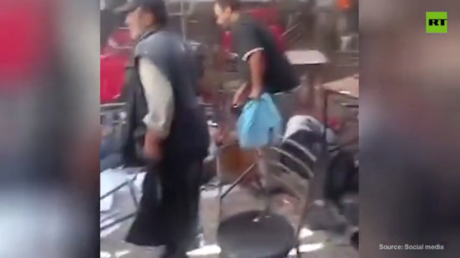
The tear gas drifting through the streets of Tirana is more than a tactical response to a riot. It is the physical manifestation of a democracy running out of oxygen. When state police deployed chemical irritants and pepper spray against crowds marching on government buildings, international news outlets captured the standard imagery of Balkan unrest—shattered glass, burning tires, and masked youths playing cat-and-mouse with riot shields. But looking only at the flashpoints misses the entire mechanism driving this crisis. The violence in Albania is not an isolated explosion of civic anger but the predictable outcome of a systematically closed political system that has left citizens with no other venue for dissent.
At its core, the recurring instability in the capital stems from the total capture of democratic institutions by a single political machine, leaving the opposition fragmented and the public deeply cynical. For over a decade, Prime Minister Edi Rama has consolidated power to an extent unseen since the fall of communism in 1991. By systematically weakening independent oversight, neutralizing the judiciary through selective reforms, and building a powerful patronage network tied to major economic interests, the ruling Socialist Party has effectively turned Albania into a de facto one-party state masquerading as a Western-aligned candidate for European Union membership. The protests are a desperate, chaotic reaction to this structural chokehold.
To understand how Tirana arrived at this point, one must look past the immediate triggers of the latest demonstration. The opposition, primarily led by the Democratic Party, routinely mobilizes its base by citing high-level corruption, economic stagnation, and massive emigration numbers that are hollowing out the country. Yet the opposition itself struggles with a profound crisis of legitimacy, heavily burdened by its own legacy of past governance failures and leadership battles. This leaves the average Albanian citizen trapped between an entrenched, arrogant government and a discredited opposition elite. The resulting friction inevitably ignites on the pavement outside the Prime Minister’s office.
The Architecture of Total Control
The current political monopoly did not happen overnight. It was constructed piece by piece through legislative maneuvers, electoral manipulation, and the deliberate erosion of institutional checks and balances.
When the Socialist Party took power, it promised a modern, European future. Instead, it delivered an administrative apparatus where the line between the ruling party and the state has completely dissolved. Independent agencies, from civil service commissions to media regulatory bodies, are staffed almost exclusively by party loyalists. This institutional alignment ensures that any challenge to government policy is choked off long before it can reach a court or a legislative debate.
Consider the reality of the Albanian parliament. It has ceased to function as a deliberative assembly. The ruling majority routinely uses fast-track procedures to pass sweeping laws affecting billions of euros in public contracts, often with minimal debate and zero input from civil society. Opposition lawmakers find themselves systematically sidelined, their investigative committees blocked, and their speaking time stripped away under highly partisan disciplinary rules. When the constitutional pathways to influence policy are welded shut, the politics of the street become the only option left on the table.
This concentration of authority is reinforced by an economic model reliant on public-private partnerships and massive construction projects that independent economists openly describe as vehicles for capital flight and money laundering. The transformation of Tirana’s skyline is a visual marker of this economic policy. High-end towers rise across the capital while the purchasing power of ordinary citizens plummets. This economic disparity creates a volatile undercurrent of resentment. The wealth generated by these projects does not trickle down to the working class; it remains concentrated within a small circle of business magnates closely allied with the political executive.
The Illusion of Reform and the Judiciary Chokehold
For years, Western diplomats pointed to Albania’s justice reform as a model for the region. This massive, international-backed effort aimed to vet every judge and prosecutor in the country to root out corruption and historical political bias.
The reality on the ground tells a vastly different story. While the vetting process successfully removed dozens of corrupt magistrates, it also created prolonged vacancies that paralyzed the court system for years. More critically, the newly established judicial bodies have shown a striking asymmetry in their prosecutions.
+------------------------------+---------------------------------------+
| Government Narrative         | Institutional Reality                 |
+------------------------------+---------------------------------------+
| Objective anti-corruption    | Disproportionate targeting of         |
| judicial bodies.             | opposition figures.                   |
+------------------------------+---------------------------------------+
| Western-style democratic     | Systemic exclusion of dissenting      |
| legislative processes.        | voices in parliament.                 |
+------------------------------+---------------------------------------+
| Modern economic growth       | Wealth concentrated in state-allied   |
| and development.             | oligarchies and construction booms.   |
+------------------------------+---------------------------------------+
The Special Anti-Corruption Structure has aggressively pursued opposition leaders, placing key figures under arrest or investigation, which the opposition denounces as a politically motivated attempt to decapitate the resistance. Meanwhile, senior government officials implicated in massive scandals involving waste incinerators, health tenders, and municipal corruption face delayed investigations or find themselves protected by an administrative shield. This double standard has destroyed public faith in the rule of law. When the public perceives that the courts are merely an extension of the Prime Minister’s office, the legitimacy of the entire state collapses, transforming ordinary legal disputes into existential political battles.
Tactical Escalation on the Streets
The mechanics of the protests themselves reveal a highly orchestrated dance between the state and the demonstrators.
During these confrontations, the vanguard of the protest typically consists of radicalized youth wings and organized militants who arrive prepared for conflict. They carry fuel, stones, and flares, aiming directly at the cordon of police protecting the government buildings. The response from the Ministry of Interior is immediate and intentionally overwhelming. The rapid deployment of tear gas canisters is not merely a crowd-dispersion tactic. It serves as a psychological tool designed to collective-punish the broader, peaceful segment of the demonstration, ensuring that middle-class citizens, families, and moderate dissenters think twice before joining future rallies.
This cycle serves both political camps perfectly. For the government, the images of burning vehicles and stone-throwing protesters are a propaganda windfall. They export these images to Western capitals to argue that the opposition is nothing more than a violent, anti-democratic mob trying to seize power by force, thereby justifying further crackdowns and a refusal to negotiate. For the opposition leadership, the state’s heavy-handed use of chemical agents serves as proof of a dictatorship, helping them rally their core base and maintain relevance in a media ecosystem overwhelmingly dominated by government narratives.
The Great Demographic Evacuation
While politicians trade blame amid the clouds of pepper spray, the true tragedy of Albania is unfolding at the borders. The country is experiencing one of the worst peacetime demographic drains in modern history.
Driven away by low wages, rampant nepotism, and the total absence of meritocracy, hundreds of thousands of young, educated Albanians have left for Western Europe over the past decade. This is not merely an economic issue. It is a profound political safety valve for the ruling party.
The very people who would form the backbone of an organized, progressive reform movement—the young professionals, the students, the independent thinkers—are choosing to exit the country rather than fight a rigged system. Their departure leaves behind a population dominated by public sector employees dependent on government goodwill for their livelihoods, and an older generation reliant on state pensions. By draining the nation of its most vital demographic, the current administration has inadvertently or deliberately engineered a society that is easier to control, less prone to sustained civil resistance, and highly dependent on the status quo.
International Cynicism and Stabilityocracy
The Western diplomatic corps in Tirana bears significant responsibility for the current impasse. For years, European and American policymakers have prioritized regional stability over genuine democratic substance, a phenomenon Balkan analysts label stabilityocracy.
As long as the government in Tirana maintains a pro-Western foreign policy, votes reliably with NATO, and prevents migrant routes from overwhelming northern Europe, Western capitals are content to look the other way regarding internal autocratic drift.
This transactional relationship is highly visible during major crises. When police use disproportionate force or when the government rams through unconstitutional legislation, the communiqués from foreign embassies are masterclasses in studied neutrality. They issue generic calls for both sides to exercise restraint and engage in dialogue, completely ignoring the massive asymmetry of power between a militarized state apparatus and an unrepresented populace. This stance has alienated the democratic-minded public, who now view Western rhetoric about human rights and the rule of law as hypocritical cover for geopolitical expediency.
The geopolitical calculus is clear, yet fatally short-sighted. By backing a regime that systematically closes off legal avenues for political change, international actors are underwriting the very instability they claim to fear. A country where the political pressure cannot be vented through elections, free media, or an independent judiciary will inevitably vent that pressure through violence on the streets. The tear gas in Tirana is not a sign of a democracy experiencing growing pains; it is the warning sign of a pressure cooker whose safety valves have been intentionally welded shut.
The current political standoff offers no easy avenues for resolution. The ruling party has no incentive to surrender its monopoly on power, while the opposition lacks the moral authority to inspire a broad-based popular uprising. The status quo is a stagnant equilibrium maintained by police force, economic patronage, and the steady departure of the disgruntled populace. True stability cannot be built on a foundation of institutional decay and public despair. Until the structural mechanisms of state capture are dismantled and genuine accountability is restored to the political process, the streets of the capital will continue to burn, and the promises of a European future will remain a distant mirage.