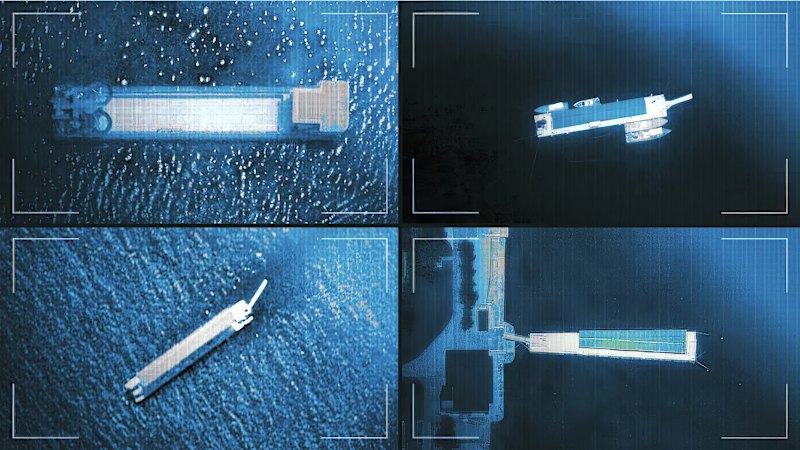
Commercial satellite imagery has exposed an 80-meter luxury yacht anchored off North Korea's Wonsan coast equipped with a 50-meter swimming pool and four water slides. Spotted repeatedly near the ruling family's Kalma villa between early July and mid-October 2026 before returning to a local ship repair dock, the vessel underscores how Pyongyang channels hard currency and engineering resources into insular royal retreats.
Headlines love a shiny bauble. Four turquoise slides and a long-course pool on a barge give readers an instant mental postcard of autocratic excess, right down to the contrast with an economy that routinely struggles to feed ordinary households.
Yet treating that floating rectangle as mere tabloid spectacle misses the real story. Over decades of watching sanctions regimes get outmaneuvered by front companies, ship-to-ship transfers, and covert procurement networks, one truth keeps repeating: luxury hardware is never just a toy. It is a stress test of international enforcement, domestic shipyard capability, and political signaling.
What Commercial Satellites Actually Caught Off Wonsan
Space imaging changed how outside observers monitor North Korea long before high-resolution commercial constellations became routine. Today, daily or near-daily passes from providers like Planet Labs and Vantor allow analysts to track vessels across seasons rather than relying on a single lucky snapshot.
In the case of the 80-meter vessel, imagery from July through September 2026 placed it stationed off the Kalma Peninsula directly in front of a villa complex associated with Kim Jong Un and his family. Mid-October brought a predictable shift back toward a Wonsan-area ship repair dock as summer weather cooled and seasonal operations wound down.
Surrounding waters told a broader story. Analysts have also tracked smaller pleasure craft—roughly 50, 55, and 60 meters in length—moving around Wonsan, the Kalma coastline, and nearby islands such as Daedo and Sindo during summer and autumn windows.
- Scale of the flagship: An 80-meter hull carrying an roughly 50-meter pool and four slides is massive by private yacht standards, where space on deck usually competes fiercely with tender garages, fuel tanks, and crew quarters.
- Seasonal rhythm: Presence off Kalma from early July to mid-October aligns closely with peak summer warmth on the Sea of Japan (East Sea) coast and overlaps with stretches when Kim Jong Un's official appearances drop out of state media.
- Maintenance footprint: Returning to a Wonsan repair facility in mid-October shows the boat is not a disposable novelty; keeping marine machinery, pumps, coatings, and desalination gear running requires dedicated local labor and spare parts.
Satellite pixels come with strict limits. A camera orbiting hundreds of kilometers up cannot prove who stood on the sun deck on a given Tuesday, nor can it confirm whether Kim Jong Un personally rode a slide or watched from shore.
Honest intelligence analysis separates pattern from proof. When vessel loitering lines up with private villas and unexplained gaps in state television coverage, correlation is strong, but assuming every boat movement equals a royal vacation stretches beyond what optical imagery can verify.
Naval Architecture Meets Political Theater
Putting a 50-meter pool on an 80-meter vessel is not a casual weekend modification. Water weighs roughly one metric ton per cubic meter, and sloshing mass high above the waterline creates free-surface effects that can ruin transverse stability if baffles, drainage, and ballast are poorly engineered.
Either the hull was purpose-built or heavily reconfigured with structural reinforcement, deep ballast compensation, and high-capacity circulation pumps. Marine engineers know that salt air, vibration, and weight distribution punish shortcuts quickly, especially on a wide, flat-topped recreational platform designed more for lounging than rough ocean passages.
Why build something that looks more like a floating waterpark than a sleek Mediterranean superyacht? Because aesthetics serve a specific audience.
Decades ago, former regime insider Ri Jong Ho and basketball figure Dennis Rodman both pointed out how oversized pleasure craft in Kim's orbit can resemble a cross between a ferry and a Disney-style attraction. That description captures an important truth about North Korean elite culture: grandeur is frequently measured by sheer size, novelty, and spectacle rather than understated European yachting minimalism.
Around Wonsan, that spectacle sits right beside the Wonsan-Kalma coastal tourism push, which Pyongyang has promoted as a showcase resort zone designed for large visitor numbers even as tight state controls govern access and surrounding neighborhoods face chronic infrastructure gaps. Power grid contrast has been visible from space before—bright resort lighting standing out against dimmer nearby residential areas—reinforcing a two-tier geography where prestige projects get priority.
A yacht with four slides projects invulnerability. It tells domestic elites that the leadership enjoys untouchable comfort despite global isolation, and it signals to foreign observers that sanctions have not choked off the regime's ability to build or acquire extravagant leisure assets.
How Sanctions Evasion Actually Works in Practice
United Nations Security Council resolutions prohibit the transfer of luxury goods and restrict vessel sales and maritime procurement involving North Korea. On paper, acquiring an 80-meter leisure vessel or high-end marine equipment should trigger red flags at every port, bank, and insurer on the map.
In reality, sanctions evasion rarely looks like a single movie-style smuggling run. It is usually a patchwork of shell companies, altered vessel registries, middlemen in permissive jurisdictions, and domestic assembly or refitting that blurs where foreign components end and local shipyard work begins.
Consider a hypothetical example to see how procurement networks mask origin. Suppose a trading firm in a third country buys marine pumps, acrylic panels, or diesel generators under a generic industrial order, routes documentation through two intermediary buyers, and ships the cargo to a regional port where manifests are loosely scrutinized before transfer to a smaller coastal feeder. No single step looks like an open-and-shut violation at the moment of dispatch, yet the assembled result ends up on a restricted coastal asset.
We do not have public customs ledgers proving the exact supply chain behind this specific 80-meter hull. Claiming certainty about its exact shipyard origin or purchase price without documentary proof would be guesswork, even though comparable large yachts on the global market can easily cost tens of millions of dollars and sometimes top $100 million.
What is clear is that sanctions enforcement is an ongoing cat-and-mouse game. Financial networks, shipping registries, and export controls tighten in one area, and procurement specialists adapt by shifting routes, buying used equipment, or leaning on domestic fabrication inside Wonsan and other shipyards.
The Domestic Economy Behind the Deck Railings
Every dollar, yuan, ruble, or ton of steel directed toward elite leisure carries an opportunity cost inside North Korea. Even when a vessel is built locally using domestic labor and materials, steel plate, welding consumables, marine paint, fuel, and skilled technicians are finite resources.
Ordinary North Koreans live in a harsh economic reality shaped by state rationing limits, fluctuating market prices, border controls, and tight restrictions on private enterprise. When food security is precarious for many families, visible luxury at a coastal retreat sharpens the moral contrast between the ruling clan and the general population.
Tourism and foreign currency generation add another layer to the picture. Pyongyang has increasingly leaned on organized foreign tours—notably involving Russian visitors—and coastal tourism initiatives to pull in hard currency through state-controlled channels.
Funds flowing through state tourism bodies and regime-linked revenue channels help finance priorities chosen at the top. Whether those funds pay for missile programs, party loyalty rewards, or coastal infrastructure, the central allocation logic remains the same: the state decides who eats well, who travels, and what gets built.
Critics outside North Korea often assume glaring inequality will automatically spark unrest. History has repeatedly proved otherwise in tightly policed authoritarian states where surveillance, informers, and severe punishment raise the cost of dissent to extreme levels.
Why This Story Matters Beyond Wonsan
It is easy to dismiss a yacht with water slides as a side note in international security. Nuclear warheads, ballistic missile tests, and troop deployments understandably dominate policy briefings.
Ignoring luxury and lifestyle intelligence is a mistake. High-value assets often reveal where the regime feels secure, which coastal bases or villas are actively maintained, and how effectively sanctions compliance holds up when enforcement faces diplomatic fatigue or competing geopolitical priorities.
Commercial imagery has also leveled the information field. Journalists, researchers, and maritime analysts no longer have to wait for defector accounts or leaked photos to spot major physical changes along North Korea's coast; open-source orbital tracking provides a continuous record that Pyongyang cannot easily erase.
Watch the dockyards and coastal waters around Wonsan next summer, because where an 80-meter vessel anchors—and how often it gets serviced—tells you far more about regime priorities than any state media broadcast.