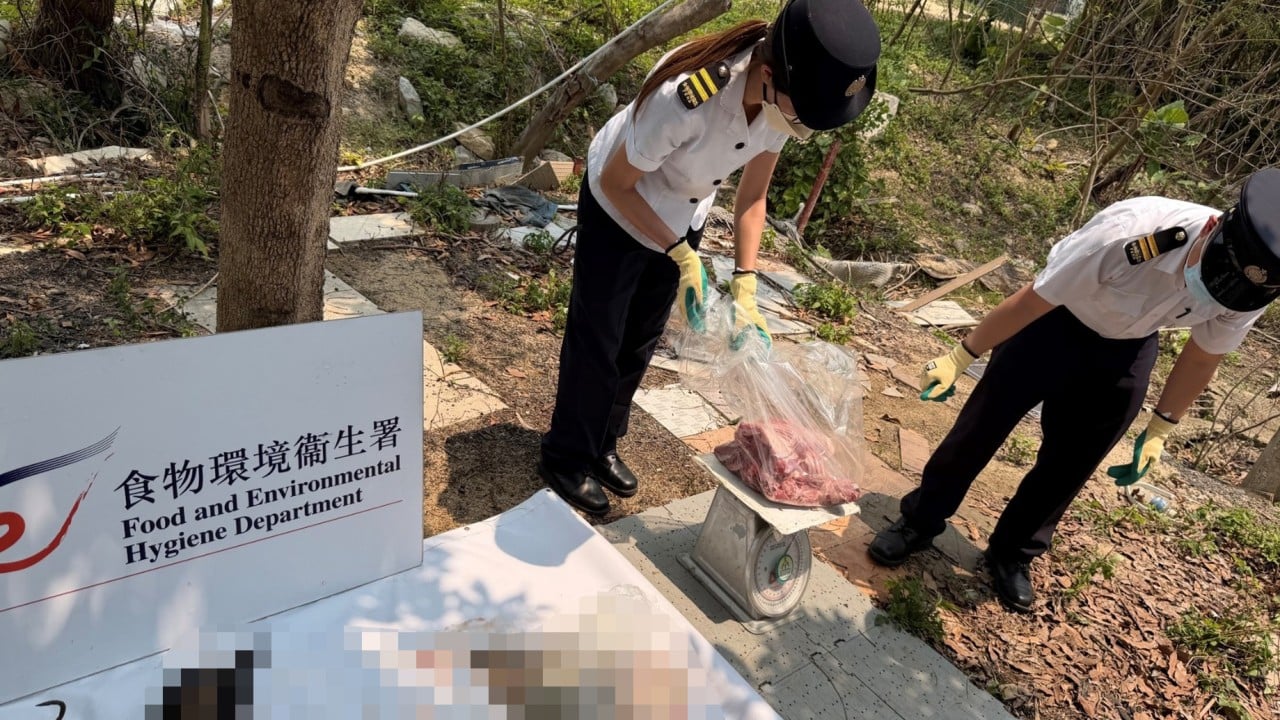
The recent raid on an illegal slaughterhouse in Yuen Long was more than a routine law enforcement operation. It was a surgical strike against a shadow economy that bypasses every safety standard designed to keep the public alive. When Hong Kong authorities deployed thermal drones to scan the rural undergrowth of the New Territories, they weren't just looking for unlicensed butchers. They were hunting a sophisticated criminal enterprise that feeds the city’s wet markets with uninspected, high-risk meat. This isn't just about administrative violations. This is about a systemic failure to seal the borders of our food supply.
High Tech Warfare in the New Territories
The Agriculture, Fisheries and Conservation Department (AFCD) has finally admitted that traditional ground patrols are no longer sufficient to police the sprawling, rugged terrain of Yuen Long. The illegal trade has become too mobile. Too secretive. By the time officers arrive at a suspected site, the evidence—the carcasses, the blood, the tools—has often been scrubbed or moved. If you found value in this article, you might want to look at: this related article.
The use of Unmanned Aerial Vehicles (UAVs) equipped with thermal imaging changed the math. These drones can detect heat signatures from boiling vats of water and activity under corrugated metal roofs that remain invisible from the road. In the recent Yuen Long operation, the eye in the sky allowed the Food and Environmental Hygiene Department (FEHD) to map the facility’s layout before the ground team even breached the perimeter. This level of tactical planning suggests the government is finally treating meat smuggling with the same gravity as narcotics.
The Economic Engine of the Shadow Abattoir
Why does this business exist in one of the most regulated financial hubs on earth? The answer is a cold calculation of margins. For another look on this story, refer to the latest coverage from The Guardian.
Operating a legal slaughterhouse in Hong Kong is an expensive, bureaucratic nightmare. You have rigorous waste disposal laws, mandatory veterinary inspections, and high labor costs. An illegal operation ignores all of it. They don't pay for sanitation. They don't pay for environmental mitigation. They don't pay for the $30 to $50 per head inspection fees that legitimate operators must absorb.
The Profit Gap
When a butcher buys from a licensed abattoir, they are paying for a paper trail. When they buy from the Yuen Long underground, they are buying pure volume at a steep discount.
- Licensed Meat: Includes costs for carbon-neutral transport, refrigerated storage, and government-mandated health certificates.
- Contraband Meat: Transported in unrefrigerated vans, slaughtered in open-air mud pits, and sold as "fresh" to unsuspecting restaurant owners looking to shave 20% off their overhead.
The incentive for the buyer is clear. The incentive for the criminal is even clearer. A single night’s work in a hidden Yuen Long shed can net tens of thousands of dollars in untaxed, untraceable cash.
The Public Health Time Bomb
We need to stop talking about "unlicensed" and start talking about "lethal."
A legal slaughterhouse is a sterile environment. The illegal site discovered in Yuen Long was the opposite. Reports from the scene described a lack of basic drainage, animal waste seeping into the local water table, and meat being processed on floors slick with filth. There is no veterinarian on-site to check for African Swine Fever or foot-and-mouth disease. There are no inspectors to ensure the animals weren't dying of sickness before the knife hit their throats.
When you remove the inspector, you invite the pathogen. The meat coming out of these raids often ends up in the "hot meat" market—pork that is sold warm, under the guise of being freshly slaughtered that morning. For many Hong Kong consumers, "warm" is a sign of quality and freshness. In reality, warm meat from an illegal source is a breeding ground for bacteria that can survive the cursory flash-fry of a high-heat wok.
The Logistics of a Raid
Executing a raid in the New Territories is a logistical headache. The terrain is a maze of "brownfield" sites—abandoned plots of land used for container storage, scrap metal, or, in this case, illicit butchery.
The FEHD and AFCD must coordinate with the police to ensure the site is contained. If one lookout sees a patrol car, the whole operation vanishes into the trees. This is why the drone was the silent protagonist of the Yuen Long raid. It provided the surveillance persistence needed to confirm that the slaughtering was actually in progress. Under Hong Kong law, catching someone with the meat isn't enough; you often need to prove the act of illegal slaughtering to make the heavy charges stick.
Challenges of Enforcement
- Private Land Rights: Many of these operations occur on private lots where entry requires specific warrants or clear evidence of a crime in progress.
- The Lookout Network: Illegal operators often employ local villagers or workers to monitor main access roads.
- Mobile Equipment: Modern illegal abattoirs use modular equipment that can be broken down and moved in the back of a truck within thirty minutes.
The Failure of the Supply Chain
This raid exposes a massive hole in the city’s traceability. If meat from an illegal slaughterhouse can reach a retail stall or a restaurant kitchen without being flagged, the system is broken.
Currently, the FEHD relies on spot checks and "stamps" on carcasses. But stamps can be forged. Paperwork can be "borrowed" from a legitimate shipment to cover a larger volume of contraband goods. Until there is a blockchain-enabled or digital DNA-traceable system for every carcass in the territory, the Yuen Long butchers will always find a back door.
The restaurants are part of the problem. In an industry where the price of electricity and rent is skyrocketing, a chef might look the other way if a supplier offers pork at a price that seems too good to be true. It’s a gamble with the customer’s life. One outbreak of a zoonotic disease traced back to an illegal slaughterhouse would not just shut down a shop; it would trigger a city-wide panic that the Hong Kong economy, still recovering from various shocks, simply cannot afford.
A New Strategy for a Hardened Problem
Drones are a start, but they aren't the solution. The government needs to stop treating this as a minor health code violation and start treating it as organized crime.
The fines for illegal slaughtering are often seen by these syndicates as a mere "tax" on doing business. If the profit from one month of operation is $500,000 and the fine is $50,000, the math favors the criminal. We need mandatory minimum prison sentences for the ringleaders and the immediate revocation of business licenses for any restaurant found with unverified meat in their walk-in freezers.
The Yuen Long raid was a tactical victory, but the war for the city’s food safety is being lost in the accounting books. We must follow the money, not just the drones.
The next time you walk through a wet market and see a slab of pork sitting on a wooden table in the humid afternoon air, ask yourself where it was at 3:00 AM. If the answer involves a dark shed in the New Territories and a drone overhead, no amount of cooking will make it safe.
Demand the receipt. Check the origin. The life you save might be your own.