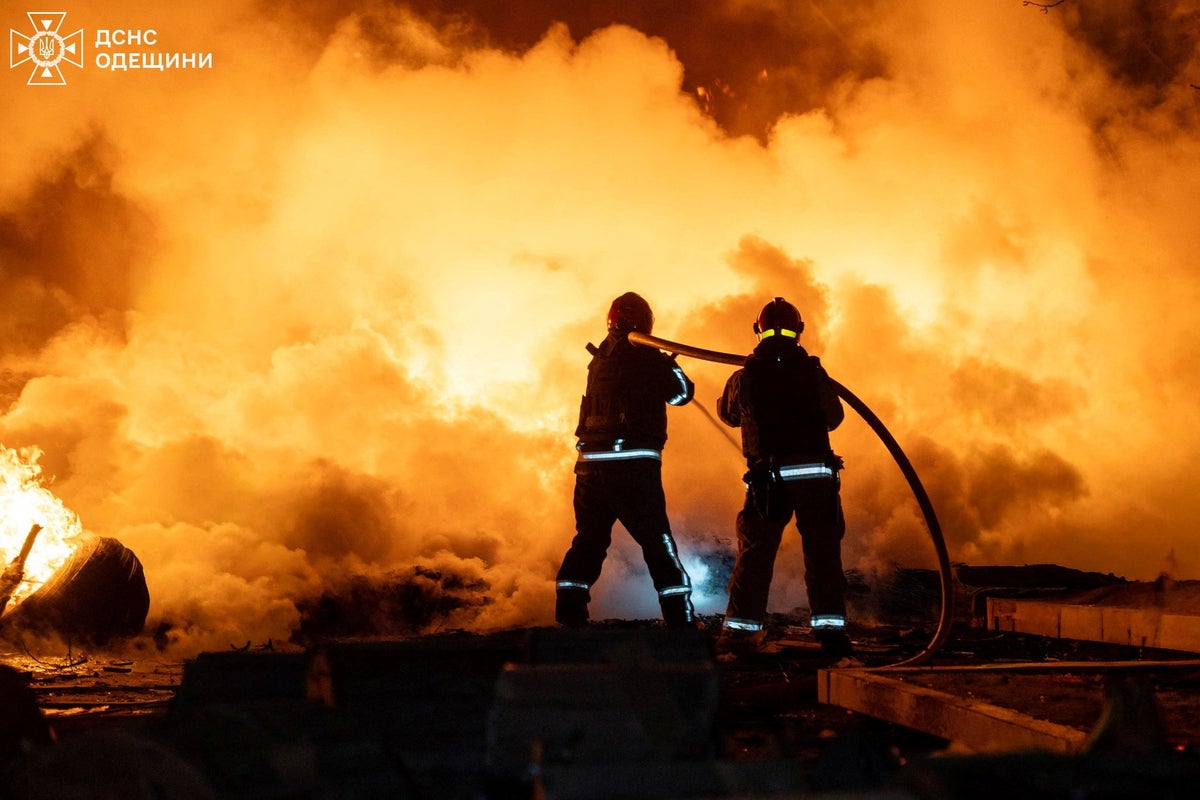
The concept of a "holiday truce" in the Russo-Ukrainian war has become a grim irony rather than a reprieve. By 7:00 a.m. on Easter Sunday, 2026, the Ukrainian General Staff reported that Russian forces had breached the 32-hour Orthodox Easter ceasefire a staggering 2,299 times. This was not a slow breakdown of diplomatic intent, but a systematic rejection of it. While Moscow’s political machinery broadcasted images of piety and calls for a "humanitarian pause," the reality on the ground was defined by 1,045 FPV drone strikes and nearly 500 artillery barrages.
The most visceral failure of this purported silence occurred in the Sumy region. Overnight, a Russian drone targeted an ambulance in a deliberate strike that wounded three paramedics—men aged 25, 52, and 57. This was not a stray shell landing in a field. It was a targeted hit on a marked medical vehicle during a window of time when the world was told the guns would fall silent.
The Architecture of a False Truce
To understand why these ceasefires fail, one must look at the mechanics of modern attrition. A 32-hour pause is tactically inconvenient for an invading force that relies on maintaining constant pressure to prevent Ukrainian fortifications from being reinforced. For the Kremlin, a ceasefire is often less about stopping the violence and more about a cynical performance for the Global South and domestic audiences.
The sheer volume of violations—averaging over 150 incidents per hour—suggests that orders to cease fire were either never issued to front-line units or were issued with a wink and a nod. The breakdown of the 2,299 reported violations includes:
- 28 Direct Infantry Assaults: High-risk maneuvers that require significant coordination, proving these were not accidental discharges.
- 747 Kamikaze Drone Launches: Pre-programmed and piloted attacks that represent intentional offensive action.
- 479 Shelling Incidents: Traditional artillery used to suppress Ukrainian positions across the 1,200-kilometer front.
The Ukrainian military noted one curious absence: there were no long-range missile strikes or Shahed-type drone swarms reported during the period. This suggests a selective de-escalation. Russia appears willing to hold back its strategic, expensive munitions to maintain the appearance of a truce while simultaneously "cleaning up" the tactical line with cheaper, more deniable FPV drones and mortar fire.
The Ambulance as a Target
Targeting medical infrastructure is a war crime under the Geneva Conventions, yet it has become a routine feature of the Russian strategy in 2026. The World Health Organization (WHO) recently noted that attacks on medical and pharmaceutical warehouses in Ukraine tripled over the last year. By hitting an ambulance during an Easter truce, the message sent to Ukrainian first responders is clear: nowhere is safe, and no agreement is sacred.
The psychological toll of these "truce strikes" is perhaps more damaging than the physical destruction. When a ceasefire is announced, there is a natural, human tendency for civilians and medics to move more freely, believing the immediate threat has subsided. This creates a target-rich environment. In Kherson, the "ceasefire" period saw three civilians killed and 12 injured, including a child. The strikes hit a gas station, a hotel, and a minibus.
A War of Competing Narratives
Moscow has not remained silent regarding the collapse of the Easter pause. The Russian Defense Ministry countered with its own claims, alleging that Ukrainian forces violated the truce 1,971 times. They cited drone strikes in the Kursk and Belgorod regions that reportedly injured five people, including a baby.
This creates a "statistical fog" where both sides point to massive numbers of violations to justify their own continued aggression. However, the nature of the strikes differs fundamentally. Ukraine’s reported actions are largely focused on cross-border drone incursions targeting Russian logistics and energy hubs—a desperate attempt to level the playing field. Russia’s violations, conversely, involve sustained front-line assaults and the shelling of residential areas within sovereign Ukrainian territory.
The High Cost of Negotiated Silence
History shows that temporary truces in this conflict are almost always a precursor to intensified violence. In 2024 and 2025, similar holiday pauses were followed by massive Russian "revenge" strikes once the clock ran out. For the Ukrainian leadership, agreeing to these pauses is a double-edged sword. To reject them is to be painted as the aggressor by Russian propaganda; to accept them is to provide the Russian military with a predictable window to reposition assets while civilian guards are lowered.
The reality of the 2026 Easter ceasefire is that it never existed. It was a diplomatic ghost, a set of numbers on a spreadsheet that bore no resemblance to the thunder of artillery in the Donbas. The "brutal truth" is that as long as the strategic goals of both nations remain mutually exclusive—with Russia demanding total annexation of four regions and Ukraine demanding a return to 1991 borders—religious holidays will continue to be marked by blood rather than prayer.
The international community often views these ceasefire violations as "setbacks" in a potential peace process. This is a fundamental misunderstanding of the current landscape. These are not setbacks; they are the strategy. Until the cost of violating a truce exceeds the tactical gain of breaking it, the numbers will only continue to climb.
Prepare for a summer of increased drone saturation. The failure of the Easter truce is not just a tragedy for the families in Sumy and Kherson; it is a clear signal that the conflict has entered a phase where the very concept of "humanitarian space" has been weaponized beyond recognition.