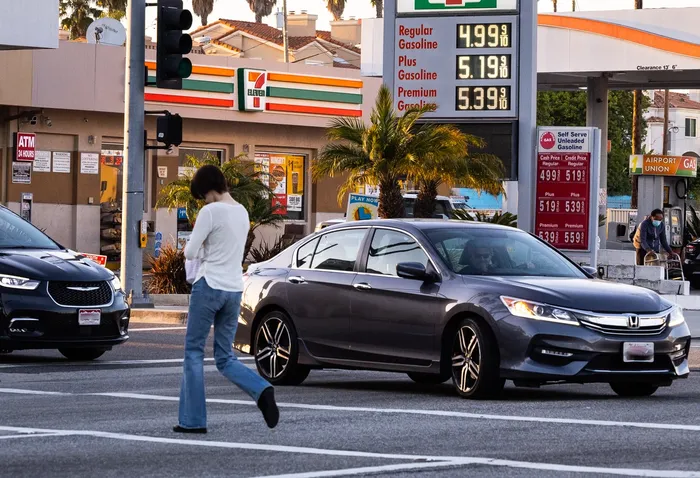
The national average for a gallon of gasoline hit $4.30 this morning, a four-year high that has effectively ended the era of cheap American mobility. While commuters across the country watch the digital displays at the pump tick upward with a sense of dread, the official line from Washington remains a cocktail of bravado and optimistic timelines. President Donald Trump has assured the public that prices will "drop like a rock" the moment the war with Iran concludes.
The math, however, tells a different story. The current price spike isn't just a temporary reaction to a geopolitical skirmish. It is the result of a systemic collapse of the world’s most vital energy artery. With the Strait of Hormuz effectively closed to commercial traffic, 20% of the global oil supply is currently stranded or non-existent. This is not a valve that can be twisted back to "open" overnight. Even if a ceasefire were signed tomorrow, the logistical wreckage and the damage to regional infrastructure mean $4.30 might be the floor, not the ceiling, for the foreseeable future.
The Hormuz Chokehold and the Supply Illusion
The fundamental problem is a massive, gaping hole in the global balance sheet. Since the conflict escalated in early March, global oil supply has plummeted by roughly 10.1 million barrels per day. For context, that is the largest supply disruption in recorded history, eclipsing even the 1970s energy crises.
Refineries in the United States are currently starving for the specific grades of heavy crude that they were built to process. While American shale production remains active, it produces a light, sweet oil that cannot simply be swapped in for the Middle Eastern barrels now trapped behind a naval blockade. This technical mismatch is forcing refineries to cut production, which in turn drives the price of finished gasoline and diesel higher.
The administration’s rhetoric suggests that the end of hostilities will immediately flood the market. This ignores the reality of force majeure. QatarEnergy and other regional giants have already declared they cannot fulfill existing contracts. Rebuilding the trust of insurance syndicates and clearing the mines from the world's most dangerous shipping lane will take months, if not years. We are looking at a long-term recalibration of energy costs, regardless of the political outcome in Tehran.
The Mirage of Post War Relief
Politics often demands a simple narrative. In this case, the narrative is that the war is the only thing standing between the American consumer and $2.50 gas. That is a dangerous oversimplification.
Even if the "short and powerful" strikes currently being weighed by the White House were to force a resolution, the Middle Eastern economic model has suffered a systemic shock. The Gulf Cooperation Council (GCC) states are facing a "grocery supply emergency" alongside their oil export crisis. When a region that provides a fifth of the world’s energy enters a state of internal economic collapse, the recovery isn't a V-shape. It is a long, slow climb out of a crater.
Disruption by the Numbers
- $126 per barrel: The peak price Brent crude touched this week.
- 6.2 million barrels: The recent weekly decrease in U.S. crude inventories.
- 70%: The surge in jet fuel costs since the start of the war, crippled by a lack of feedstock.
Wall Street isn't buying the "drop like a rock" promise either. Traders are increasingly moving their volume into July and August contracts, betting that the volatility is here to stay. There is very little backup crude supply in the global market to act as a cushion. The Strategic Petroleum Reserve has been tapped repeatedly, leaving the U.S. with fewer tools to blunt future shocks if the current "ceasefire" talks fail to produce a permanent deal.
Why Domestic Production Cannot Save the Pump
A common counter-argument suggests that the U.S., as a leading producer, should be insulated from these shocks. It’s a compelling theory that falls apart the moment you look at the plumbing of the energy industry.
American refineries are not charity organizations; they are profit-seeking entities tied to a global market. If they can sell a gallon of gas for the equivalent of $6.00 in Europe or Asia, domestic prices will rise until they reach parity. Furthermore, the war has more than doubled the price of kerosene-based products like diesel and jet fuel. These are the lifeblood of the trucking and shipping industries. When it costs 80% more to fill a semi-truck, the price of the milk and bread inside that truck goes up too.
We are seeing the beginning of a inflationary feedback loop. Higher energy costs lead to higher transportation costs, which drive up the Consumer Price Index, which in turn prevents the Federal Reserve from lowering interest rates. The "Iran War Surcharge" is being baked into every corner of the American economy.
The Strategy of Attrition
The administration's current strategy appears to be a blockade designed to throttle the Iranian economy into a "State of Collapse." While this avoids the high casualty count of a full-scale ground invasion, it is a slow-motion car crash for the global energy market.
By keeping the Strait of Hormuz closed to Iranian exports, the U.S. is effectively keeping those barrels off the global market indefinitely. The hope is that the Iranian leadership will buckle under the pressure of internal divisions. However, history shows that besieged regimes often become more unpredictable, not less. Every day the blockade continues is another day that global inventories are drawn down.
We are currently burning through the world's "floating storage"—oil that was already on ships when the war started. Once those ships are empty, the true scarcity begins.
The $4.30 per gallon price tag is a symptom of a world that has lost its safety margin. For decades, the global economy relied on the assumption that the Middle East would remain a functional gas station. That assumption has been set on fire. Expecting prices to return to pre-war levels simply because the shooting stops is a failure to understand the permanent damage done to the world's energy supply chain. The era of cheap, reliable fuel didn't just pause; it broke.