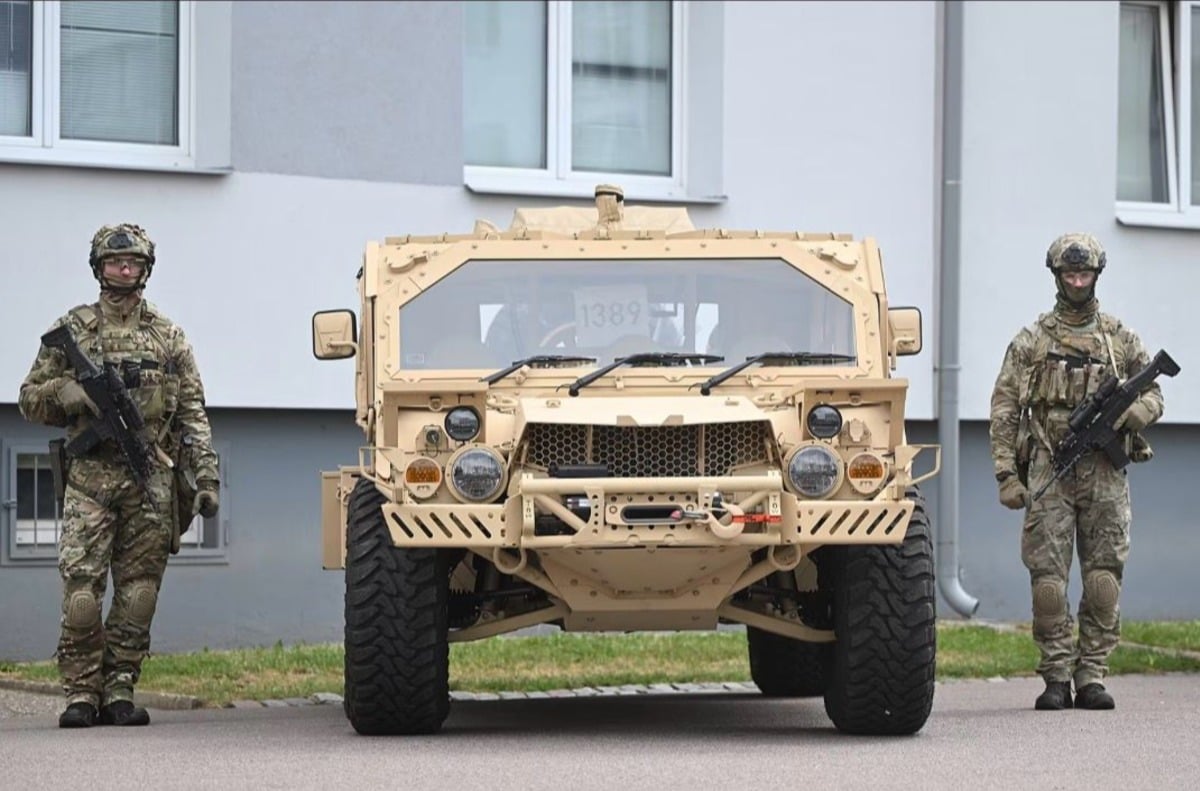
The Czech Republic 43rd Airborne Regiment has officially taken delivery of its first batch of Flyer 72 Heavy Duty ultra-light tactical vehicles. This initial handover transitions the Chrudim-based elite unit away from obsolete, soft-skinned legacy platforms and cements a long-delayed tactical shift toward air-transportable, high-mobility strike configurations. While defense officials celebrate the milestone as a clean victory for rapid deployment capabilities along NATO's eastern flank, a deeper inspection of the procurement reveals the unforgiving trade-offs between speed, protection, and modern battlefield survivability.
For a decade, the Czech military relied on aging Land Rover Defenders and Soviet-designed UAZ-469 utility trucks to move its airborne forces. These platforms offered zero ballistic protection and lacked the structural integrity to support modern heavy weapon systems, communication suites, or electronic warfare components. The arrival of the Flyer 72 Heavy Duty (HD) alters this equation by introducing a purpose-built military chassis capable of carrying more than its own empty weight. Learn more on a similar topic: this related article.
Yet, this procurement occurs during a profound identity crisis for light infantry worldwide. The war in Ukraine has proved that unarmored or lightly protected vehicles are extremely vulnerable to ubiquitous first-person view (FPV) drones and artillery fragmentation. The Czech military is making a high-stakes bet that speed and off-road agility will protect its paratroopers better than heavy steel plating.
The Engineering Realities of the Flyer 72 Platform
To understand why Prague selected this specific platform, one must look at the strict physics of aerial delivery. Standard armored personnel carriers are too heavy for rapid transport via medium-lift cargo aircraft or transport helicopters. The Flyer 72 HD solves this weight restriction through an open tubular space-frame design made of high-strength lightweight steel. More reporting by The Washington Post delves into comparable perspectives on the subject.
The vehicle features a gross vehicle weight rating of approximately 11,000 pounds while maintaining a curb weight of just 5,500 pounds. This creates a one-to-one payload-to-weight ratio. This capability allows a single vehicle to carry up to nine fully equipped paratroopers alongside their ammunition, fuel, rations, and specialized mission kits. Power comes from a 2.0-liter multi-fuel turbo diesel engine generating 220 horsepower and 369 pound-feet of torque. This configuration gives the platform the ability to negotiate 60-percent gradients and traverse rugged, trackless terrain at high operational speeds.
Crucially, the physical dimensions of the vehicle match the internal cargo bays of standard NATO transport aircraft. It can drive directly into a C-130 Hercules, an Embraer C-390 Millennium, or a CH-47 Chinook helicopter without requiring any disassembly or preparation by the crew. This allows an airborne unit to roll off the ramp fully armed and ready for immediate combat operations within minutes of landing.
The Strategic Pivot on NATO Eastern Flank
The acquisition of 95 Flyer 72 HD vehicles is not an isolated equipment purchase. It represents a fundamental restructuring of how Czechia intends to fulfill its collective defense obligations under NATO Article 5. The 43rd Airborne Regiment serves as the country’s primary rapid reaction force, tasked with deploying anywhere in Europe within hours to secure airfields, conduct deep reconnaissance, or delay advancing adversary forces.
In a conflict scenario involving a near-peer adversary, heavy mechanized brigades require days or weeks to mobilize and deploy via rail or heavy heavy transport networks. Light airborne units must bridge that critical gap. By equipping these forces with highly mobile platforms capable of mounting heavy machine guns, automatic grenade launchers, or anti-tank guided missile systems, Prague increases the lethality of its initial response force.
However, this doctrine introduces significant operational friction. The Flyer 72 relies entirely on its low profile, speed, and terrain utilization to avoid destruction. While the vehicle can be fitted with modular armor kits to provide basic ballistic protection against small arms fire and shell splinters, adding this weight directly degrades its off-road performance, fuel economy, and air-transportability. Commanders face a permanent dilemma: maximize protection and slow down the unit, or maximize speed and accept catastrophic risk if caught in an artillery ambush.
Logistical Tail and Procurement Friction
While the delivery of the first vehicles marks a tangible step forward, the broader contract has faced persistent scrutiny regarding domestic industrial integration and long-term sustainment. The original agreement specified that state-owned military repair enterprise VOP CZ would handle a substantial portion of the assembly, customization, and long-term maintenance of the fleet. This domestic involvement was intended to secure local technical expertise and ensure the Czech military could repair its vehicles during a prolonged crisis without relying on transatlantic supply lines.
The reality has been more complicated. Delays in technology transfer and supply chain bottlenecks disrupted the initial delivery timeline, highlighting the friction that occurs when integrating foreign defense technology into domestic defense ecosystems. Furthermore, running a fleet of highly specialized, low-volume American tactical vehicles creates a distinct logistical footprint within an army that is simultaneously trying to manage heavy tracked vehicles from Sweden and wheeled carriers from Austria.
The 2.0-liter commercial-derivative engine offers excellent fuel efficiency and a familiar mechanical architecture, but military technicians must still be trained to maintain the specialized suspension and drivetrain components that allow the vehicle to survive high-velocity air drops and extreme cross-country driving. If parts storage within the Czech Republic is underfunded, the operational readiness rate of the 43rd Airborne could drop rapidly during sustained field operations.
The Drone Enigma and Modern Lethality
The most pressing question surrounding the deployment of the Flyer 72 HD is how the vehicle will survive on a battlefield saturated with loitering munitions and thermal surveillance assets. An open-topped vehicle provides excellent situational awareness and allows troops to fire their personal weapons in all directions, but it leaves the occupants completely exposed to top-attack submunitions dropped from cheap commercial drones.
During recent training exercises, light infantry units across Europe have experimented with makeshift steel canopies and electronic warfare jammers mounted directly to light vehicles. These modifications add weight, alter the center of gravity, and can prevent the vehicle from fitting into the tight confines of a helicopter cargo bay. The Czech military must find a way to integrate modern counter-unmanned aerial systems tech onto the Flyer 72 without neutralizing the exact physical traits that made the vehicle attractive in the first place.
Moreover, the weapon configurations chosen for these vehicles will dictate their tactical utility. If configured primarily as personnel carriers, they simply move troops to the fight faster. If integrated with long-range anti-tank missiles like the Spike-LR or modern loitering munitions, the Flyer 72 transforms into a highly lethal, hit-and-run tank hunter platform that can exploit gaps in enemy flanks before disappearing into forested terrain.
Operational Realism Over Procurement Optimism
The delivery of the first Flyer 72 HD units gives the Czech 43rd Airborne Regiment a capability it has lacked for decades: true tactical mobility matched with strategic air-transportability. It removes a dangerous reliance on unarmored, mechanically exhausted transport vehicles that had no place in a modern theater of war.
The true test of this procurement will not be found in official acceptance ceremonies or polished promotional videos. It will be decided by how effectively the Czech military integrates these platforms into its wider command structure, how reliably the domestic logistics network can supply spare parts, and how quickly tactics can adapt to protect these unarmored crews from the realities of modern electronic and aerial warfare. Speed is an excellent asset, but it is a poor substitute for armor plating when the artillery begins to fall.


