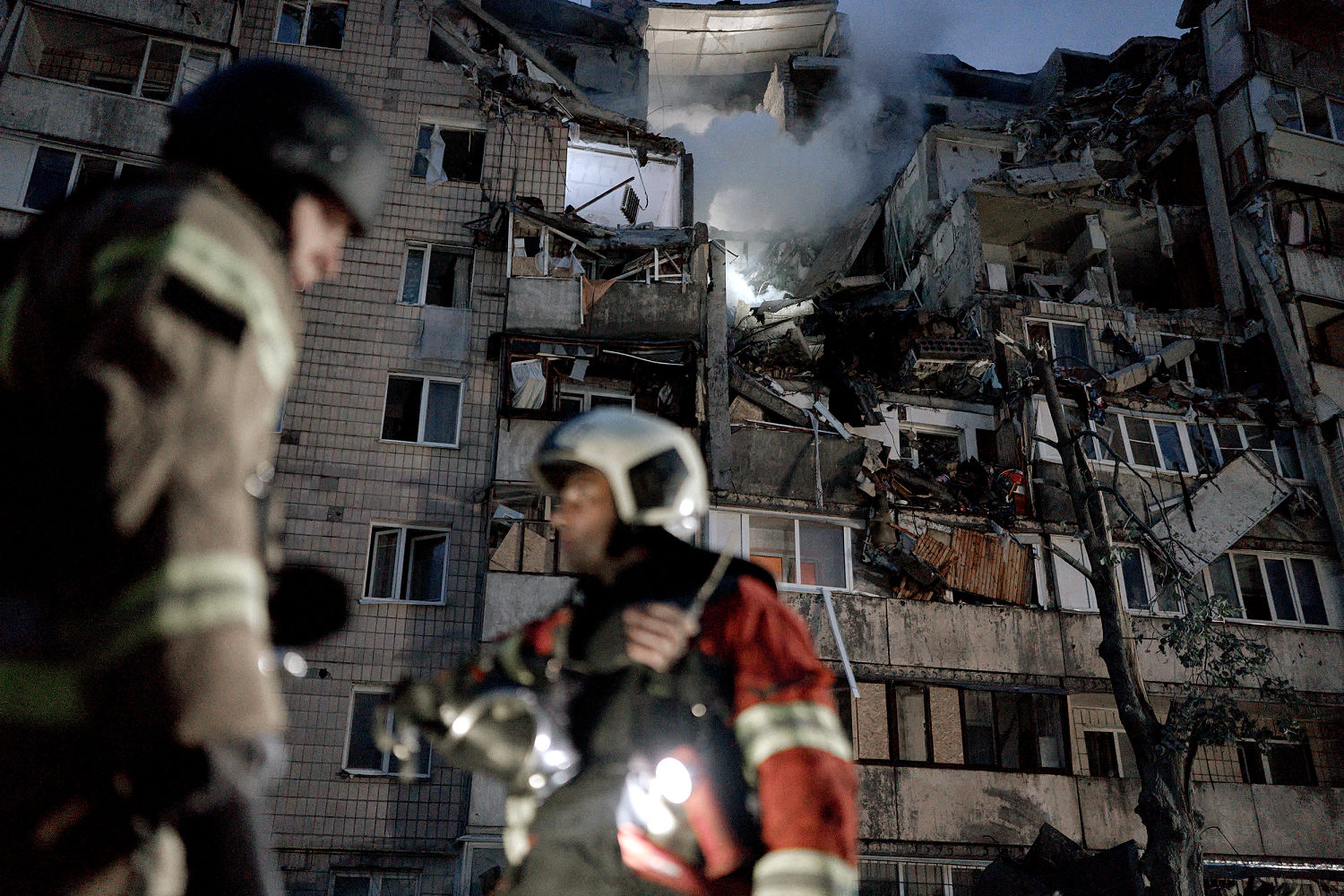
The devastating Russian missile barrage that tore through Kyiv overnight, killing at least 14 people and wounding over a hundred, is not just another tragic episode in a four-year war. It is a calculated opening gambit aimed directly at the negotiating table. By launching 68 missiles and 351 drones hours before US President Donald Trump arrives at the critical NATO summit in Ankara, Vladimir Putin is sending an unmistakable message to Washington and Europe. The Kremlin wants to demonstrate that it retains absolute escalation dominance at the exact moment the Trump administration attempts to force a diplomatic resolution to the conflict.
The timing is entirely intentional. Coming immediately after America's Independence Day celebrations and right on the eve of the Ankara summit, the assault exposed a dangerous vulnerability in Ukraine’s defensive architecture. While Ukrainian forces managed to neutralize hundreds of incoming drones and standard cruise missiles, their air defenses failed to intercept a single one of the 23 ballistic missiles or six hypersonic projectiles fired at the capital. This catastrophic failure stems from an acute, well-documented depletion of Patriot air defense interceptor stockpiles. Moscow knows the West is running low on these high-end interceptors, and Putin is exploiting this deficit to force an unconditional settlement before diplomatic talks even begin.
Blood on the Streets of Podilskyi
The immediate human cost of this strategic maneuvering is visible in the historic Podilskyi district of Kyiv. A nine-story residential block was virtually sheared in half from the fifth floor up, leaving dozens of families trapped in the burning remains of their homes. Emergency crews used ladder trucks to evacuate terrified children through smoke-filled windows while volunteers combed the smoking rubble for survivors. Across the capital, at least 15 multi-story apartment buildings sustained severe structural damage, turning ordinary residential neighborhoods into active disaster zones.
This represents the second massive aerial assault on Kyiv in less than a week, following a strike that claimed 31 lives. The sheer volume of ordnance deployed indicates that Russia is emptying its production reserves for maximum psychological effect. For months, Western intelligence analysts suggested that Russian missile manufacturing was slowing under the weight of international sanctions. The reality on the ground contradicts this optimistic assessment. Moscow has successfully re-engineered its supply chains through third-party intermediaries, allowing its factories to churn out ballistic and hypersonic weapons at a steady, lethal pace.
The Exhaustion of Ukraine Air Defenses
To understand why this attack was so uniquely lethal, one must examine the shifting physics of the air war. Ukraine has proven remarkably adept at shooting down Iranian-designed Shahed drones and older subsonic cruise missiles. However, stopping advanced ballistic assets like the Iskander-M or hypersonic Kinzhal missiles requires the highly sophisticated Patriot defense system. The system works, but it relies on a finite supply of interceptor missiles that Ukraine simply cannot replace on its own.
President Volodymyr Zelensky has spent months warning Western allies that his country's stockpiles are reaching a critical tipping point. The latest engagement data confirms his worst fears. When multi-million-dollar ballistic missiles slip through the defensive net completely unimpeded, it signifies that Ukraine is rationing its remaining interceptor stockpiles, saving them exclusively for the protection of critical military infrastructure rather than civilian centers. By forcing Ukraine to make these impossible choices, the Kremlin is systematically wearing down the domestic resolve of the Ukrainian populace.
A Desperate Attempt to Mask Domestic Crises
While Moscow wants to project an image of absolute military dominance, this sudden escalation is also driven by severe domestic pressures building inside the Russian Federation. Over the past several weeks, Ukraine has executed a highly effective campaign targeting Russian energy infrastructure far behind the front lines. Long-range Ukrainian drone strikes recently hammered major oil export terminals at the Baltic Sea ports of Vysotsk and Ust-Luga, causing significant disruption to Russia’s primary source of hard currency.
These economic strikes have triggered acute fuel shortages within Russia itself. Gasoline rationing has been introduced across multiple Russian regions, and commuters in Moscow now face sprawling queues at filling stations. Furthermore, a highly successful Ukrainian strike on energy infrastructure near Sevastopol completely crippled the electrical grid in Russian-annexed Crimea, forcing local authorities to declare a state of emergency. By launching a highly visible, devastating strike on Kyiv's civilian population, Putin is attempting to distract his own public from these widening internal fractures and reassure hardliners that Russia still holds the upper hand.
The High Stakes Diplomacy in Ankara
The upcoming NATO summit in Turkey is shaping up to be the most contentious gathering of Western leaders in decades. Donald Trump has made it clear that ending the war in Ukraine is his primary foreign policy objective, and he is scheduled to hold a pivotal face-to-face meeting with Zelensky on Wednesday. Following those discussions, the US President intends to engage directly with Putin to outline a potential framework for a ceasefire.
This gives the Kremlin an immense incentive to maximize its leverage right now. By demonstrating that no corner of Ukraine is safe from its ballistic arsenal, Russia is signaling to the Trump administration that any peace deal must be negotiated on Moscow’s terms. The Kremlin wants to convince Western policymakers that continuing to fund Ukrainian resistance is a futile endeavor that will only lead to further destruction. This puts immense pressure on Zelensky, who must convince a skeptical American administration that Ukraine can still hold the line if it receives immediate, unrestricted air defense resupply.
The Territorial Fiction of the Eastern Front
The aerial campaign is closely synchronized with a brutal war of attrition along the eastern front lines. Moscow recently claimed full control over the strategic town of Kostyantynivka, a critical gateway to Ukrainian defensive positions in the wider Donetsk region. Kyiv has vehemently dismissed this claim as a fabric of Russian propaganda, maintaining that its forces are still actively defending the outpost.
This corporate-style public relations battle over ruined towns highlights the broader strategy at play. Putin needs to show concrete territorial gains to justify the immense human and financial costs of the invasion to his domestic audience before any formal peace talks begin. If Russia can solidify its grip on Donetsk while simultaneously rendering life in Kyiv unlivable, it believes the Western alliance will ultimately fracture, forcing Ukraine to accept a deeply unfavorable partition of its sovereign territory.
The Cost of Western Hesitation
For years, European NATO allies have debated the escalatory risks of providing Ukraine with long-range weapons and advanced defensive platforms. That hesitation has created a predictable tactical vacuum that Russia is now ruthlessly filling. While Poland briefly scrambled fighter jets to protect its own airspace during the overnight bombardment, the broader Western response remains confined to diplomatic condemnation and incremental aid packages.
The harsh truth is that statements of solidarity do not intercept ballistic missiles. If the United States and Europe continue to keep their Patriot interceptors stored in domestic warehouses rather than deploying them to the front lines, the aerial destruction of Ukrainian cities will continue unabated. Putin has correctly identified the Western hesitation to fully commit its own defense industrial base as a critical strategic vulnerability, and he will continue to exploit it until someone forces him to stop.
The wreckage still smoking in Podilskyi is proof that the war has entered a dangerous new phase where diplomacy and mass destruction are explicitly intertwined. As leaders gather in Ankara, the smoke rising over Kyiv serves as a grim reminder of what happens when geopolitical calculations override immediate humanitarian necessities. The coming days will reveal whether the Western alliance possesses the political will to counter Moscow's brutal leverage, or if the future of Ukraine will be decided by the sheer volume of unchecked Russian steel.