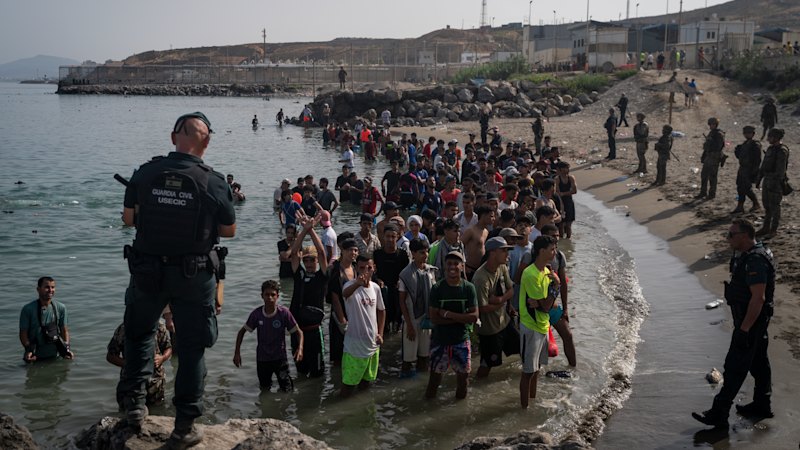
The concrete walls separating Morocco from Ceuta were designed to stop people. They failed. When fifty thousand individuals moved across the border in a single, sustained surge, the physical barrier did not merely look porous—it looked irrelevant. This was not a chaotic accident of history. It was a calculated breakdown of administrative function and diplomatic pressure that exposed the fragility of Europe’s southern flank.
Governments often speak of borders as lines drawn in stone. The reality at the Spanish exclave of Ceuta proves they are merely lines drawn in ink, easily smudged by political friction. The breach was not caused by a failure of masonry but by the deliberate withdrawal of enforcement. When Moroccan authorities pulled their patrol units from the perimeter, the gate effectively ceased to exist. Learn more on a connected topic: this related article.
The Anatomy of a Managed Crisis
To understand why thousands marched into Spanish territory without meaningful resistance, one must look past the immediate scene of desperation and toward the capital cities. Migration in this region functions as a high-stakes bargaining chip. For years, Spain and the broader European Union have relied on Moroccan cooperation to intercept migrants before they reach the water or the fence. This is a fragile arrangement built on mutual dependency and significant financial subsidies.
When that cooperation vanishes, the result is predictable. By relaxing border control protocols, a state can exert immediate, intense pressure on its neighbor. The surge was a demonstration of proximity. It proved that control over the flow of people is not an inherent quality of the state, but a service provided by the partner on the other side of the fence. Once that service is withdrawn, the geography of the border becomes a liability rather than a defense. Additional journalism by Associated Press delves into comparable perspectives on the subject.
Observers often mistake these events for spontaneous uprisings. They are rarely that. The logistics of moving fifty thousand people—organizing transit, managing timing, and ensuring visibility—require a level of oversight that suggests tacit permission. This was a message sent from Rabat to Madrid, projected through the bodies of people seeking a different life. It shifted the narrative from a humanitarian tragedy to a geopolitical maneuver, leaving European officials struggling to define their next move.
The Myth of the Unstoppable Wave
Technological surveillance systems and motion-sensitive fencing are sold to taxpayers as impenetrable shields. They are not. If a state decides to allow traffic to flow, no amount of thermal imaging or barbed wire can maintain a sealed border. The equipment is designed to deter individuals or small groups, not to counter a coordinated movement of tens of thousands.
Consider the hypothetical scenario of a localized supply chain collapse. If security personnel abandon their posts because of a salary dispute or a directive from above, the most advanced biometric scanners become nothing more than expensive lawn ornaments. The security architecture in Ceuta relies on the assumption that the partner force will remain engaged. When that variable changes, the entire system collapses instantly.
This reveals the fundamental flaw in modern border management: the over-reliance on external proxies. Europe has outsourced the dirty work of deterrence to third-party nations, paying for the privilege of keeping the crisis out of sight. When those third-party nations face domestic trouble or seek political concessions, the outsourced border becomes a theater for public failure.
Beyond the Concrete Perimeter
The human cost of this friction is obscured by the obsession with political optics. For the people involved, the border is not a diplomatic tool; it is a life-altering obstacle. Families, laborers, and dreamers are caught in the wake of policy decisions they cannot influence. They act on the opportunities presented to them by the shifting moods of international relations.
Security analysts tend to focus on the numbers. They track the volume of crossings to determine the success of a policy. This is a narrow view that ignores the erosion of institutional credibility. When fifty thousand people walk through a door that is supposed to be locked, the perception of authority is damaged. It invites future attempts and creates a feedback loop where border integrity becomes increasingly difficult to restore.
The Spanish government found itself in a position where it could neither effectively repel the crowd without sparking a humanitarian catastrophe nor accept the arrivals without signaling vulnerability. This is the goal of such maneuvers. The point is to paralyze the target state by forcing a choice between two equally damaging options.
The Cost of Diplomatic Entanglements
The dependency on Morocco for border enforcement is not merely a strategic choice; it is a systemic trap. By tying the security of the border to a specific diplomatic relationship, Spain has limited its room for maneuver. Every time a new demand arises—whether it concerns trade agreements, resource allocation, or diplomatic recognition of territory—the threat of a border surge looms as the inevitable counter-response.
This creates a cycle of constant renegotiation. There is no such thing as a "solved" border issue in this environment. Instead, there is only a series of temporary ceasefires maintained through economic and political concessions. The price of keeping the gates closed continues to climb, and the leverage of the partner nation continues to grow.
True security would require a departure from this reliance on external proxies, yet the cost of building a self-sustaining defense system is deemed too high by almost every administration. They prefer the cheap, volatile option of outsourcing to the expensive, permanent option of self-reliance. As long as this remains the priority, the events seen at the border will repeat with predictable frequency.
The Reality of Future Pressure
Looking forward, the factors driving these surges are only intensifying. Climate stressors, economic instability, and regional conflicts ensure that the desire to cross these lines will remain high. When the motivation of the individuals meets the political goals of the states, the border will always be the first place to crack.
The strategy of building higher walls is a distraction. It addresses the symptom while the root cause—the lack of genuine institutional control over one's own territory—remains untouched. A government that cannot secure its own perimeter without the permission of its neighbor is not in control of its own policy.
The people who crossed into Ceuta were not just migrants; they were evidence. They proved that the border is a theater, and the audience is currently watching the house of cards fall. Whether the solution involves a fundamental shift in diplomatic strategy or a total overhaul of internal security, the status quo is no longer viable. The gate is not just broken; the belief in its function has been permanently shattered. What happens next depends on whether governments finally choose to prioritize their own agency over the convenient, temporary, and ultimately fragile partnerships that have brought them to this point.