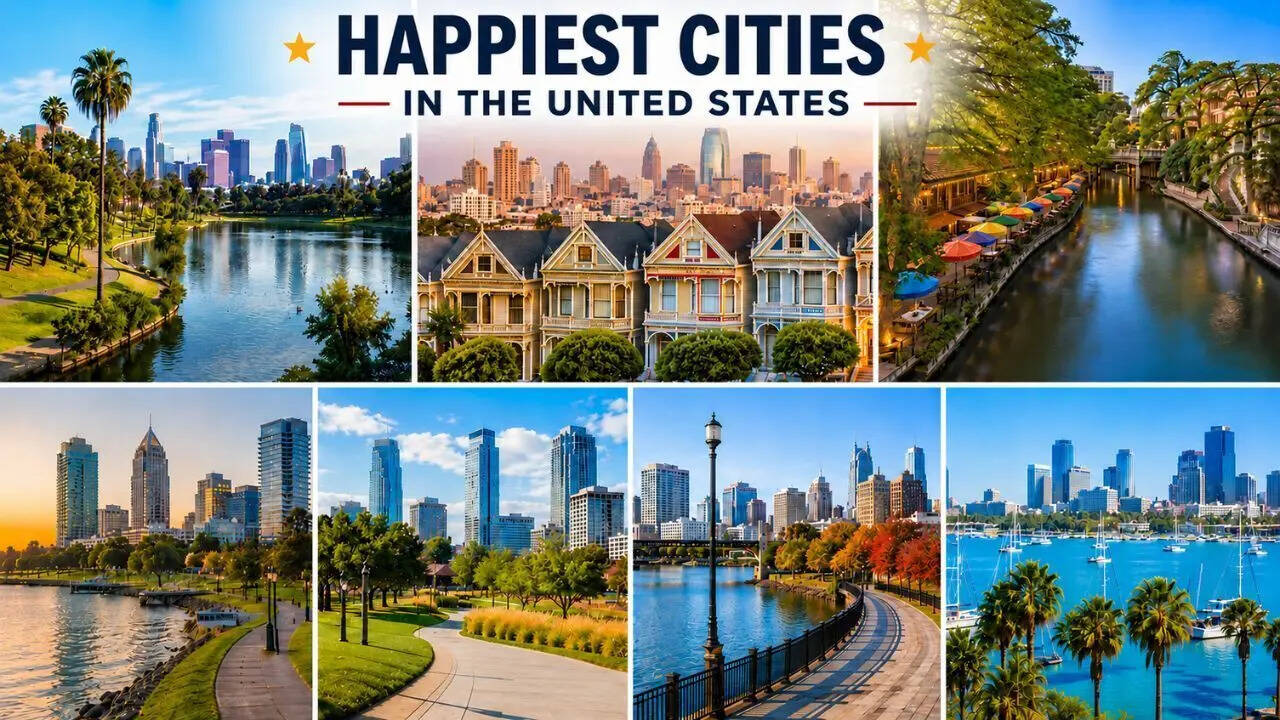
The annual release of civic happiness rankings has become a predictable ritual. Municipal marketing departments eagerly await the data, ready to blast press releases if they land in the top tier, while local columnists in cellar-dwelling cities pen defensive essays about "grit" and "character."
The latest data crowns Fremont, California, as the happiest city in America, closely followed by affluent enclaves like Scottsdale, Arizona, and Overland Park, Kansas. The metrics used to determine these rankings seem reasonable on the surface. Analysts look at depression rates, divorce statistics, income growth, and average daily leisure time.
But these rankings do not actually measure happiness. They measure insulation.
The glittering scores achieved by cities like Fremont, Scottsdale, and Overland Park are not the result of secret community-building formulas or superior local governance. They are the predictable byproduct of extreme wealth and socioeconomic sorting. When a city successfully prices out working-class struggle, its baseline metrics naturally skyrocket.
The real story isn't how these communities built happiness. It is how they bought it.
The 75000 Dollar Illusion
To understand the flaw in the civic happiness narrative, look at the financial baseline of the winners.
In Fremont, nearly 80 percent of households earn more than $75,000 a year. Statistically, this specific income threshold has long been cited by economists as the point where day-to-day emotional well-being plateaus. More importantly, it is the point where the acute anxiety of survival disappears.
When nearly every household in a municipality is free from the crushing stress of food insecurity, housing instability, and predatory medical debt, the city's aggregate data reflects that relief.
- Fremont, California: Holds the lowest separation and divorce rates in the country, alongside the lowest share of adults reporting prolonged mental distress.
- Scottsdale, Arizona: Boasts astronomical sports-participation rates and exceptionally high physical health scores.
- Overland Park, Kansas: Ranks consistently high for suburban family stability and low economic volatility.
This is not a triumph of civic design; it is a manifestation of capital. High-income households can afford therapy. They can afford gym memberships, organic groceries, marriage counseling, and private childcare.
When a data model heavily weights low depression rates and high life expectancy, it is effectively running a diagnostic on wealth distribution. The happiest cities are simply elite country clubs with municipal charters.
The Suburb as a Fortress
The architectural layout of these top-tier cities reveals a deliberate strategy of isolation rather than integration.
Consider Overland Park or Scottsdale. These are largely suburban, automobile-dependent communities designed around Master Planned Communities (MPCs). They feature pristine park systems, manicured cul-de-sacs, and strict zoning laws that keep high-density, low-income housing far beyond the city limits.
+-------------------------------------------------------+
|             THE REVENUE-ZONING LOOP                   |
+-------------------------------------------------------+
|  Strict zoning limits affordable housing              |
|                         v                             |
|  Low-wage workers forced to commute from outside      |
|                         v                             |
|  Municipal data reflects only high-income residents   |
|                         v                             |
|  City wins "Happiest City" award based on metrics     |
+-------------------------------------------------------+
This exclusionary design creates a statistical distortion. The baristas, teachers, janitors, and retail workers who keep Scottsdale and Fremont functioning cannot afford to live there. They commute from more affordable, less "happy" neighboring towns.
Consequently, their daily stress, long commutes, and economic anxieties are completely absent from the host city's data pool. The town's metrics remain pure because the pain is outsourced across county lines.
The Cost of Pristine Parks
In these highly rated suburbs, public spaces are often highly regulated environments designed for passive leisure rather than spontaneous community friction.
A perfectly paved running trail or a spotless playground looks excellent on a municipal evaluation. However, it does not replace the deep, messy social infrastructure that historically defined vibrant urban life.
True community requires shared spaces where different socioeconomic classes interact. When a city uses zoning as a filter, it trades authentic cultural vitality for predictable, sterile comfort.
The Dark Side of the Happiness Premium
Living in a statistical paradise comes with an unspoken psychological tax.
When a community is branded as objectively happy, those who do not fit the mold experience heightened isolation. If you are struggling with a failing marriage, a sudden layoff, or a quiet battle with severe depression in a city where everyone else appears to be thriving, the contrast is agonizing.
Furthermore, the economic pressure to maintain this pristine image drives a quiet migration. Middle-class families are quietly priced out of these enclaves every year, replaced by a hyper-wealthy demographic that further skews the local data.
The real question we should be asking is not how these ten cities managed to top the chart. We should ask what happens to the human fabric of a nation when wellness becomes a luxury item reserved for specific zip codes.
Redefining Civic Well-Being
If we want to evaluate the true health of an American city, we must discard models that merely reward affluent demographics.
A truly successful community is not one that prices out adversity. It is one that builds the infrastructure to absorb it. Future assessments should measure cities by how effectively they support their most vulnerable populations, the accessibility of their public transit, the affordability of their housing stock, and the diversity of their economic base.
Until then, happiness rankings will remain a vanity metric. They tell us exactly where the money is, while telling us absolutely nothing about the soul of the people living there.
The next time a suburban enclave celebrates its placement at the top of a national happiness list, do not look at their parks or their bike lanes. Look at their real estate listings and their borders. That is where the real answer lies.