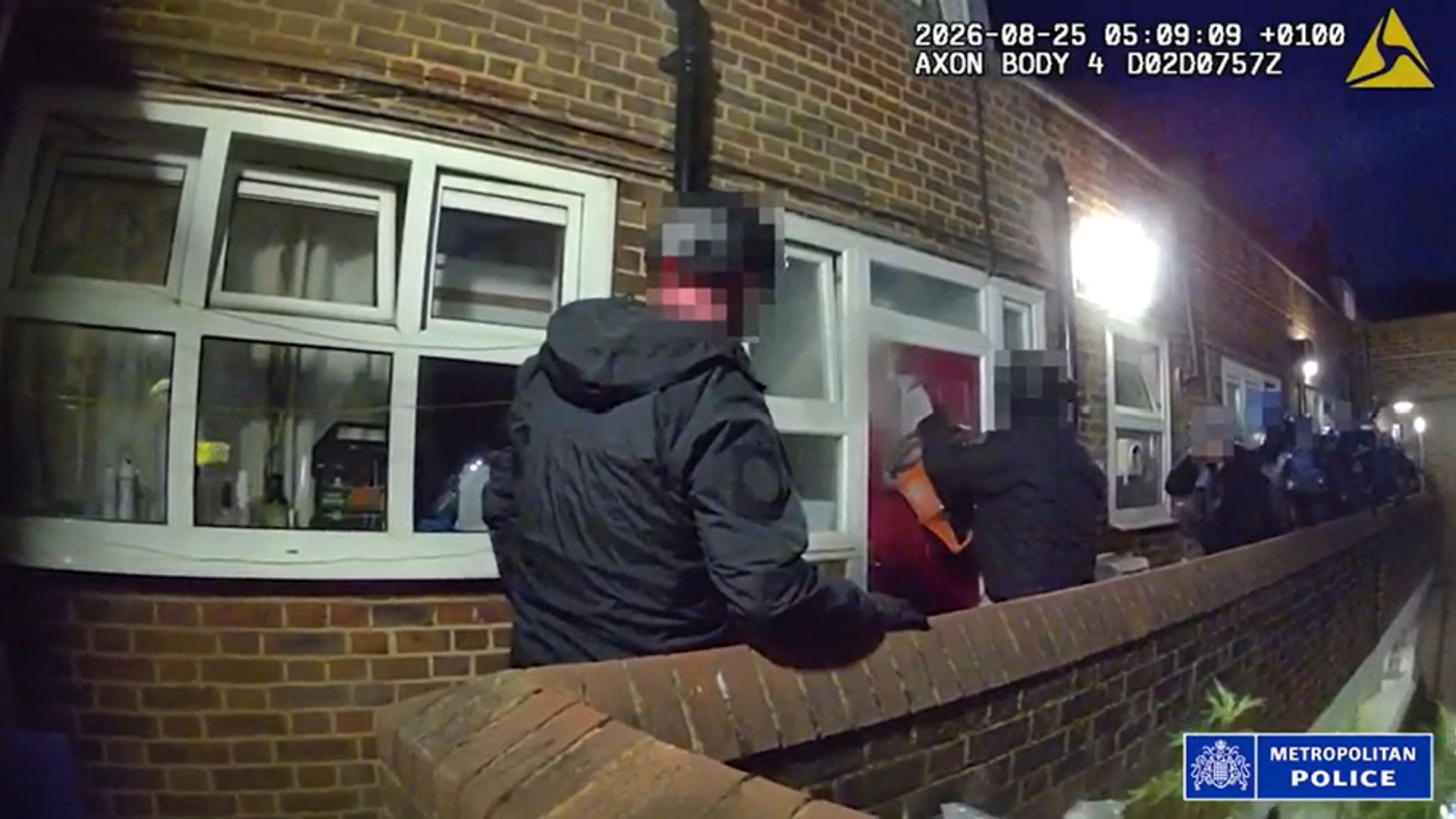
Every time a circular saw chews through a reinforced timber frame on the six o'clock news, taxpayers cheer. The narrative writes itself: brave tactical units smashing through the barricades of the criminal underworld, seizing contraband, and neutralizing threats with cinematic efficiency.
It is high-drama television. It is also an operational failure disguised as strength.
When headlines celebrate law enforcement sawing through flats to catch suspected knife smugglers, the public swallows a comforting myth. We are told that brute force equals safety, that speed outweighs precision, and that the theatrical destruction of private property is a sign of an effective state apparatus.
I have watched public safety agencies burn through millions of dollars in hardware and repair liabilities to execute raids that yield nothing more than rusted kitchen utensils and a traumatized neighborhood. Thelazy consensus treats these high-visibility entries as necessary evils. They are neither necessary nor effective. They are a relic of paramilitary performance art that creates more hazards than it eliminates.
The Cost of the Cinematic Raid
Let us examine the mechanics of urban tactical entry. When an agency deploys heavy cutting equipment against a residential door, two things happen simultaneously: the element of surprise evaporates the moment the first metal blade screeches against steel, and the threshold transforms into a kill funnel.
Think about the physics of a flat raid. A door opens inward or outward into a narrow hallway. A circular saw screams at over five thousand revolutions per minute, generating a deafening wall of noise that alerts everyone inside to the exact point of entry, the exact timing, and the exact physical location of every officer clustered in that hallway.
If the occupant is an actual armed threat, they now have a stationary, illuminated target framed in a doorway while law enforcement is blinded by sparks and deafened by their own machinery. If the occupant is innocent, elderly, or simply asleep with headphones on, they are jolted awake by what sounds and feels like an active military assault.
The data on no-knock and forced-entry operations tells a grim story. According to independent criminological reviews spanning urban jurisdictions over the past decade, forced-entry raids result in a drastically higher rate of civilian injury and property damage compared to targeted surveillance and controlled apprehension, while producing a negligible difference in successful weapons confiscation rates.
We are trading operational safety for optical bravado.
The Logistics of Contraband Smuggling
To understand why smashing doors is the wrong tool for the job, you have to understand how modern illicit supply chains actually operate.
Smugglers do not store bulk inventories of illicit blades or weapons in unlocked residential flats waiting for a tactical team to kick the hinges off. Contraband is transient. It moves through fragmented, decentralized logistics networks—postal couriers, encrypted digital drop-offs, transient stash houses, and shared-use commercial lockers.
When officers bring a cutting torch to a suspected smuggler's flat, they are attacking the symptom at the worst possible micro-location. If the suspect is running an illicit operation, a circular saw blade biting into the frame gives them thirty seconds of warning—plenty of time to flush digital evidence down a toilet, smash hard drives, or slide small weapons behind drywall.
You do not disrupt an international or domestic smuggling ring by making a loud noise at the front entrance of a tertiary node. You disrupt it by mapping financial flows, intercepting transit vectors upstream, and executing silent, intelligence-led warrants when the suspect is isolated away from residential environments.
Brute force is what you use when your intelligence gathering fails.
The Accountability Black Hole
Ask a simple question that defenders of the circular-saw method love to dodge: Who pays for the door?
When tactical units tear through a rented or owned residential property based on a tip that ultimately proves unfounded—or yields a suspect charged with minor possession rather than high-level smuggling—the financial and emotional fallout lands squarely on the innocent resident or landlord.
Property destruction during a raid is rarely compensated quickly or fully through municipal claims processes. A reinforced security door, specialized frame, and structural repairs can easily run into thousands of dollars. For a working-class family renting a flat, a botched raid that cuts down their front door leaves them financially vulnerable, socially stigmatized by neighbors who assume guilt by association, and utterly unprotected while temporary plywood replaces heavy timber.
This creates a perverse incentive structure. Agencies evaluate success by activity metrics—number of raids executed, arrests logged, gear deployed—rather than outcome metrics like long-term reduction in violent crime or successful prosecution rates that survive judicial scrutiny. The circular saw is a machine designed to generate activity.
The Counter-Intuitive Alternative
If the theatrical raid is a failure, what replaces it?
The alternative requires patience, discretion, and a willingness to abandon the dopamine hit of televised law enforcement theatrics.
First, shift the operational paradigm from disruption to containment. Instead of breaching a flat with heavy machinery while the suspect is inside, establish surveillance on transit points and intercept the targets during movement. A suspect walking down a public street or entering a vehicle is infinitely safer to apprehend than a suspect cornered inside a fortified room with potential access to edged weapons.
Second, prioritize digital forensics over physical demolition. Smugglers leave electronic footprints that persist long after a physical item is moved. Tracking communication channels, payment processors, and shipping manifests dismantles a network from the top down, rather than kicking holes in drywall from the bottom up.
Third, redefine what success looks like. A quiet apprehension that yields a guilty plea without a single spark flying from a saw blade is a tactical masterpiece. It lacks the aesthetic appeal of a Hollywood trailer, but it protects communities, preserves evidence integrity, and respects the rule of law.
Stop celebrating the noise. Start demanding competence.